

Did you know that the average cost of fixing a payroll compliance error in Singapore is now estimated at S$28,000? For many SME owners, this isn’t just a statistic; it’s a source of genuine stress that keeps you away from your core business. Between the January 2026 increase of the CPF Ordinary Wage ceiling to S$8,000 and the meticulous requirements of IR21 tax clearances for departing staff, the margin for error has never been thinner. You’re likely trying to determine if the payroll outsourcing cost Singapore firms charge is a justifiable expense or a vital safeguard for your company’s reputation.
We know how daunting these statutory regulations can feel, and we’re here to help you navigate them with confidence. This guide provides a transparent look at the 2026 pricing landscape and how to evaluate the true ROI of a compliance-first partnership. We’ll walk you through the latest MOM changes and CPF contribution rates, ensuring you have the clarity needed to reduce your administrative burden. By the end, you’ll understand how to choose a boutique partner who treats your business with the bespoke care it deserves.
Key Takeaways
- Evaluate the three primary pricing models to determine which structure—whether per-employee or a fixed retainer—best aligns with your SME’s current headcount and growth stage.
- Gain clarity on the payroll outsourcing cost Singapore market rates for 2026 and how they compare to the high financial risks of manual compliance errors.
- Understand how complex variables like IR21 tax clearances for foreign staff and the S$8,000 CPF wage ceiling influence your monthly service fees.
- Compare the long-term ROI of professional outsourcing against the rising overhead of maintaining in-house HR staff and dedicated payroll software subscriptions.
- Learn how a bespoke, boutique service model provides the extreme accessibility and localized expertise needed to navigate Singapore’s evolving employment laws with confidence.
Understanding Payroll Outsourcing Cost in Singapore: More Than Just a Fee
Managing a business in Singapore requires a meticulous eye for detail, especially when it comes to your most valuable asset: your people. While many see payroll as a simple monthly task, it’s actually a complex ecosystem of regulatory deadlines and mathematical precision. Before we dive into the specific numbers, it’s helpful to have a foundational understanding of payroll as a business function that extends far beyond just cutting checks. In a professional context, payroll outsourcing is a managed service where external experts handle everything from gross-to-net salary calculations and CPF contributions to complex tax filings like the IR8A and IR21 tax clearance for foreign employees.
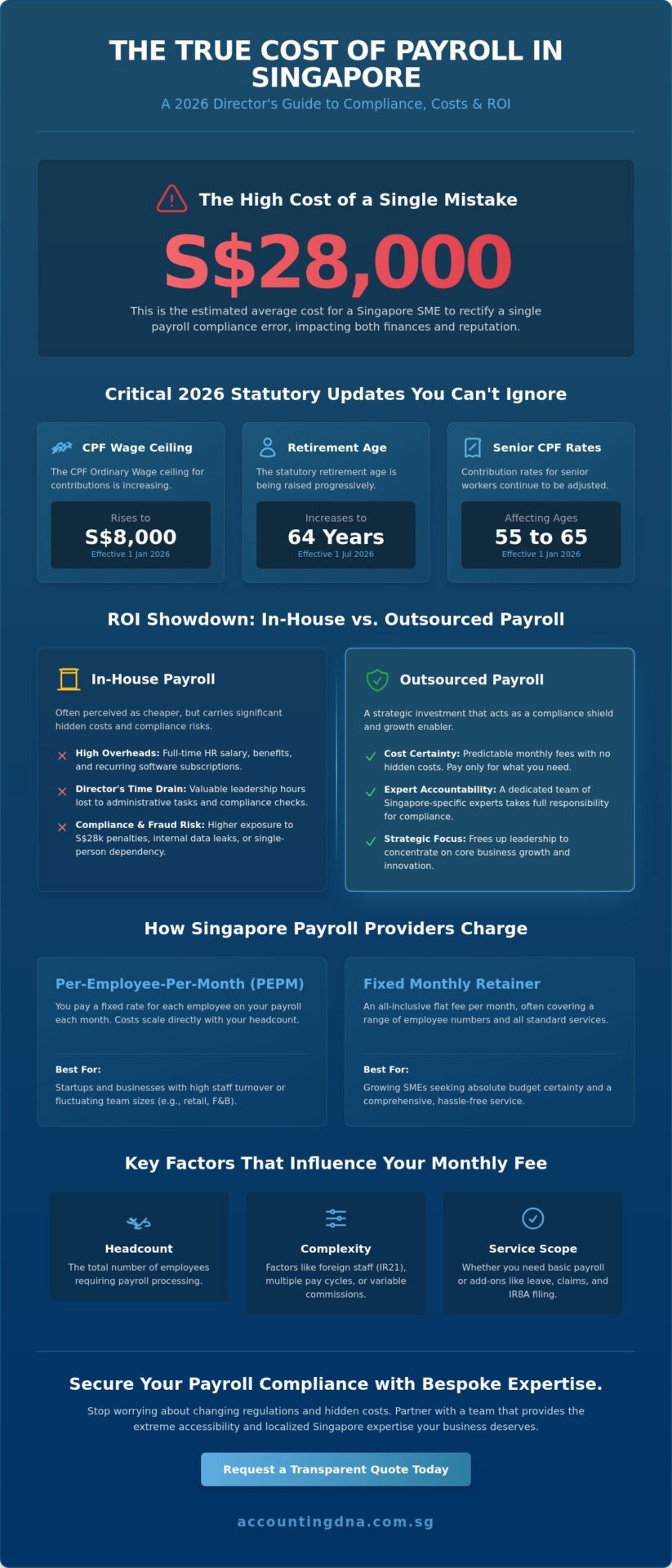
The year 2026 marks a significant turning point for local businesses. With the CPF Ordinary Wage ceiling rising to S$8,000 on January 1st and the statutory retirement age shifting to 64 in July, the administrative burden on internal teams has reached a breaking point. When you evaluate the payroll outsourcing cost Singapore providers offer, you must distinguish between ‘software-only’ subscriptions and ‘managed services.’ A software subscription gives you a tool, but a managed service provides a dedicated team that takes full accountability for your compliance. Payroll outsourcing acts as a strategic compliance shield for Singapore directors, absorbing the legal risks associated with statutory errors.
The True Cost of Payroll Compliance in 2026
Compliance isn’t just about avoiding fines; it’s about the hours spent recalculating contribution rates for employees in the 55 to 65 age bracket, which saw another increase in January 2026. Under Ministry of Manpower (MOM) regulations, failing to provide accurate, itemised payslips can lead to costly disputes and administrative penalties. Industry research indicates the average cost to fix a payroll compliance error in Singapore is approximately S$28,000. By choosing to outsource, you ensure that every Skills Development Levy (SDL) payment and CPF contribution is processed with 100% accuracy, scaling seamlessly as your headcount grows. Understanding the payroll outsourcing cost Singapore businesses face helps you budget for long-term growth without compromising on legal safety.
Why SMEs are Moving Away from In-House Processing
Many founders realize that hiring a dedicated HR executive in Singapore is becoming increasingly expensive, with salaries rising to meet the demand for specialized compliance knowledge. Beyond the salary, small teams face a higher risk of internal fraud or sensitive data leaks when payroll is handled by a single person. There’s also a massive opportunity cost involved. Every hour a director spends navigating the Workplace Fairness Act or calculating pro-rated salaries for a departing foreign employee is an hour not spent on business growth. Offloading these tasks to a trusted partner allows you to focus on strategy while we handle the foundational details. For a clearer picture of how this fits your budget, you can explore our transparent pricing options.
2026 Pricing Models: How Singapore Payroll Providers Charge
How do you determine if a quote is genuinely cost-effective or just a low entry price masking hidden fees? Understanding the payroll outsourcing cost Singapore providers offer requires looking past the surface. In 2026, the market has matured, moving away from opaque billing toward three primary structures: Per-Employee-Per-Month (PEPM), fixed monthly retainers, and, less commonly for SMEs, a percentage of total payroll. Your headcount and how often you run cycles, such as bi-monthly for part-timers versus monthly for executives, will dictate which path offers the best value for your specific operations.
Per-Employee-Per-Month (PEPM) vs. Fixed Retainers
For startups or retail businesses with high staff turnover, the PEPM model remains popular because it scales directly with your team size. You only pay for what you use. However, as an SME grows, the administrative overhead of variable monthly billing can become a headache. This is why we see a shift toward all-inclusive fixed retainers. These provide absolute budget certainty, covering all standard salary disbursements and compliance checks required under Singapore’s Employment Act. While a ‘cheap’ per-head rate might look attractive on a spreadsheet, it often excludes the high-touch support needed when calculating the total payroll outsourcing cost Singapore businesses should expect.
Ad-hoc Charges for Year-End Filing (IR8A and IR21)
Don’t let the base fee fool you. Many providers strip out essential statutory filings to keep their initial quote low. Year-end IR8A submissions and the critical IR21 tax clearance for departing foreign employees are frequently billed as ‘ad-hoc’ services. In 2026, with the minimum qualifying salary for Employment Passes rising to S$5,600 for non-financial sectors, the stakes for accurate IR21 filings are higher than ever. A single mistake in tax clearance can lead to significant delays and personal liability for directors. It’s a common misconception that all providers include these filings by default; always check the fine print to avoid seasonal price spikes.
We recommend looking for a partner who integrates these statutory requirements into a transparent monthly fee. This prevents the ‘sticker shock’ that often occurs in March during tax season. If you’re tired of unpredictable invoices and want a partner who prioritizes your peace of mind, it might be time to speak with a specialist about a more integrated approach. Choosing a provider based on holistic value rather than the lowest unit price ensures your business remains compliant without the stress of constant upselling or administrative friction.
Factors That Influence Your Monthly Payroll Service Fees
Why do two companies with the same headcount often receive vastly different quotes? It’s a question we hear frequently from directors who are trying to balance their budgets. The reality is that a flat fee rarely tells the whole story. When you look at the payroll outsourcing cost Singapore providers present, you’re seeing a reflection of the administrative labor required to maintain your specific compliance profile. Factors like workforce diversity and the intricacy of your commission structures play a much larger role than simple headcount alone.
Another major driver of your monthly investment is the level of integration required with your existing systems. If you’re using platforms like Xero or QuickBooks, a managed service provider must ensure that every payroll entry syncs perfectly with your general ledger. This eliminates manual data entry errors and provides a real-time view of your staff costs. While some competitors might offer a “software-only” price of a few dollars, these low-cost options often leave the heavy lifting of reconciliation and statutory filing to you. We believe in a more holistic approach where we handle the technical details so you don’t have to.
Complexity of Workforce (Foreign Workers vs. Locals)
Managing a local workforce is relatively straightforward, but the complexity spikes the moment you hire foreign talent. Each foreign employee on an S Pass or Employment Pass introduces additional layers of administration, from calculating the Foreign Worker Levy (FWL) to ensuring the Skills Development Levy (SDL) is paid accurately. You also have to manage contributions to various ethnic funds like CDAC, SINDA, or the Mosque Building and Mendaki Fund (MBMF) based on the employee’s race and residency status. Because foreign employee payroll carries the added weight of IR21 tax clearance and stricter MOM scrutiny, it typically requires more senior expertise and results in higher service fees. Understanding the full scope of CPF for foreign employees and the status-monitoring obligations that come with it is essential to accurately forecasting your compliance costs.
Frequency of Pay Cycles and Variable Components
Does your business run a standard monthly cycle, or do you have part-timers requiring bi-monthly payments? Increasing the frequency of your pay runs directly impacts the resource allocation of your provider. This is especially true for sales-heavy teams where commissions, performance bonuses, and overtime (OT) must be calculated from scratch every month. Variable pay structures significantly increase the volume of data that must be verified to maintain a robust audit trail for MOM inspections. If your team has high variability in their monthly take-home pay, a fixed retainer often proves more economical than a per-employee model that might charge extra for complex calculations. You can explore how these variables fit into a predictable budget on our pricing page.
The ROI of Outsourcing: Comparing In-House vs. Professional Services
Is hiring a dedicated payroll officer truly the most cost-effective path for your SME? Many directors initially prefer the control of an in-house hire, but the financial reality in 2026 often tells a different story. When you look beyond the surface level of a monthly invoice, the payroll outsourcing cost Singapore firms provide is frequently 30% to 50% lower than maintaining an internal department. This isn’t just about saving on a base salary; it’s about eliminating the high total cost of ownership associated with specialized back-office staff.
Direct Costs: Salary of a Payroll Officer vs. Service Fees
In the current Singapore labor market, a junior payroll specialist commands a significant premium. Beyond the monthly salary, you must account for the 17% employer CPF contribution, annual wage supplements (AWS), performance bonuses, and medical benefits. For many small businesses, paying upwards of S$50,000 annually for a single headcount who might only be fully utilized a few days a month is a heavy burden. Professional outsourcing allows you to access a team of senior experts for a fraction of that cost. You can view our transparent pricing for SME services to see how these economies of scale work in your favor.
Indirect Costs: Software Licenses and MOM Penalty Risks
In-house processing requires more than just a person; it requires an infrastructure. You have to pay for secure payroll software subscriptions, cloud storage, and regular training to keep up with the latest IRAS and MOM updates. There’s also the hidden cost of “key man risk.” If your only payroll staff member falls ill or resigns during tax season, your business faces immediate compliance jeopardy. We’ve seen that the average cost of fixing compliance-related payroll errors in Singapore has reached approximately S$28,000. This makes the “Penalty ROI” of outsourcing—the money you save by simply not getting fined—one of the strongest arguments for a managed service.
Outsourcing acts as a safeguard against the financial impact of a single MOM non-compliance notice. By leveraging our expertise, you ensure that your records are audit-ready at all times, protecting your company’s reputation and your directors’ personal liability. To better understand the risks you might be overlooking, read our guide on Payroll Compliance Singapore: 7 Dangerous Myths Debunked. If you’re ready to trade administrative headaches for reliable, scalable growth, contact us today to discuss a tailored solution for your team.
Choosing the Right Partner: Why DNA Accounting’s Bespoke Model Works
Finding the right fit is about more than just comparing a few spreadsheets. While larger firms might offer a lower unit price through mass automation, they often lack the contextual understanding that a boutique firm provides. We believe the payroll outsourcing cost Singapore businesses pay should reflect a commitment to accuracy and personalized care. For us, every client has a unique “DNA,” and our services are built to support that individual structure. We don’t just process numbers; we act as a protective partner for your business, ensuring that your foundation remains rock-solid as you scale.
The Boutique Advantage: Personalized Care Over Mass Automation
Integrating Payroll with Accounting and Tax for Maximum Efficiency
A centralized service model is the most effective way to reduce administrative friction. When your payroll is managed by the same team handling your bookkeeping and accounting, data entry errors are virtually eliminated. This integration ensures a seamless year-end transition from monthly payroll data to your final corporate tax filing. You won’t have to spend hours reconciling different reports from multiple vendors; everything is handled under one roof with absolute precision. This holistic approach doesn’t just save time; it provides a clearer picture of your company’s financial health and ensures that your statutory obligations are always met ahead of time.
Choosing a partner is an investment in your company’s future. We invite you to reflect on whether your current service provides the level of security and accessibility your growth demands. If you’re looking for a compliance-first partner who treats your business with the care it deserves, we’re ready to help. It’s time to move away from generic solutions and toward a model that scales with your ambition. Contact DNA Accounting for a bespoke payroll quote and discover how we can simplify your compliance journey today.
Secure Your Business Foundation for 2026 and Beyond
Is your current payroll setup a source of strength or a hidden vulnerability? We’ve explored how the payroll outsourcing cost Singapore providers charge is actually a strategic investment in avoiding S$28,000 compliance errors and navigating the 2026 CPF ceiling hikes with ease. By choosing a boutique partner, you gain more than just a service; you secure a dedicated guide who understands the specific DNA of your SME. You deserve a solution that scales with your ambition without the overhead of a bloated internal department.
Since 2016, DNA Accounting has focused on providing the bespoke care that startups and foreign entrepreneurs need to thrive in our complex regulatory landscape. We ensure full compliance with ACRA, IRAS, and MOM standards, giving you the freedom to focus on growth while we handle the foundational details. Our commitment to extreme accessibility means we’re here for you even during evenings and non-working days, because we know business challenges don’t stop at sunset. Ready to trade administrative stress for professional peace of mind? Get a Customized Payroll Quote for Your SME today. We look forward to supporting your business journey with the reliability and expertise you deserve.
Frequently Asked Questions
Is payroll outsourcing cheaper than hiring an in-house HR executive?
Yes, outsourcing is generally 30% to 50% more affordable for SMEs compared to hiring a full-time professional. When you hire internally, you’re responsible for the base salary, 17% employer CPF, and annual bonuses. Outsourcing provides access to a team of experts for a fraction of that overhead. It also eliminates the stress of finding a replacement if your internal staff resigns during a critical tax window.
What is the average per-employee cost for payroll services in Singapore?
Industry rates for a per-employee-per-month (PEPM) model typically range from S$5 to S$30 in the Singapore market. The exact payroll outsourcing cost Singapore providers charge depends on your workforce complexity, such as the ratio of foreign workers to locals. While software-only platforms might sit at the lower end, managed services that handle full compliance and advisory usually fall into the mid-to-high range of that scale.
Are year-end IR8A filings typically included in the monthly cost?
Inclusion of IR8A filings depends entirely on your service agreement. Many boutique firms bundle annual tax reporting into their fixed monthly retainers to help you avoid seasonal price spikes in March. However, some providers treat year-end submissions as an ad-hoc administrative task with separate billing. You should always clarify this during your initial consultation to ensure your annual budget remains predictable and transparent.
How much extra does it cost to process IR21 for departing foreign employees?
Processing IR21 tax clearances for departing foreign employees is often billed as a separate professional fee due to its technical nature. This process requires a deep understanding of IRAS requirements and immediate attention to avoid tax liability for the company. While it’s an additional expense, the cost is minimal compared to the legal risks of failing to withhold the correct amount from an employee’s final paycheck.
Can I switch to a payroll provider in the middle of the financial year?
You can absolutely switch to a new payroll partner at any point during the financial year. The transition process involves a comprehensive migration of your year-to-date salary data and CPF records to ensure continuity. A reliable provider will manage this handover meticulously, verifying that all previous filings are accurate before taking over. This ensures your year-end IR8A and tax submissions remain consistent and error-free.
Do payroll service providers handle CPF submissions and SDL payments?
Yes, a comprehensive managed service handles all your monthly statutory obligations, including CPF submissions and Skills Development Levy (SDL) payments. They calculate the correct contributions based on the latest 2026 rates and ensure they’re submitted to the CPF Board by the 14th of the following month. This proactive oversight protects you from late payment interest and ensures your company remains in good standing with the authorities.
What are the penalties for late or inaccurate payroll filing in Singapore?
Penalties for inaccurate filings can be severe, ranging from heavy fines to potential prosecution for company directors. Research indicates that the average cost to rectify a compliance-related payroll error in Singapore is now approximately S$28,000. Beyond the financial impact, frequent errors can trigger MOM audits and damage your reputation with employees. Professional oversight acts as a safeguard, ensuring every payslip and submission meets current regulatory standards.
Does the cost of payroll outsourcing include the software subscription?
Managed payroll services typically include the cost of the cloud-based software subscription within their monthly fee. This means you don’t have to worry about paying for separate licenses or handling technical updates yourself. In contrast, “software-only” models require you to pay a subscription fee while still doing the manual data entry. Choosing a managed partner gives you the best of both worlds: advanced technology and expert human oversight.
Disclaimer
The information provided on this website is for general informational purposes only and is not intended to constitute professional accounting, tax, legal, or financial advice. While we strive to ensure that the content is accurate and up to date, regulations in Singapore, including those administered by ACRA, IRAS, CPF Board, and MOM, may change from time to time and may differ depending on individual circumstances.
Readers should not act or rely on any information contained on this website without seeking specific advice from a qualified professional based on their individual situation.
DNA Corporate Services and its affiliates accept no responsibility or liability for any loss or damage arising from reliance on the information provided in this website or any linked materials.
For tailored advice relating to accounting, taxation, corporate secretarial, or compliance matters in Singapore, please contact us directly for professional consultation.



