

Could an “honest mistake” in your monthly CPF calculations trigger a Ministry of Manpower (MOM) audit that costs your business more than a year’s worth of salary? Many SME owners believe that “close enough” is fine for payroll compliance Singapore, but the regulatory reality in 2026 is much harsher. With the CPF Ordinary Wage ceiling now at S$8,000 and the Local Qualifying Salary (LQS) rising to S$1,800 in July 2026, the margin for error has effectively disappeared.
We understand that keeping up with shifting age-based contribution rates and the 30% PWCS co-funding feels like a full-time job you didn’t sign up for. You’re likely feeling the weight of manual processing and the constant fear of missing a March 1st IR8A deadline. This guide will help you trade that stress for total peace of mind by debunking seven dangerous myths that lead to heavy penalties. We’ll preview exactly how you can automate your obligations and ensure your business remains a secure, compliant home for your team.
Key Takeaways
- Master the three-pillar framework of payroll compliance Singapore to ensure your business remains fully aligned with MOM, CPF, and IRAS regulations.
- Debunk common misconceptions about payment timelines and itemized payslip requirements that often lead to avoidable MOM penalties.
- Clarify exactly who qualifies for CPF contributions and ensure your Skills Development Levy (SDL) payments are calculated accurately for 2026.
- Transition from risky manual spreadsheets to a robust compliance calendar that tracks critical filing deadlines automatically.
- Realize the strategic value of boutique payroll support in freeing up founder time for high-impact business growth.
The High Stakes of Payroll Compliance in Singapore
How many founders wake up at 3 AM worrying about their payroll? If you’re running an SME, the answer is probably “too many.” In our professional experience, payroll compliance Singapore isn’t just a back-office task; it’s a high-stakes legal requirement that sits at the vital intersection of the Employment Act, the CPF Act, and the Income Tax Act. While Singapore is globally recognized for its business-friendly environment, its regulatory framework is among the most transparent and strictly enforced in Asia.
Thinking your company is too small to attract the attention of the Ministry of Manpower (MOM) is a dangerous gamble. In 2026, automated data sharing between government agencies means that a single discrepancy in a CPF contribution can trigger an inquiry from IRAS or a full-scale MOM audit. The “silent” costs of cutting corners are often worse than the immediate fines. Beyond the financial sting, non-compliant firms face severe reputational damage and can be debarred from hiring foreign talent, effectively stalling your growth for years to come.
The Three Pillars of Singapore Payroll
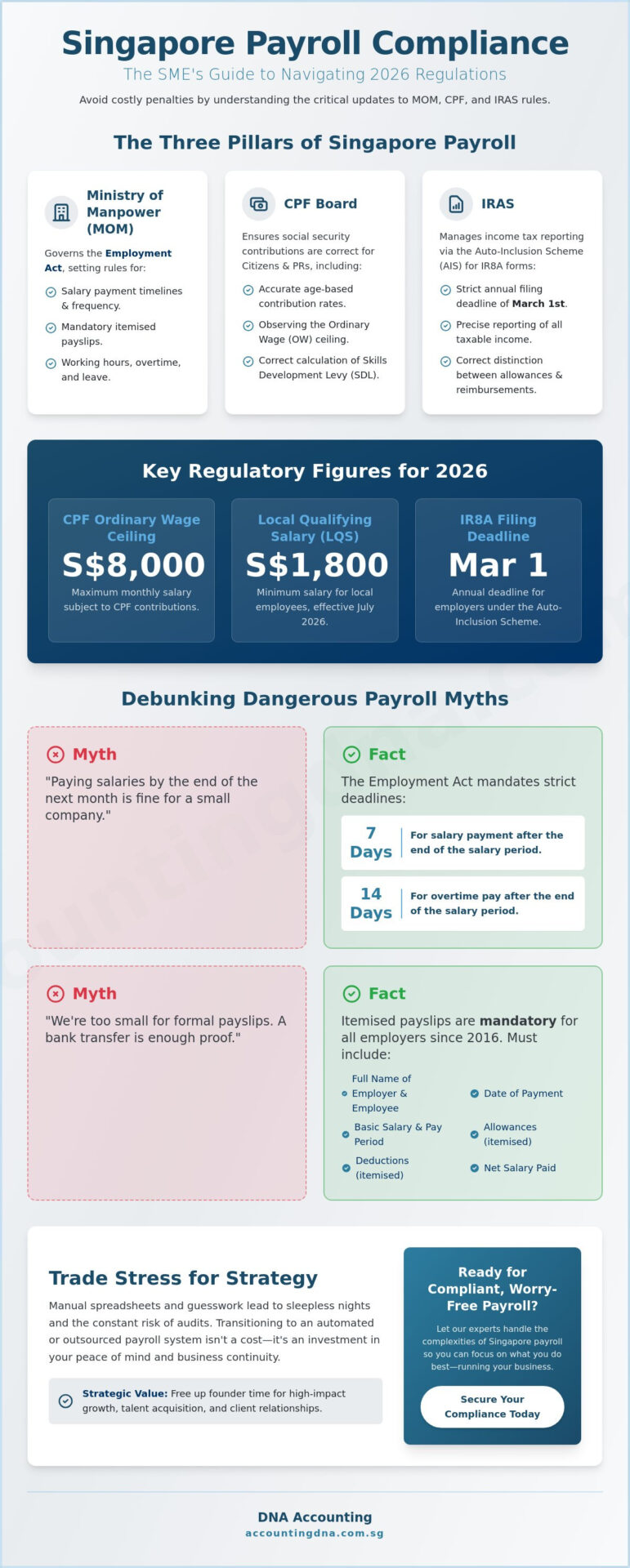
To stay protected, you need to understand the three distinct authorities watching your ledger. First, the MOM oversees Employment in Singapore, setting the rules for working hours, public holidays, and the strictly mandated salary payment frequency. Second, the CPF Board ensures that social security contributions for citizens and Permanent Residents are calculated accurately. With the Ordinary Wage ceiling now at S$8,000, even a minor miscalculation can lead to significant arrears. Finally, IRAS requires precise income reporting through the Auto-Inclusion Scheme (AIS) by the March 1st deadline each year.
Why SME Owners Feel the Burn
Does it feel like the goalposts are constantly moving? You aren’t alone. Keeping up with legislative updates like the 2026 CPF rate increases for older workers or the Local Qualifying Salary (LQS) jump to S$1,800 is exhausting. Balancing these changes while managing daily operations and issuing mandatory itemized payslips creates an immense administrative burden. This is where professional accounting services in Singapore become more than just a vendor; they act as a safety net. By letting experts handle the technical nuances, you can focus on scaling your business without the constant fear of a regulatory “knock on the door.”
Myth-Busting Part 1: The Employment Act & Salary Secrets
Do you believe that as long as your team gets paid eventually, the exact date doesn’t matter? This is a dangerous misconception that puts your payroll compliance Singapore at risk. Many SME owners operate under the “small family” myth, assuming that informal arrangements or verbal handshakes can bypass the strict requirements of the Employment Act. Unfortunately, the Ministry of Manpower (MOM) doesn’t see it that way. Whether you have two employees or twenty, the law applies equally to everyone.
The 7-Day Rule: Timing Your Salary Payments
One of the most persistent myths is that you have until the end of the following month to settle salaries. In reality, you must pay your employees at least once a month and within seven days after the end of the salary period. If you’re calculating overtime, you have a slightly longer window of 14 days. Failing to meet these deadlines is a serious breach of Ministry of Manpower employment practices. If a dispute arises, MOM’s perspective is clear; late payment is an offense that can lead to prosecution. We recommend setting your internal “cut-off” date at least three days before the deadline to account for bank processing times or public holidays.
The Itemised Payslip Mandate
Since April 1, 2016, the “we’re too small for paperwork” excuse has been legally invalid. Every employer must issue itemised payslips. These aren’t just simple receipts; they must include specific fields like basic pay, every deduction made, and the exact date of payment. In 2026, soft copies are perfectly acceptable and often safer for record-keeping. A frequent trap for founders is mislabeling “Allowances” and “Reimbursements.” Remember, allowances are generally taxable and subject to CPF, while reimbursements for actual business expenses are not. Getting this wrong can lead to messy reconciliations with IRAS later. If you’re feeling overwhelmed by these administrative hurdles, a quick chat about our payroll services can help clarify your specific obligations.
Another common error involves overtime pay. Many managers assume overtime is only for “blue-collar” workers. However, under Part IV of the Employment Act, non-workmen earning up to S$2,600 are also entitled to overtime pay, capped at an hourly rate of S$13.60. Finally, never rely on a verbal agreement. While they might be legally binding in theory, the law requires you to provide written Key Employment Terms (KETs) to every employee. Skipping the contract doesn’t save time; it only creates a legal vacuum that usually ends in costly mediation.
Myth-Busting Part 2: CPF, SDL, and Statutory Contributions
Think the Central Provident Fund (CPF) is a simple flat rate for everyone? Assuming that statutory contributions are “set and forget” is a leading cause of audit red flags in payroll compliance Singapore. As we move through 2026, the complexity has only increased. Between the Ordinary Wage (OW) ceiling reaching S$8,000 and the phased increases in contribution rates for older workers, manual calculations are no longer just tedious; they’re risky. Missing the mark by even a few dollars can trigger automatic late interest penalties of 1.5% per month from the CPF Board.
Who Gets CPF? (And Who Doesn’t)
CPF is mandatory for all Singapore Citizens and Permanent Residents (PRs) earning more than S$50 a month. However, the rates are not uniform. For new PRs, a “graduated” rate applies during the first two years of residency to help both the employer and employee adjust to the lower take-home pay. By the third year, you must transition to the full rate. For 2026, the total contribution for employees aged 55 and below stands at 37%. As employees age, these rates taper down to 12.5% for those above 70. Keeping track of these birthdays is essential for accurate IRAS income record submission at year-end. For employers hiring foreign talent, understanding the full scope of CPF for foreign employees — including the critical moment when an Employment Pass holder transitions to PR status — is essential to avoiding costly contribution errors.
Understanding the Skills Development Levy (SDL)
Unlike CPF, the SDL is not a social security contribution; it’s a mandatory levy that funds workforce training. It’s often mistaken for a voluntary donation, but it’s legally required for every single employee, including foreign talent and part-timers. The calculation is 0.25% of an employee’s total monthly wages. There’s a floor of S$2 and a cap of S$11.25 per month. While these amounts seem small, ignoring them is a major red flag during an ACRA or MOM audit. It signals to authorities that your internal controls are lacking. Ensuring these micro-payments are handled correctly is a hallmark of a mature, compliant business.
Building a Compliant Payroll Workflow for Your SME
Are you still relying on that “tried and tested” Excel spreadsheet to manage your monthly salaries? While manual tracking might feel comfortable, it’s arguably the single greatest threat to your payroll compliance Singapore. In 2026, the margin for human error has effectively vanished. A simple formula mistake in calculating the S$8,000 Ordinary Wage ceiling or a forgotten birthday that triggers a new CPF age band can lead to months of reconciliation work and potential MOM inquiries.
Building a robust workflow starts with a dedicated “Compliance Calendar.” This isn’t just about marking the 14th of each month for CPF submissions; it’s about aligning your internal cycles with the Auto-Inclusion Scheme (AIS). For 2026, IRAS mandates that almost all employers submit income records electronically by the March 1st deadline. Handling “incomplete months” also requires precision. If a new hire joins on the 10th, you must use the MOM-approved formula for pro-rating salary to ensure you aren’t violating the Employment Act by underpaying based on the actual working days in that month.
The 2026 Payroll Checklist
To keep your operations airtight, your monthly routine should include these non-negotiables:
- Verify employee status: Confirm if any staff have recently attained Permanent Resident (PR) status, as this immediately shifts their contribution rates.
- Distinguish pay rates: Use the “Gross Rate” for calculating paid leave and the “Basic Rate” for overtime to avoid the calculation errors that often trigger audits.
- Meet the 14th deadline: Ensure all CPF and SDL contributions are processed early enough to clear by the 14th of the following month.
- Timely payslips: Issue itemized payslips within three working days of the payment date to stay fully compliant with MOM regulations.
Leveraging Cloud Payroll Technology
Why struggle with manual updates when technology can do the heavy lifting for you? Moving to MOM-compliant cloud software ensures that your system automatically adjusts for the latest CPF rate changes and salary ceilings without you having to lift a finger. These platforms integrate leave management directly into the payroll run, which eliminates the risk of paying an employee for unearned leave. Beyond accuracy, cloud systems provide the encryption necessary for PDPA compliance, protecting sensitive employee bank details from data breaches. If you’re ready to stop worrying about these technicalities, our payroll services can provide the automated, error-free workflow your business deserves.
Why Boutique Payroll Outsourcing is the DNA of SME Success
How much is your time worth as a founder? This is the heart of the “Founder’s Dilemma.” If you’re spending 10 hours every month wrestling with payroll compliance Singapore, you’re losing 10 hours of high-value sales activity or strategic planning. For many SMEs, these administrative hours represent a significant opportunity cost that stalls growth. At DNA Accounting, we believe that payroll shouldn’t be a source of anxiety; it should be the invisible, foundational “DNA” that supports your company’s expansion. When your back-office processes are airtight, your front-office can move with total confidence.
Personalised Support Beyond the Numbers
We position ourselves as your protective partner, not just another service provider. Managing payroll compliance Singapore involves more than just pushing buttons; it requires navigating complex human scenarios. Whether you’re dealing with the nuances of maternity leave entitlements, calculating pro-rated salary for a termination notice period, or managing the transition of a staff member to PR status, our specialists provide clear, actionable guidance. You get the peace of mind that comes from having a dedicated expert who knows your business and your team by name. Before committing to any provider, it’s worth understanding the payroll outsourcing cost Singapore SMEs typically pay in 2026, so you can evaluate the true ROI of a compliance-first partnership. This level of customization ensures that your specific operational needs are always met without compromise.
Taking the First Step Toward Stress-Free Compliance
Ready to trade your manual spreadsheets for total peace of mind? We invite you to a complimentary consultation to review your current payroll health and identify any hidden compliance risks. Our team handles the heavy lifting of transitioning your records to our managed services, ensuring a seamless move that doesn’t disrupt your monthly operations. We’ll audit your existing data, align it with current 2026 MOM and CPF standards, and set up a workflow that runs like clockwork. Let DNA Accounting handle your payroll compliance so you can focus on growth.
Future-Proof Your Business with Bulletproof Payroll
Mastering payroll compliance Singapore is about more than just avoiding MOM fines. It’s about building a foundation of trust with your employees and the authorities. We’ve explored how debunking myths around salary deadlines and statutory contributions can save you from the “silent” costs of an audit. By moving away from risky manual spreadsheets and embracing a structured compliance calendar, you protect your company’s reputation and its long-term growth potential.
Since 2016, DNA Accounting has focused on helping Singapore SMEs navigate these complex waters with bespoke, personalized care. Our MOM and ACRA compliance specialists are uniquely available during non-traditional hours to suit your busy schedule. You don’t have to carry the administrative burden alone. Secure Your Business with DNA’s Expert Payroll Services and get back to what you do best: leading your company toward success. We’re ready to be the protective partner your business deserves, providing the reliability you need to sleep soundly at night.
Frequently Asked Questions
What are the penalties for late salary payment in Singapore?
Failure to pay salaries within seven days after the end of the salary period is a serious offense under the Employment Act. First-time offenders can face fines ranging from S$3,000 to S$15,000 per charge, or even imprisonment for up to six months. Beyond these immediate fines, late payments often trigger a wider investigation into your payroll compliance Singapore history, which can lead to your business being debarred from hiring foreign talent or renewing work passes.
Is it compulsory to issue payslips to all employees?
Yes, since April 1, 2016, all employers must issue itemized payslips to employees covered by the Employment Act. You must provide these records at least once a month, usually together with the salary payment. These payslips can be in soft or hard copy and must include specific details such as basic salary, every deduction made, and the date of payment. Keeping these records for at least two years is a legal requirement for all SMEs.
Do I need to pay CPF for part-time or casual workers?
You must pay CPF for any employee who is a Singapore Citizen or Permanent Resident earning more than S$50 a month. This obligation applies regardless of whether the staff member is on a part-time, casual, or temporary contract. The contribution rates are determined by the employee’s total wages and their specific age group. It’s a common mistake to assume “freelancers” or “casuals” are exempt; if they’re under a contract of service, CPF is mandatory.
How is overtime pay calculated under the Employment Act?
Overtime is calculated at a minimum of 1.5 times the employee’s hourly basic rate of pay. For non-workmen, this entitlement is specifically capped at a monthly salary of S$2,600, and the hourly rate used for the calculation is capped at S$13.60. You must ensure you’re using the “basic rate” rather than the “gross rate” to avoid overpayment or underpayment errors. Payments for overtime must be settled within 14 days after the last day of the salary period.
What is the Auto-Inclusion Scheme (AIS) for employment income?
The AIS is a mandatory electronic reporting system where employers submit employee income information directly to IRAS. By the March 1st deadline each year, you must report salaries, bonuses, and any benefits-in-kind provided to your team. In 2026, this scheme is a cornerstone of payroll compliance Singapore for almost all registered businesses. This automated process ensures that your employees’ tax returns are prepopulated correctly, reducing the risk of individual filing errors.
Can I make deductions from an employee’s salary for poor performance?
No, you cannot legally deduct an employee’s salary as a penalty for poor performance or disciplinary issues. The Employment Act only permits specific, authorized deductions, such as for absence from work, recovery of salary advances, or damage to goods entrusted to the employee. Any unauthorized deduction is considered a breach of the law. Performance issues should be managed through documented appraisals, warning letters, or termination procedures rather than through the payroll ledger.
What happens if I accidentally overpay CPF for an employee?
If you discover a CPF overpayment, you can apply for a refund or adjustment through the CPF EZPay portal. This often happens if an employee’s age group was recorded incorrectly or if you accidentally contributed on non-wage reimbursements. You should submit your refund application as soon as the error is identified. Once the CPF Board approves the request, the excess amount is typically credited back to your employer’s account, though administrative fees may apply in some cases.
Do I need to file tax for my foreign employees who have left the country?
Yes, you must file for Tax Clearance using Form IR21 at least one month before a foreign employee ceases employment or leaves Singapore for more than three months. As the employer, you’re required to withhold all monies due to the employee until tax clearance is granted by IRAS. If you fail to do this, your company becomes liable for the employee’s unpaid taxes. This is a critical step in the offboarding process that founders shouldn’t overlook.
Disclaimer
The information provided on this website is for general informational purposes only and is not intended to constitute professional accounting, tax, legal, or financial advice. While we strive to ensure that the content is accurate and up to date, regulations in Singapore, including those administered by ACRA, IRAS, CPF Board, and MOM, may change from time to time and may differ depending on individual circumstances.
Readers should not act or rely on any information contained on this website without seeking specific advice from a qualified professional based on their individual situation.
DNA Corporate Services and its affiliates accept no responsibility or liability for any loss or damage arising from reliance on the information provided in this website or any linked materials.
For tailored advice relating to accounting, taxation, corporate secretarial, or compliance matters in Singapore, please contact us directly for professional consultation.



