

What if the biggest risk to your company’s compliance isn’t what you’re paying, but what you’ve forgotten to track? For many Singapore SMEs, the rules surrounding CPF for foreign employees seem straightforward until a long-term staff member proudly announces their new Permanent Resident status. You likely already know that hiring foreign talent on an Employment Pass or S Pass offers a reprieve from statutory contributions, but that exemption isn’t a permanent “set and forget” solution. It’s a status-monitoring obligation that requires a proactive payroll strategy to avoid heavy MOM penalties or late payment interest.
We understand how daunting it feels to keep up with the 2026 Ordinary Wage ceiling of $8,000 and the shifting graduated rates for new SPRs. It’s easy to feel overwhelmed by the administrative burden of manual calculations, especially when a single oversight can lead to a 1.5% monthly interest charge. This guide provides a definitive “Yes/No” framework for CPF eligibility and a practical checklist for the foreigner-to-PR transition. You’ll gain a reliable process for handling statutory filings, ensuring your payroll stays audit-ready while you focus on growing your business. As your dedicated partner, we’re here to make these complex regulations feel manageable, providing the bespoke support your firm needs to thrive.
Key Takeaways
- Confirm that CPF for foreign employees on EP, S Pass, or Work Permits remains exempt in 2026, allowing you to focus resources on business growth.
- Identify the specific “Date of PR” trigger to ensure your payroll compliance begins the exact moment an entry permit is issued.
- Navigate the two-year graduated contribution scale for new Permanent Residents to manage cash flow while meeting statutory obligations.
- Avoid costly 1.5% monthly late interest and composition fines by adhering to the mandatory 14th-of-the-month submission deadline.
- Implement a proactive status-monitoring strategy to transform manual payroll burdens into a streamlined, audit-ready administrative process.
CPF Eligibility and Exemptions for Foreign Employees in 2026
The Central Provident Fund (CPF) is a cornerstone of Singapore’s social security system, but it doesn’t apply to everyone on your payroll. Under the CPF Act, contributions are strictly mandatory only for Singapore Citizens (SC) and Permanent Residents (SPR). This means that CPF for foreign employees is generally not required, providing a significant cost reprieve for SMEs managing international talent. You shouldn’t fall for the “voluntary contribution” myth; legally, employers cannot make CPF contributions for foreign work pass holders. If you’d like to provide extra retirement benefits for these staff members, you’ll need to explore private pension schemes or direct cash bonuses instead.
As of January 1, 2026, the monthly Ordinary Wage (OW) ceiling has reached $8,000 for eligible employees. While this cap affects your SC and SPR staff, it serves as a vital benchmark for your overall compensation strategy. Even though you aren’t remitting CPF for foreign employees, staying aware of these statutory caps helps you maintain a competitive and compliant payroll structure in a tightening labor market.
Who Exactly is Exempt?
Specific pass types are entirely exempt from the CPF regime. This includes Employment Pass (EP), S Pass, Work Permit (WP), and Personalised Employment Pass (PEP) holders. Be particularly careful with student internships. While local students from government-aided schools often require CPF contributions, foreign students on valid training passes are typically exempt. Misclassifying a trainee’s status is a common pitfall that can lead to unnecessary administrative friction with the CPF Board.
The Director Exception
Don’t assume all directors are treated the same under the law. A foreign director who doesn’t hold SPR status and only receives director’s fees is exempt from CPF. However, if you appoint a resident director who receives a monthly salary for executive functions, CPF becomes mandatory for that individual. Managing these appointments requires technical precision. Our corporate secretarial services can help you navigate director appointments to ensure your board structure remains fully compliant with both ACRA and MOM requirements.
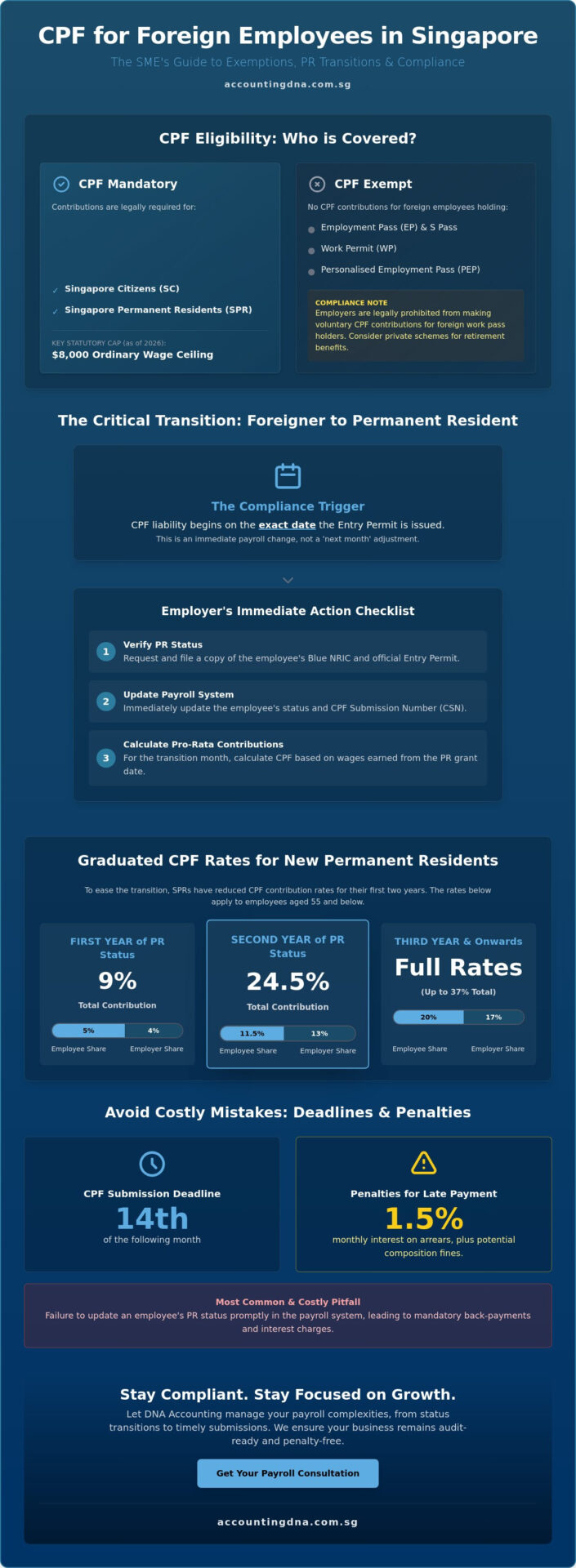
Checklist: Managing the Transition from Foreigner to PR (SPR)
The transition from a foreign work pass to Singapore Permanent Residency is a significant milestone for your staff, but it’s also a critical compliance trigger for your payroll. The moment an entry permit is issued, the exemption for CPF for foreign employees ends. You become legally liable for contributions starting from the exact date PR status is granted. This isn’t a “next month” adjustment; it’s an immediate shift that requires precise pro-rating of wages to ensure both the employee and employer shares are accurate.
Singapore uses a graduated contribution system to help new residents adjust to a lower take-home pay. For the first year of PR status, the total contribution is 9% (5% from the employee and 4% from the employer). In the second year, this rises to 24%. By the third year, full rates apply. You can find the specific CPF contribution rates for Singapore Permanent Residents on the official CPF Board website. If both you and your employee prefer to build retirement savings faster, you can jointly opt to pay the full rates earlier through a formal election process.
Managing these shifting percentages manually is a recipe for error. Our payroll services Singapore can automate these transitions, ensuring your system updates the moment a status change occurs. If you’re unsure how to handle a mid-month conversion, you can reach out to our team for a quick clarification.
Step-by-Step SPR Onboarding Checklist
- Request a copy of the Blue NRIC and the official Entry Permit to verify the exact “Date of PR.”
- Update your CPF Submission Number (CSN) and employee profile in your payroll software immediately.
- Calculate pro-rated contributions for the transition month based on the number of days the employee held PR status.
Common Transition Pitfalls
The most frequent mistake is failing to update the status in time, which leads to back-payments and a 1.5% monthly interest penalty on outstanding amounts. Don’t forget that the Skills Development Levy (SDL) Singapore still applies to the full gross salary. While CPF for foreign employees is no longer the rule once they become PRs, your total statutory obligations actually increase, making diligent tracking essential for your bottom line.
Ensuring Payroll Compliance and Avoiding Penalties
Maintaining a clean compliance record with the CPF Board is less about complex math and more about disciplined timing. Every Singapore employer must remit contributions by the 14th of the following month. If you miss this window, the consequences are immediate. The Board applies a late payment interest rate of 1.5% per month, which effectively scales to a punishing 18% per annum. While your primary concern might be CPF for foreign employees who have recently converted to PR status, you shouldn’t forget that other statutory levies apply to your entire workforce from day one.
Even when you aren’t paying CPF for foreign employees on EPs or S Passes, you’re still legally required to contribute to the Skills Development Levy SDL Singapore and relevant Self-Help Group (SHG) funds. These contributions are mandatory for all employees, regardless of their nationality or pass type. Misunderstanding these nuances is a common trap that can lead to a surprise audit. You can learn more about avoiding such pitfalls in our guide on Payroll Compliance Singapore: 7 Dangerous Myths Debunked.
The Role of Professional Payroll Management
Outsourcing your payroll ensures your records remain perfectly aligned with both ACRA and the CPF Board. By using an integrated approach, our bookkeeping services allow for seamless data flow between your daily accounts and your monthly statutory filings. This centralized model eliminates the friction of manual data entry and reduces the risk of human error during the foreigner-to-PR transition. We act as your protective partner, making sure you never miss a deadline.
2026 Compliance Audit for SMEs
To keep your business audit-ready, we recommend conducting a quarterly internal review. You should verify the pass statuses of all international staff and double-check that your SDL calculations reflect their current gross salaries accurately. If you find the administrative burden is pulling you away from your core business goals, Contact DNA Accounting for a comprehensive payroll health check. We’re here to provide the bespoke care and technical expertise your SME deserves to thrive in Singapore’s regulatory environment.
Secure Your Business Growth with Proactive Payroll Compliance
With over 10 years of Singapore SME expertise and a 100% ACRA and CPF compliance track record, our team provides the reliable guidance you need. We specialize in dedicated support for foreign-owned startups, ensuring every filing is precise and timely. Don’t let payroll complexity slow your momentum. Get a Personalized Payroll & CPF Compliance Quote today. Let’s work together to make your business compliance simple and secure.
Frequently Asked Questions
Do I need to pay CPF for an Employment Pass (EP) holder in 2026?
No, you don’t need to pay CPF for an Employment Pass (EP) holder in 2026. This exemption also covers S Pass and Work Permit holders. It’s a significant financial advantage for SMEs hiring international talent. We recommend keeping a clear record of pass expiry dates to ensure your payroll remains accurate, as these exemptions only apply while the work pass is valid and active.
What happens to CPF contributions when a foreigner becomes a Singapore PR?
Mandatory contributions start immediately on the date the employee is granted Singapore Permanent Resident (SPR) status. To ease the transition, the CPF Board uses a graduated rate system for the first two years. In Year 1, the total contribution is 9%; in Year 2, it increases to 24%. You’ll only pay the full 37% rate starting from the third year of their residency for employees aged 55 and below.
Can a foreign employee choose to contribute to CPF voluntarily?
No, a foreign employee cannot contribute to CPF through your company’s payroll. Legally, CPF for foreign employees is not permitted under the CPF Act; you cannot deduct or remit funds for them. While they can make personal voluntary contributions directly to the CPF Board, this is a private matter. Your role as an employer is to ensure you don’t accidentally include them in your monthly corporate submissions.
Is the Skills Development Levy (SDL) required for foreign employees?
Yes, the Skills Development Levy (SDL) is a mandatory requirement for all employees, including those on foreign work passes. You must remit 0.25% of the employee’s total monthly wages. This ranges from a minimum of $2 to a maximum of $11.25 for those earning above $4,500. It’s a small but essential payment that supports workforce training and must be paid alongside your other statutory obligations every month.
What are the penalties for late CPF submissions in Singapore?
Late payments attract a 1.5% monthly interest charge on the unpaid amount, calculated from the day after the due date. You may also face composition fines of up to $1,000 per offense. We understand that managing these tight timelines can feel like a heavy burden. Setting up an automated reminder for the 14th of each month is a simple way to protect your business from these avoidable and costly penalties.
How do the 2026 CPF salary ceiling changes affect foreign staff hiring?
While the 2026 Ordinary Wage ceiling of $8,000 doesn’t directly affect CPF for foreign employees, it changes the landscape for your resident staff. Hiring foreign talent remains CPF-exempt, but you must still meet the rising minimum qualifying salaries for EPs, which is now $6,000. Balancing these different cost structures requires a clear strategy to ensure your SME remains competitive while staying within the legal boundaries of Singapore’s labor laws.
Disclaimer
The information provided on this website is for general informational purposes only and is not intended to constitute professional accounting, tax, legal, or financial advice. While we strive to ensure that the content is accurate and up to date, regulations in Singapore, including those administered by ACRA, IRAS, CPF Board, and MOM, may change from time to time and may differ depending on individual circumstances.
Readers should not act or rely on any information contained on this website without seeking specific advice from a qualified professional based on their individual situation.
DNA Corporate Services and its affiliates accept no responsibility or liability for any loss or damage arising from reliance on the information provided in this website or any linked materials.
For tailored advice relating to accounting, taxation, corporate secretarial, or compliance matters in Singapore, please contact us directly for professional consultation.



