

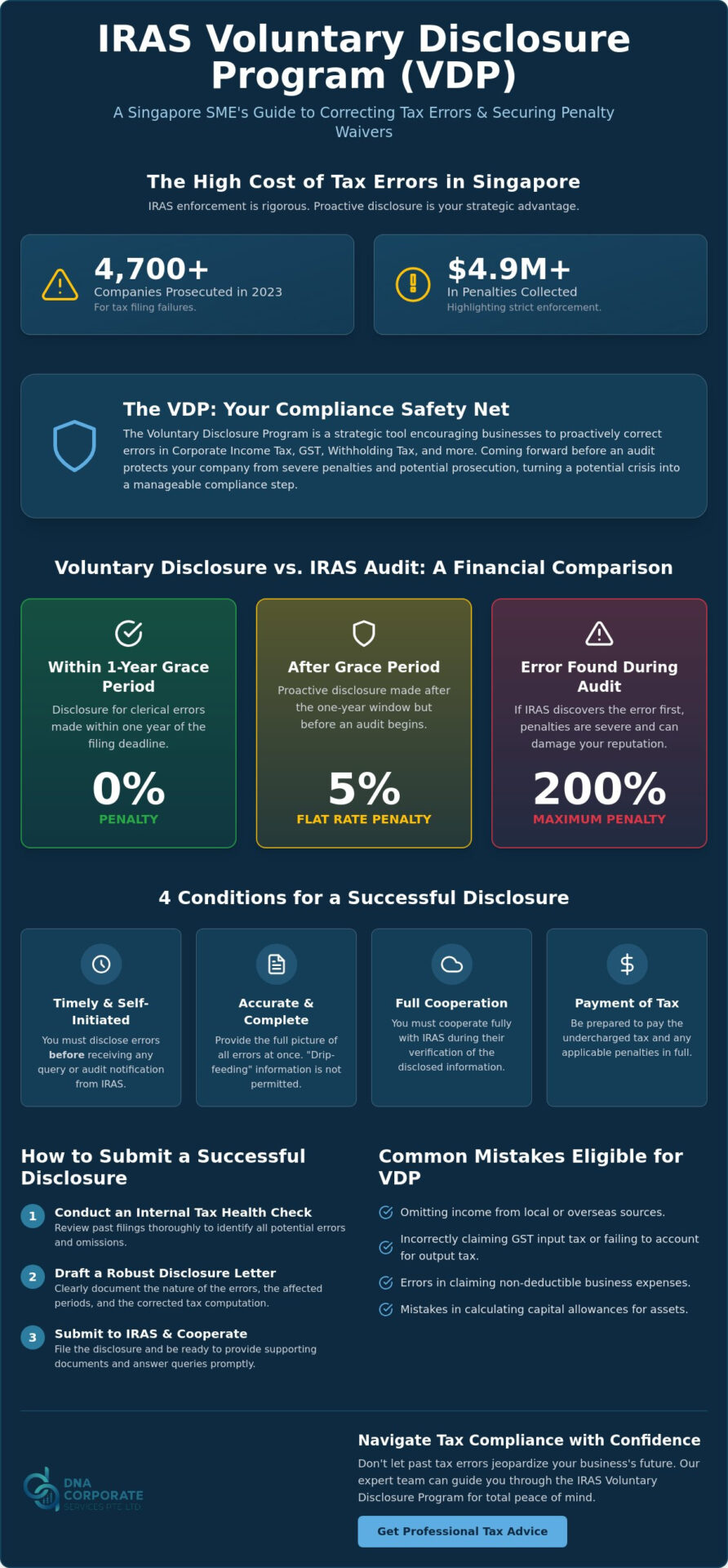
Did you know that IRAS prosecuted over 4,700 companies in 2023 for filing failures, collecting more than $4.9 million in penalties? It’s a sobering figure that highlights just how rigorous Singapore’s tax enforcement has become. If you’ve recently discovered an error in your past filings, that initial spike of anxiety is completely understandable. You’re likely worried about heavy financial penalties reaching up to 200% or the potential for a public investigation that could damage your business’s hard earned reputation.
We understand that technical tax terminology is often confusing and mistakes can happen even with the best intentions. This expert voluntary disclosure program IRAS guide is designed to help you proactively correct those omissions and safeguard your company’s future. By coming forward before an audit starts, you can often secure a full penalty waiver or significantly reduced fines, effectively turning a potential legal crisis into a manageable compliance step. We’ll walk you through the 2026 grace periods, the specific conditions for qualifying disclosures, and the clear path toward total peace of mind for your SME.
Key Takeaways
- Learn how the IRAS “Safety Net” concept works to protect your business from the heavy financial penalties typically associated with audit-driven discoveries.
- Identify the specific criteria in this voluntary disclosure program IRAS guide that differentiate a successful, penalty-free disclosure from a rejected “drip-feed” submission.
- Understand the 2026 grace periods for Income Tax and GST, including the one-year window that allows for a total waiver of penalties on qualifying errors.
- Gain a step-by-step framework for conducting an internal tax health check and drafting a robust disclosure letter that ensures long-term regulatory compliance.
Understanding the IRAS Voluntary Disclosure Program: A Safety Net for Singapore SMEs
Have you ever looked back at your previous Year of Assessment filings and realized a mistake was made? It’s a common source of stress for directors, but the Inland Revenue Authority of Singapore (IRAS) offers a way out. The Voluntary Disclosure Program (VDP) isn’t just a regulatory procedure; it’s a strategic safety net designed to encourage transparency and self-correction. IRAS understands that the tax landscape is complex, so they prefer proactive compliance over the heavy handed nature of a formal audit. This program covers Corporate Income Tax, GST, Withholding Tax, and Stamp Duty. Crucially, making a qualifying disclosure provides a massive relief: it generally protects your company from criminal prosecution for the errors being disclosed.
Why Proactive Disclosure is Better Than Waiting for an IRAS Audit
Why should you step forward now instead of waiting to see if IRAS notices? The difference lies in the financial impact. While an audit-discovered error can lead to penalties as high as 200% of the tax undercharged, a voluntary disclosure often results in a full waiver or a significantly reduced rate of just 5%. Beyond the money, proactive disclosure improves your corporate tax governance rating. It signals to the authorities that your business is committed to compliance. This peace of mind allows you to focus on growth without the looming shadow of legacy tax issues or the threat of a public investigation.
Common Tax Mistakes Eligible for VDP Correction
Many SMEs find themselves needing this voluntary disclosure program IRAS guide because of honest oversights in their corporate tax and GST filing services. Common errors include:
- Omitting income earned from local sales or overseas sources.
- Incorrectly claiming GST input tax or failing to account for output tax on certain transactions.
- Mistakes in calculating capital allowances for equipment or machinery.
The grace period is the specific 1-year window following a tax filing deadline during which you can often correct errors without any penalties at all.
Qualifying Conditions and Penalty Reductions: The 2026 VDP Framework
To benefit from the IRAS Voluntary Disclosure Programme, your submission must meet four strict criteria. First, it must be timely and self-initiated. This means you must come forward before you receive any query, audit notification, or investigation letter from the authorities. If the taxman knocks first, the opportunity for reduced penalties usually vanishes. Second, your disclosure must be accurate and complete. IRAS doesn’t allow “drip-feeding” information; you need to provide the full picture of all errors in one go to demonstrate genuine transparency.
The final two conditions involve your conduct after the disclosure. You must cooperate fully with IRAS during the verification process and make arrangements to pay the undercharged tax in full. While this might seem daunting, it’s a far better alternative than facing the consequences of an unforced audit. If you’re unsure where to start, it’s often wise to speak with a tax professional to review your records before submitting a formal letter.
The 1-Year Grace Period: Achieving a 0% Penalty
The most significant advantage of this voluntary disclosure program IRAS guide is understanding the “Golden Window.” For Income Tax and GST, IRAS provides a one-year grace period starting from the statutory filing deadline. If you disclose an accidental clerical error within this timeframe, the penalty is typically waived entirely. Imagine a business owner who realizes they missed a $5,000 GST output tax entry from nine months ago. By disclosing this now, they simply pay the tax owed with zero additional fines, protecting their cash flow and reputation.
Penalty Tiers for Disclosures Beyond the Grace Period
Even if you’ve missed the one-year window, stepping forward is still highly beneficial. For disclosures made after the grace period but before an audit begins, the penalty is generally capped at a flat 5% of the tax undercharged. Contrast this with the 35% or higher penalties often applied when errors are uncovered during a formal investigation. For a broader look at how this fits into your overall business obligations, check out The Master Guide to Statutory Compliance in Singapore. Taking action now ensures you remain in control of the narrative.
How to Submit a Successful Voluntary Disclosure: A Step-by-Step Approach
The 5-Step Internal Preparation Framework
Preparation is your best defense. Follow this structured approach to organize your records before making any formal contact:
- Step 1: Identify the scope. Determine exactly which Years of Assessment or GST periods contain errors.
- Step 2: Quantify the tax undercharged. Use professional bookkeeping and accounting services to calculate the precise figures owed.
- Step 3: Document the reason. Was the error due to a lack of care, a complex technical misunderstanding, or a systemic failure in your software?
- Step 4: Formulate a remediation plan. Show IRAS that you’ve implemented new controls to prevent the same mistake from recurring.
- Step 5: Draft the disclosure. Use the IRAS-preferred format to ensure all necessary details are included from the start.
How DNA Accounting Secures Your Compliance Future
At DNA Accounting, we provide the bespoke care that SMEs need to navigate the corporate tax and GST filing landscape safely. We don’t just crunch numbers; we act as your dedicated partner, liaising with IRAS on your behalf to manage follow-up queries and verification requests. This centralized service model means you have a single point of contact who understands the nuances of your business. Mistakes happen to the best entrepreneurs. Taking the first step to correct them today protects your business from the stress of future audits and ensures your reputation remains intact.
Securing Your Business Future Through Proactive Tax Compliance
Why leave your business’s reputation to chance when a clear path to correction exists? We’ve explored how the VDP acts as a vital safety net, protecting your SME from the heavy 200% penalties that often follow an unexpected audit. By acting within the one-year grace period or even stepping forward later, you demonstrate a commitment to transparency that the authorities value. Using this voluntary disclosure program IRAS guide as your roadmap, you can move from a state of compliance anxiety to one of regulatory confidence.
At DNA Accounting, we specialize in helping Singapore entrepreneurs resolve these legacy issues with bespoke care. Our experienced Singapore tax advisors provide the technical expertise needed for complex GST and Corporate Tax self-disclosures, ensuring every figure is quantified correctly before submission. We’re ready to act as your protective partner, managing the technical details so you can focus on what you do best. Mistakes don’t have to define your company’s future if you take the initiative to fix them now.
Take the first step toward total peace of mind today. Contact DNA Accounting for a Confidential Tax Health Check and let’s ensure your business remains on solid ground for years to come.
Frequently Asked Questions
What happens if I cannot pay the full tax amount immediately after disclosure?
You can apply for a payment plan via GIRO installments if your business is facing genuine cash flow constraints. While the VDP requires the undercharged tax to be paid, IRAS is often open to reasonable installment arrangements for companies that come forward voluntarily. It’s best to propose a realistic payment timeline during your submission to demonstrate your commitment to settling the outstanding amount and maintaining compliance.
Will IRAS still audit me if I participate in the Voluntary Disclosure Program?
Participation does not grant total immunity from future audits, but it significantly lowers your risk profile in the eyes of the authorities. By following this voluntary disclosure program IRAS guide and self-correcting your records, you effectively resolve the specific issues you’ve disclosed. IRAS typically prioritizes its investigative resources on non-compliant businesses rather than those that have proactively demonstrated transparency and a commitment to accurate reporting.
Can I use the VDP for errors made more than five years ago?
Yes, you can disclose errors that occurred more than five years ago to ensure your company’s tax history is completely clean. While the standard statutory limit for IRAS to raise an assessment is generally five years, this limit doesn’t apply in cases where fraud or wilful intent to evade tax is suspected. Clearing these legacy issues now is a smart move, especially if you’re preparing for a future business sale or merger.
What is the difference between an “error” and “tax evasion” in the eyes of IRAS?
The primary distinction lies in intent and the level of care taken during the filing process. An “error” usually involves honest oversights, clerical mistakes, or a technical misunderstanding of Singapore’s tax regulations. Tax evasion, however, involves a deliberate and wilful intent to understate income or inflate expenses through falsified records. While the VDP is designed to help correct both, those with wilful intent must come forward before an audit to avoid criminal prosecution.
Disclaimer
The information provided on this website is for general informational purposes only and is not intended to constitute professional accounting, tax, legal, or financial advice. While we strive to ensure that the content is accurate and up to date, regulations in Singapore, including those administered by ACRA, IRAS, CPF Board, and MOM, may change from time to time and may differ depending on individual circumstances.
Readers should not act or rely on any information contained on this website without seeking specific advice from a qualified professional based on their individual situation.
DNA Corporate Services and its affiliates accept no responsibility or liability for any loss or damage arising from reliance on the information provided in this website or any linked materials.
For tailored advice relating to accounting, taxation, corporate secretarial, or compliance matters in Singapore, please contact us directly for professional consultation.



