

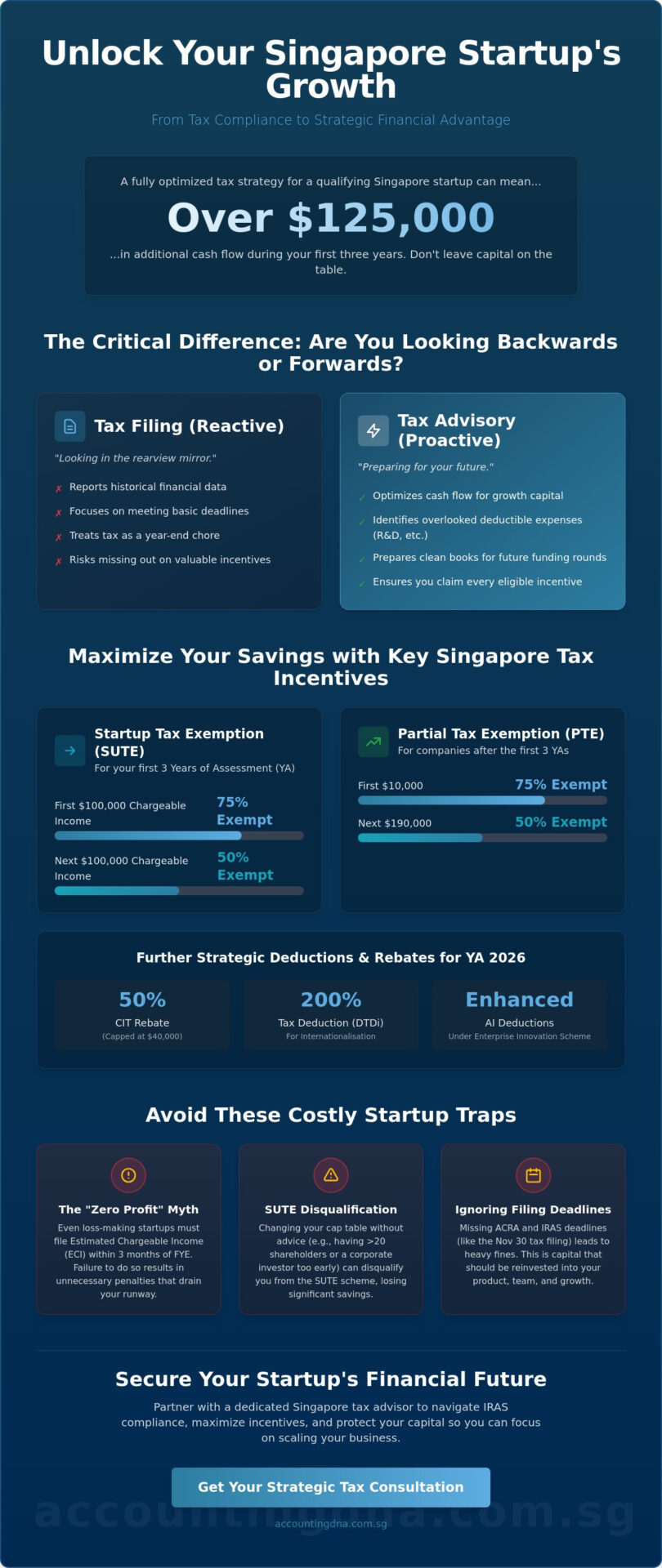
Did you know that for a qualifying Singapore startup, the difference between a standard tax filing and a fully optimized strategy could mean keeping over $125,000 in additional cash flow during your first three years? It’s a staggering figure, yet many founders treat tax as a year-end chore rather than a strategic growth lever. Securing the right tax advisory services for startups Singapore is about more than just staying on the right side of IRAS; it’s about ensuring your hard-earned capital stays where it belongs: in your business.
We know how overwhelming the regulatory environment can feel when you’re already juggling product development and fundraising. It’s completely natural to worry about missing a deadline or failing to claim the Startup Tax Exemption (SUTE) correctly. This guide is here to give you total peace of mind. We’ll show you how to maximize your tax savings while maintaining flawless compliance with the latest 2026 regulations. You’ll learn about the 50% CIT rebate capped at $40,000, the new AI-related deductions under the Enterprise Innovation Scheme, and the specific filing timelines you need to hit to avoid unnecessary penalties.
Key Takeaways
- Learn how to transition from basic compliance to strategic tax planning that actively protects your startup’s cash flow and growth capital.
- Identify the specific criteria to qualify for the Startup Tax Exemption (SUTE) and the Partial Tax Exemption (PTE) to maximize your early-stage savings.
- Discover why engaging professional tax advisory services for startups Singapore is critical even for loss-making companies to avoid future IRAS complications.
- Understand the benefits of a boutique partnership, including bespoke care and the flexibility of advisors who are available during non-traditional hours.
- Stay ahead of the 2026 regulatory curve by mastering the latest CIT rebate caps and the Enterprise Innovation Scheme requirements for AI-driven growth.
Why Strategic Tax Advisory is Critical for Singapore Startups
How can you ensure your startup remains capital-efficient while meeting every IRAS mandate? Many founders believe that tax is a problem they’ll solve once they’re profitable. This “zero profit” myth is one of the most dangerous traps for early-stage companies. Even if your startup is operating at a loss, you’re still required to engage with IRAS. Properly managing your Estimated Chargeable Income (ECI) filings within three months of your financial year-end isn’t just a box-ticking exercise; it’s a vital part of managing your startup’s runway. Securing specialized tax advisory services for startups Singapore helps you navigate these requirements so you don’t face unexpected cash flow drains from late penalties or missed incentives.
Understanding Singapore’s tax system is foundational for any director. While the flat 17% corporate rate is attractive, the real value lies in how you structure your expenses and claims from day one. Falling into the “founder’s trap” of ignoring ACRA and IRAS deadlines often leads to heavy fines that could have been reinvested into your team or product. We see ourselves as your protective partner, ensuring you stay compliant while you focus on scaling. For those looking for broader support, our corporate tax and GST filing services provide the comprehensive oversight needed to grow safely.
The Difference Between Tax Filing and Tax Advisory
Tax filing is essentially looking in the rearview mirror; it’s about reporting what happened last year. Strategic tax advisory is forward-looking. It prepares you for your next funding round by ensuring your books are clean and your tax position is defensible. A dedicated advisor identifies deductible expenses that founders often overlook, such as qualifying R&D costs or specific internationalization expenses, which can be carried forward to offset future profits.
IRAS Compliance: More Than Just a Deadline
Compliance in 2026 requires a proactive approach. It’s not just about hitting the November 30 filing date. It’s about understanding how your business decisions today impact your tax liability tomorrow. Whether it’s managing GST registration thresholds or ensuring your documentation is fully compliant, having a guide who knows the local landscape makes all the difference. We’re here to make sure you never feel lost in the regulatory weeds. By choosing the right tax advisory services for startups Singapore, you secure a partner who is invested in your long-term success.
Maximizing Singapore Tax Incentives for Early-Stage Companies
How much of your startup’s profit is actually yours to keep? Singapore is globally recognized for Singapore’s business-friendly environment, but the real magic happens when you layer specific tax incentives on top of the competitive 17% flat rate. For the first three Years of Assessment (YA), qualifying companies benefit from the Tax Exemption Scheme for New Start-Ups (SUTE). This provides a 75% exemption on your first $100,000 of chargeable income and a 50% exemption on the next $100,000. When you’re scaling fast, these savings aren’t just numbers on a spreadsheet; they represent the capital needed for your next key hire or marketing push.
As you move beyond those initial three years, you don’t lose all support. You’ll transition to the Partial Tax Exemption (PTE) scheme, which offers a 75% exemption on the first $10,000 and 50% on the next $190,000. Additionally, for the Year of Assessment 2026, the government has provided a 50% Corporate Income Tax rebate, capped at $40,000. If your startup is looking beyond our borders, the Double Tax Deduction for Internationalisation (DTDi) allows for a 200% tax deduction on eligible expenses for market expansion. Leveraging tax advisory services for startups Singapore ensures you don’t leave these incentives on the table due to simple administrative oversights.
Qualifying for the Startup Tax Exemption (SUTE)
Qualifying for SUTE isn’t automatic. Your company must be a tax resident in Singapore and have no more than 20 shareholders. Crucially, at least one individual shareholder must hold a minimum of 10% of the ordinary shares. A common mistake we see is startups bringing on corporate investors too early or changing shareholding structures without realizing it might disqualify them from these lucrative exemptions. It’s vital to review your cap table with an advisor before making major structural changes.
Managing GST Registration for Growing Startups
Is your taxable turnover approaching the $1 million mark? Once you cross this threshold, GST registration becomes compulsory. However, many startups choose voluntary registration earlier to claim back GST on their business inputs. This is a nuanced decision that affects your pricing and cash flow. Our corporate tax and GST filing services help you weigh the pros and cons of voluntary registration so you can make the best move for your specific business model. If you’re unsure where your startup stands, feel free to reach out for a quick chat about your current compliance status.
Choosing the Right Tax Partner: Why Boutique Expertise Matters
Choosing a specialized advisor means moving away from generic templates toward a centralized service model. This ensures that your tax planning, bookkeeping, and corporate secretarial needs are all aligned. In the fast-moving 2026 business climate, having a guide who knows every detail of your financial history prevents the communication gaps that often lead to IRAS compliance issues. We focus on building a singular, integrated experience where your advisor acts as a proactive protector of your cash flow.
The DNA Accounting Approach to Startup Growth
We believe that trust is built through a combination of high-level professional qualifications and a deeply customer-centric mindset. Our approach isn’t about pushing a standard package; it’s about tailoring our support to your specific stage of development. Whether you’re transitioning from incorporation to your first annual tax filing or preparing for a Series A round, we’re here to simplify the process. If you’re ready for a partnership that values your time as much as you do, you can contact DNA Accounting for a consultation to see how we can support your journey.
Real-World Compliance Scenarios for Founders
Consider the case of a local tech startup that nearly missed the compulsory GST registration threshold due to a sudden surge in export services. Without the right tax advisory services for startups Singapore, they would have faced significant back-dated taxes and penalties. By reviewing their accounts monthly, we identified the trend early and managed the registration process seamlessly. This type of proactive oversight is what separates a basic service from a strategic partner. You can explore more about managing these risks in our guide to corporate tax and GST filing services.
Securing Your Startup’s Financial Future
Strategic tax planning in 2026 is about much more than staying compliant; it’s about optimizing your startup’s cash flow to fuel long-term growth. By moving beyond simple year-end filings and proactively leveraging schemes like SUTE or the 50% CIT rebate, you ensure your capital stays within your business where it can do the most good. We’ve seen how personalized tax advisory services for startups Singapore can transform a founder’s relationship with IRAS from one of stress to one of total confidence.
Since 2016, DNA Accounting has served as a dedicated partner for Singapore’s SME and startup community. We understand that your business doesn’t stop at 6 PM, which is why we offer unique accessibility during evenings and non-working days to suit your intensive schedule. Our boutique model ensures you receive bespoke care and a centralized service experience rather than getting lost in a corporate machine. Ready to protect your runway? Book a Stress-Free Tax Consultation with DNA Accounting today. We’re here to help you navigate the complexities of the regulatory landscape so you can focus on building what matters most.
Frequently Asked Questions
Do I need to file corporate tax if my startup made a loss this year?
Yes, you’re still required to file your Corporate Income Tax return even if your startup is currently in a loss position. Filing allows you to officially record these losses with IRAS, which can then be carried forward to offset future profits once your business becomes profitable. It’s a strategic move that protects your future cash flow. Missing these filings can lead to unnecessary penalties and complicate your company’s compliance record.
What is the Tax Exemption Scheme for New Start-Ups (SUTE) in Singapore?
SUTE is a lucrative tax incentive for newly incorporated companies during their first three Years of Assessment. It offers a 75% exemption on the first $100,000 of chargeable income and a 50% exemption on the next $100,000. Your startup must be a Singapore tax resident and have a maximum of 20 shareholders to qualify. At least one of these shareholders must be an individual holding at least 10% of the ordinary shares.
When is the deadline for filing Estimated Chargeable Income (ECI) with IRAS?
You must file your Estimated Chargeable Income (ECI) within three months of your company’s financial year-end. This filing provides IRAS with an early estimate of your taxable profits before the final tax return is due. Filing on time is particularly beneficial because it allows you to pay your tax in installments. If you miss this window, you lose the chance to spread out your tax payments, which can tighten your startup’s immediate runway.
Can I handle my startup’s tax filing on my own using myTax Portal?
Technically, yes, but many founders find the process overwhelming and prone to error. Professional tax advisory services for startups Singapore provide more than just data entry; they offer the strategic insight needed to claim every available deduction. Between navigating the 2026 CIT rebate and the Enterprise Innovation Scheme, the risk of an IRAS audit or missed savings often outweighs the cost of hiring a boutique expert who understands your business DNA.
Disclaimer
The information provided on this website is for general informational purposes only and is not intended to constitute professional accounting, tax, legal, or financial advice. While we strive to ensure that the content is accurate and up to date, regulations in Singapore, including those administered by ACRA, IRAS, CPF Board, and MOM, may change from time to time and may differ depending on individual circumstances.
Readers should not act or rely on any information contained on this website without seeking specific advice from a qualified professional based on their individual situation.
DNA Corporate Services and its affiliates accept no responsibility or liability for any loss or damage arising from reliance on the information provided in this website or any linked materials.
For tailored advice relating to accounting, taxation, corporate secretarial, or compliance matters in Singapore, please contact us directly for professional consultation.



