

Is your company actually paying more than it should because your current advisor only reaches out when a deadline is looming? For many directors, corporate tax planning Singapore feels like a high-stakes puzzle where the rules are constantly shifting, especially with the enhanced YA 2026 rebates and the strict November 30 filing deadline. It’s natural to feel frustrated by generic advice that doesn’t account for your specific industry or your eligibility for schemes like the Start-Up Tax Exemption (SUTE).
We believe that managing your tax position should feel empowering, not exhausting. This guide gives you a definitive roadmap for your YA 2026 obligations, ensuring you don’t miss out on the 50% CIT rebate or the S$2,000 cash grant for qualifying employers. You’ll learn how to legally optimize your deductions using the latest IRAS frameworks and the Enterprise Innovation Scheme. By the end of this article, you’ll have the clarity needed to lower your effective tax rate and keep more capital inside your business where it belongs.
Key Takeaways
- Leverage the enhanced 50% CIT Rebate and the S$2,000 cash grant to protect your company’s cash flow for the 2026 Year of Assessment.
- Master the specific eligibility criteria for SUTE and PTE to ensure your business captures every dollar of available tax exemption.
- Implement proactive corporate tax planning Singapore strategies that align your 2025 financial performance with your upcoming 2026 tax obligations.
- Navigate the transition to mandatory digital filing and maximize new deductions available under the Enterprise Innovation Scheme for AI expenditures.
- Reduce compliance anxiety by understanding the critical differences between high-risk self-filing and the security of a bespoke, centralized service model.
Navigating the Singapore Corporate Tax Landscape for YA 2026
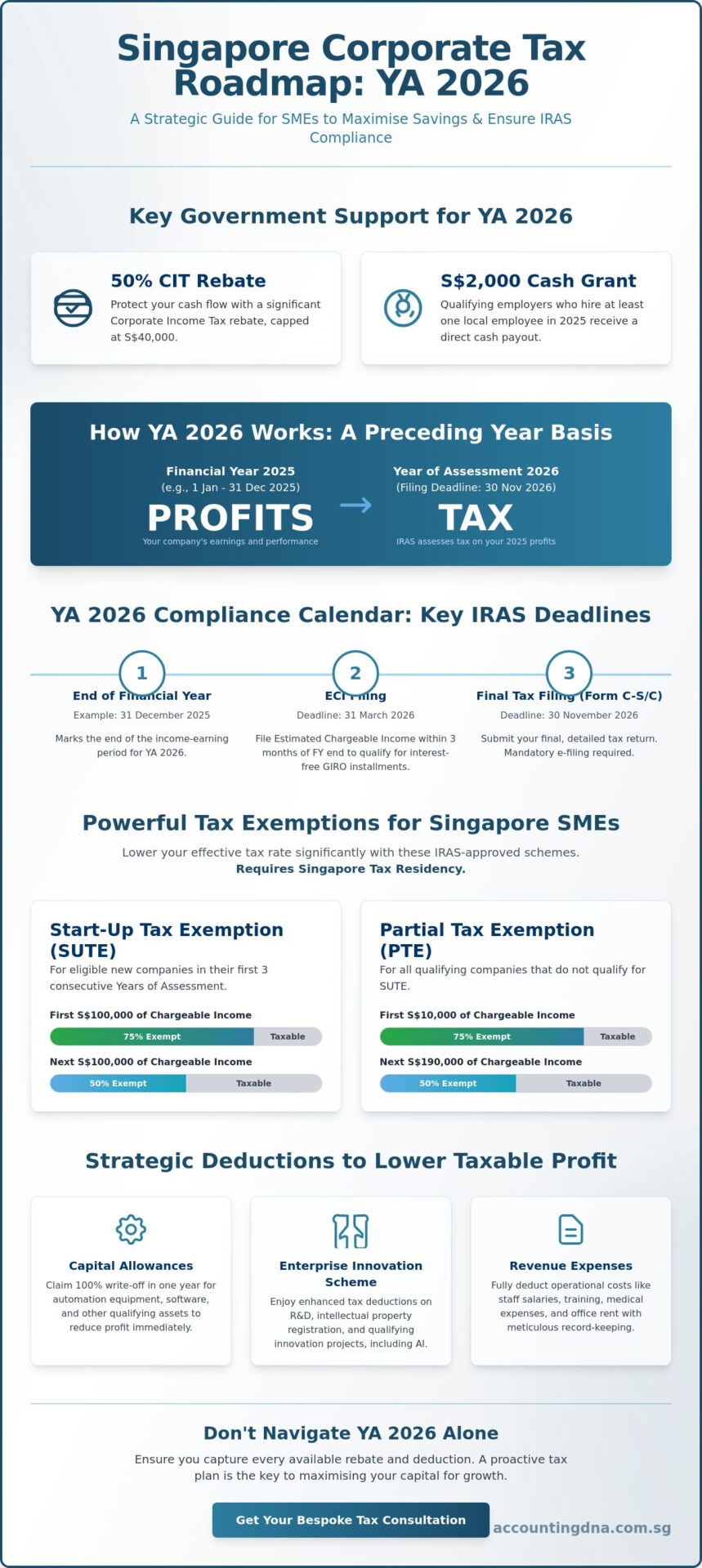
Many business owners find the concept of ‘Year of Assessment’ (YA) a bit backwards. In Singapore, you’re taxed on a preceding year basis. This means your 2026 tax bill is actually determined by the profits you generated during your 2025 financial year. While the headline rate sits at a flat 17%, most local SMEs never actually pay that amount. Thanks to Singapore’s single-tier corporate tax system, your effective rate can drop significantly once you apply various rebates and exemptions. Effective corporate tax planning Singapore isn’t about finding loopholes; it’s about the strategic, legal arrangement of your business affairs to ensure you’re utilizing every IRAS-approved incentive available to you.
For company directors, staying ahead of the curve requires mastering two critical filings: Estimated Chargeable Income (ECI) and the final tax return (Form C-S or Form C). ECI is your company’s “best guess” of its taxable profits. Form C-S is the simplified version for SMEs with annual revenue of S$5 million or less. Getting these right is the difference between a smooth financial year and a stressful encounter with the taxman.
The 2026 Compliance Calendar: Key Dates for IRAS and ACRA
Timing is everything for compliance. You must file your ECI within three months of your financial year-end. If your year ends on 31 December 2025, your ECI deadline is 31 March 2026. Missing this window means losing the option to pay your taxes via interest-free GIRO installments. The final deadline for YA 2026 tax returns is 30 November 2026. We often see founders struggle when their ACRA annual return dates and IRAS filings overlap. Using professional taxation services ensures these milestones are met without the last-minute scramble.
Determining Tax Residency: Why it Matters for Your Exemptions
Is your company a Singapore tax resident? It’s not just about where you incorporated. IRAS uses the ‘Control and Management’ test, which looks at where your strategic decisions are made. Usually, this means where your Board of Directors meets. Residency is the golden ticket for corporate tax planning Singapore because it unlocks access to the Start-Up Tax Exemption (SUTE) and Singapore’s vast network of Avoidance of Double Taxation Agreements (DTAs). Without residency, your company might be taxed twice on the same dollar of foreign income, which is a costly mistake for any growing SME.
Practical Tax Planning Strategies to Maximise SME Deductions
Think of your tax return as the final score of a game you’ve been playing all year. Effective corporate tax planning Singapore isn’t a year-end sprint; it’s a series of deliberate choices made during your daily operations. For new companies, the Start-Up Tax Exemption (SUTE) scheme is your most powerful tool. It provides a 75% exemption on your first S$100,000 of chargeable income and 50% on the next S$100,000 for your first three consecutive Years of Assessment. If your business is more established, you’ll transition to the Partial Tax Exemption (PTE), which still shields a significant portion of your profits from the full 17% rate.
Another area where SMEs often leave money on the table is Capital Allowances. Instead of spreading the cost of equipment over many years, you can often claim a 100% write-off in a single year for automation equipment and software. This immediate deduction lowers your taxable profit today, keeping more cash in your bank account for growth. Combining these strategies with the YA 2026 50% Corporate Income Tax Rebate, which is capped at S$40,000, can lead to substantial savings. If you’re unsure which schemes apply to your specific industry, it’s worth reaching out for a quick chat to clarify your eligibility.
Optimising Business Expenses and Deductions
Successful claims start with distinguishing between ‘Capital’ and ‘Revenue’ expenditure. While revenue expenses like office rent and staff salaries are fully deductible, capital costs like property purchases are not. However, IRAS allows for generous deductions on staff training and medical expenses up to certain limits. According to this IRAS guide to corporate income tax, staying compliant means keeping meticulous records of these costs. Don’t overlook the Enterprise Innovation Scheme (EIS), which provides enhanced deductions for qualifying R&D and innovation-related spending.
Strategic Dividends and Shareholder Planning
Singapore operates a one-tier corporate tax system. This is a massive win for shareholders because the tax paid by the company is final. Any dividends you distribute from your after-tax profits are completely tax-exempt in the hands of your shareholders. We often guide directors on the balance between taking a salary versus director’s fees. While salaries are subject to CPF contributions, director’s fees are not; however, they are only deductible for the company in the year they are voted on and approved. Choosing the right mix is a cornerstone of smart corporate tax planning Singapore.
Avoiding Compliance Risks with Professional Tax Consultation
Is the time you spend wrestling with tax forms actually costing your business more than a professional fee? While IRAS provides digital tools for self-filing, they don’t offer the strategic foresight needed for effective corporate tax planning Singapore. Simple errors in classification or missed deadlines often trigger unwanted audits that drain your focus. We see many SMEs struggle with the ‘hidden costs’ of self-filing, ranging from penalties to lost sleep. At DNA Accounting, we offer a personalized alternative to the distant service models of larger firms. We focus on proactive, centralized care that monitors your tax position throughout the financial year, moving you away from messy spreadsheets into tax-ready, cloud-based reporting.
Common Tax Mistakes that Trigger IRAS Audits
IRAS audits aren’t random; they’re often the result of specific red flags. According to the IRAS Basic Guide to Corporate Income Tax, companies must maintain proper records for at least five years. Common pitfalls include:
- Inaccurate ECI reporting: Underestimating income to delay tax payments can lead to audits and heavy penalties.
- Co-mingling funds: Mixing director’s personal expenses with business accounts is a major red flag that suggests poor internal controls.
- Incomplete documentation: Failing to produce invoices or receipts during a query can lead to the rejection of legitimate expense claims.
Next Steps: Building Your 2026 Tax Roadmap
Waiting until December to think about your taxes is a recipe for missed opportunities. Strategic corporate tax planning Singapore works best when done quarterly. This allows us to adjust for changing GST registration thresholds or newly announced corporate tax rebates before your financial year ends. By having a dedicated advisor, you gain a partner who understands your industry’s specific challenges and keeps you ahead of the November 30 filing deadline. If you’re ready to secure your company’s financial future and stop worrying about compliance, you can view our Corporate Tax & GST Filing Services to see how we can streamline your YA 2026 obligations.
Take Charge of Your 2026 Tax Strategy
Mastering your tax obligations doesn’t have to be a source of constant stress. By understanding the preceding year basis and maximizing schemes like SUTE or the YA 2026 CIT rebate, you position your business for sustainable growth. Effective corporate tax planning Singapore requires a proactive approach that balances strict compliance with strategic deductions. Whether you’re a fresh startup or an established SME, the goal remains the same: keeping more of your hard-earned profits to reinvest in your vision.
At DNA Accounting, we specialize in helping founders navigate the complexities of IRAS and ACRA regulations with ease. We understand that your schedule doesn’t always fit into a nine-to-five window, so we offer personalized support during non-working hours to suit your needs. Don’t leave your savings to chance or settle for generic advice that misses the nuances of your industry. Our team is ready to provide the bespoke care and technical expertise your business deserves. Book a Consultation with DNA Accounting’s Tax Experts today and let’s build a roadmap that ensures you’re fully optimized for the year ahead. We look forward to supporting your success.
Frequently Asked Questions
What is the difference between ECI and Form C-S in Singapore?
ECI is your Estimated Chargeable Income, which you must file within three months of your financial year-end. It’s a preliminary report of your company’s taxable profits. Form C-S is your final, actual tax return due by 30 November. While ECI is an estimate, filing it accurately is crucial because it determines your eligibility for interest-free GIRO installment plans to manage your cash flow.
How much can a new startup save under the SUTE scheme in 2026?
Qualifying startups can achieve a maximum annual tax saving of S$21,250 through the SUTE scheme alone. This is calculated using a 75% exemption on your first S$100,000 of income and a 50% exemption on the next S$100,000. For YA 2026, these savings are further enhanced by the 50% Corporate Income Tax Rebate and a potential S$2,000 cash grant. Proper corporate tax planning Singapore ensures you capture the full S$63,750 in savings available over your first three years.
Is corporate tax planning legal in Singapore?
What happens if I miss the IRAS corporate tax filing deadline?
Missing the 30 November deadline triggers an immediate composition fee that can reach S$5,000 per year of assessment. IRAS may also issue a summons to the company director or take legal action if the return remains unfiled. Additionally, you’ll face a late payment penalty of 5% on any unpaid tax, which can increase if the delay persists. It’s always safer to file early to protect your company’s reputation and avoid these avoidable financial penalties.
Disclaimer
The information provided on this website is for general informational purposes only and is not intended to constitute professional accounting, tax, legal, or financial advice. While we strive to ensure that the content is accurate and up to date, regulations in Singapore, including those administered by ACRA, IRAS, CPF Board, and MOM, may change from time to time and may differ depending on individual circumstances.
Readers should not act or rely on any information contained on this website without seeking specific advice from a qualified professional based on their individual situation.
DNA Corporate Services and its affiliates accept no responsibility or liability for any loss or damage arising from reliance on the information provided in this website or any linked materials.
For tailored advice relating to accounting, taxation, corporate secretarial, or compliance matters in Singapore, please contact us directly for professional consultation.



