

What if your biggest business hurdle in 2026 isn’t the rising cost of operations, but the tax dollars you’re unintentionally leaving on the table? For many SME owners, the flat 17% rate feels like a heavy anchor, especially when you’re unsure if you qualify for the latest YA 2026 incentives or the $1,500 cash grant. Learning how to reduce corporate tax in Singapore isn’t about finding loopholes or taking risks that invite an IRAS audit. Instead, it’s about the strategic alignment of your business operations with government backed schemes designed to help you thrive.
We understand that navigating statutory regulations can feel daunting, but you don’t have to do it alone. We’ll show you how to legally minimize your tax liability and maximize the 50% CIT rebate, which is capped at $40,000 for this Year of Assessment. This guide provides a clear roadmap through the Start-Up Tax Exemption (SUTE) and the Partial Tax Exemption (PTE) frameworks. You’ll gain a firm grasp on which expenses are truly deductible, allowing you to lower your bill with total confidence and full compliance.
Key Takeaways
- Understand why Singapore’s 17% flat rate is often much lower in practice through the strategic use of Chargeable Income adjustments and exemptions.
- Learn how to reduce corporate tax in Singapore by implementing proactive planning strategies long before the November filing deadline.
- Identify the specific qualifying conditions for the YA 2026 50% CIT rebate and the $1,500 cash grant for companies with local employees.
- Distinguish between legal tax avoidance and illegal evasion to ensure your deductions remain fully IRAS-compliant and audit-proof.
- Avoid the hidden costs of DIY filing by mastering the nuances of Form C-S/C and meeting critical ECI deadlines to protect your savings.
Understanding Singapore’s Corporate Tax Framework in 2026
While Singapore’s flat corporate tax rate of 17% is one of the most competitive in the world, it’s rarely the rate that SMEs actually pay. We often see business owners pleasantly surprised to find their effective tax rate is significantly lower, sometimes even in the single digits. This is because Singapore’s tax framework is built to reward growth and local employment through a series of rebates and exemptions. Understanding how to reduce corporate tax in Singapore starts with knowing the difference between your gross profit and your Chargeable Income. Chargeable Income is your taxable profit after accounting for deductible expenses and capital allowances, and it’s the figure that truly determines your tax bill.
Another foundational piece of the puzzle is your tax residency. If your company is controlled and managed from Singapore, you can apply for a Certificate of Residence (COR). This isn’t just a piece of paper; it’s your gateway to claiming benefits under Avoidance of Double Taxation Agreements (DTAs) and qualifying for specific local tax exemptions. In the 2026 landscape, where operational costs remain a concern for many, these administrative details become vital tools for protecting your company’s cash flow.
The YA 2026 Corporate Income Tax (CIT) Rebate and Cash Grant
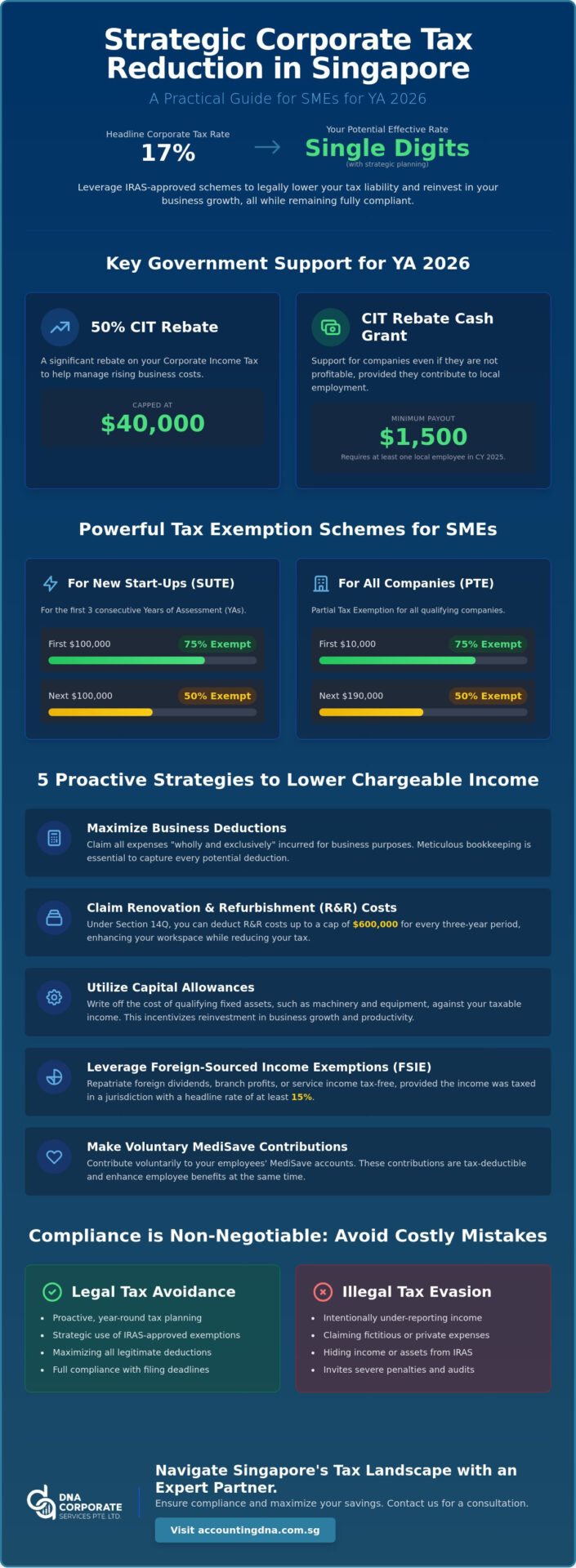
To help businesses manage rising costs, IRAS has introduced a 50% CIT Rebate for the Year of Assessment 2026. This rebate is capped at $40,000, providing a substantial reduction for profitable SMEs. However, even if your company isn’t currently profitable, you might still benefit from the CIT Rebate Cash Grant of $1,500. To qualify for this cash grant, your company must have employed at least one local employee, defined as a Singapore Citizen or Permanent Resident, during the 2025 calendar year. Companies will receive the higher of the calculated rebate or the $1,500 cash grant, subject to the overall cap.
Tax Exemption Schemes for New Startups and SMEs
If you’re in your first few years of operation, the Tax Exemption Scheme for New Start-Up Companies is your most powerful ally. It offers a 75% exemption on the first $100,000 of normal chargeable income and a further 50% on the next $100,000 for your first three consecutive YAs. For established companies that no longer qualify for the startup scheme, the Partial Tax Exemption (PTE) still provides a 75% exemption on the first $10,000 and 50% on the next $190,000 of income. You can learn more about how to navigate these Tax Exemption Schemes for New Startups in Singapore to ensure you’re maximizing every available dollar.
5 Strategic Ways to Legally Reduce Your Corporate Tax Bill
Do you wait until the November filing deadline to think about your tax bill? True tax efficiency is a year-round commitment, not a last-minute scramble. When considering how to reduce corporate tax in Singapore, it’s vital to distinguish between tax avoidance, which is the legal use of the tax regime to your advantage, and tax evasion, which involves illegal practices. By proactively aligning your business spending with IRAS-approved incentives, you protect your company’s bottom line while staying fully compliant with the official corporate income tax guide.
Maximizing Business Deductions and Capital Allowances
Utilizing Foreign-Sourced Income Exemptions (FSIE)
Does your business operate across borders? Singapore’s territorial tax system means foreign dividends, branch profits, or service income can often be repatriated tax-free. To qualify for this exemption, the income must have been subject to tax in the foreign jurisdiction where the highest corporate tax rate is at least 15%. Leveraging Singapore’s extensive Double Taxation Agreements (DTAs) ensures you aren’t paying twice on the same dollar, keeping more capital available for your local operations.
Voluntary MediSave Contributions for Employees
An often overlooked strategy involves making voluntary contributions to your employees’ MediSave accounts. These contributions are tax-deductible for the company, provided they don’t exceed 1% of the employee’s total monthly wages. It’s a win-win scenario: you support your team’s long-term healthcare needs while reducing your company’s chargeable income. Calculating these specific limits precisely can be technical, so many directors rely on corporate tax & GST filing services to ensure every deduction is claimed correctly. If you’re unsure how these specific strategies apply to your 2026 financial year, you can always speak with our team for a tailored assessment.
Avoiding Common Compliance Risks and Filing Mistakes
Many directors try to save costs by handling their own filings, but the hidden price of a DIY approach can be steep. A single missed Estimated Chargeable Income (ECI) deadline or an incorrectly classified expense can lead to penalties that quickly wipe out your hard earned tax savings. According to Singapore’s Corporate Income Tax Framework, companies must maintain high standards of transparency, especially regarding ‘arm’s length’ transactions between related parties. If IRAS suspects that prices between sister companies aren’t reflective of market rates, they may adjust your tax figures, leading to unexpected liabilities.
Another common pitfall involves the ‘local employee’ condition for the $1,500 YA 2026 cash grant. It isn’t enough to simply have staff on paper; your CPF contributions must be accurate and paid on time throughout the 2025 calendar year to qualify. This is where many founders feel the stress of statutory regulations, fearing that a small administrative slip might trigger an audit. Mastering how to reduce corporate tax in Singapore requires more than just knowing the rules. It requires a robust internal system to catch errors before they ever reach the tax authority’s desk.
The Synergy Between Accurate Bookkeeping and Tax Savings
Consistent, monthly bookkeeping is the foundational layer of every successful tax strategy. When you wait until the end of the year to organize your receipts, you’re almost guaranteed to miss deductible expenses or lose track of key invoices. Cloud accounting tools change the game by providing real-time estimates of your tax liability, so there are no nasty surprises when filing season arrives. Our Stress-Free Monthly Bookkeeping Services are designed to keep your records audit-ready and your mind at ease while ensuring every possible deduction is captured.
Why a Bespoke Tax Advisor is Essential for SMEs
Generic tax calculators can’t account for the unique nuances of your specific business model. They don’t see the opportunities for customized planning that a dedicated expert can identify. At DNA Accounting, we take an empathy-driven approach, acting as a protective partner for founders who want to focus on growth rather than paperwork. We’re here to help you navigate the complexities of YA 2026 with confidence and clarity. Contact DNA Accounting for a personalized tax consultation today and let’s secure your company’s financial future together.
Secure Your Company’s Financial Future for YA 2026
Are you ready to turn tax season from a source of stress into a strategic advantage? We’ve explored how a deep understanding of how to reduce corporate tax in Singapore relies on more than just basic filing. It requires a proactive approach to maximizing capital allowances, leveraging foreign-sourced income exemptions, and ensuring your bookkeeping is audit-ready. By aligning your business goals with Singapore’s supportive tax framework, you protect your hard-earned profits and keep your cash flow healthy for the year ahead.
At DNA Accounting, we bring over 10 years of Singapore tax expertise specifically tailored to the needs of SMEs and startups. Our team provides dedicated support for all your ACRA and IRAS filings, ensuring you meet every deadline with confidence. We believe in providing bespoke, empathy-driven care that larger firms often overlook. Don’t leave your tax savings to chance. Maximize Your Tax Savings with DNA Accounting’s Expert Tax Services and let us handle the compliance headache for you. You’ve worked hard to grow your business, and we’re here to help you keep it thriving.
Frequently Asked Questions
Can I reduce my corporate tax by paying myself a higher director’s fee?
Yes, increasing your director’s fee can lower your company’s chargeable income, but the amount must be commercially justifiable. While these fees are deductible for the company, they’re taxable as personal income for the individual. This strategy is most effective when your personal tax bracket is lower than the company’s corporate rate. It’s a practical way how to reduce corporate tax in Singapore while managing your personal tax liabilities effectively.
What is the difference between ECI and Form C-S filing?
The primary difference is that ECI is an estimate, while Form C-S is your actual tax return. You must file your Estimated Chargeable Income (ECI) within three months of your financial year-end to give IRAS an early look at your projected profits. Form C-S is the final declaration of your actual income and expenses, which is filed by November 30 each year. Filing your ECI promptly is essential if you want to pay your tax via interest-free installments.
Is my company eligible for the startup tax exemption if it was incorporated 4 years ago?
No, your company is likely no longer eligible because the Tax Exemption Scheme for New Start-Up Companies only applies to the first three consecutive Years of Assessment (YA). Once you enter your fourth YA, you’ll automatically transition to the Partial Tax Exemption (PTE) scheme. While the startup benefits are more generous, the PTE still provides significant relief by exempting 75% of your first $10,000 and 50% of the next $190,000 in chargeable income.
What happens if I accidentally claim a non-deductible expense?
If you discover an error in your filing, you should make a voluntary disclosure to IRAS as soon as possible. We’ve seen that IRAS is generally much more lenient with companies that come forward to correct genuine mistakes than those caught during an audit. Penalties for incorrect returns can be significantly reduced or even waived if you report the error before IRAS initiates an investigation. This proactive approach is a key part of how to reduce corporate tax in Singapore while maintaining a clean compliance record.
Disclaimer
The information provided on this website is for general informational purposes only and is not intended to constitute professional accounting, tax, legal, or financial advice. While we strive to ensure that the content is accurate and up to date, regulations in Singapore, including those administered by ACRA, IRAS, CPF Board, and MOM, may change from time to time and may differ depending on individual circumstances.
Readers should not act or rely on any information contained on this website without seeking specific advice from a qualified professional based on their individual situation.
DNA Corporate Services and its affiliates accept no responsibility or liability for any loss or damage arising from reliance on the information provided in this website or any linked materials.
For tailored advice relating to accounting, taxation, corporate secretarial, or compliance matters in Singapore, please contact us directly for professional consultation.



