

In July 2026 alone, 5,890 business entities ceased their registration with ACRA. If you’re managing a dormant entity, you’ve likely felt the weight of potential late filing penalties or the confusion of distinguishing between striking off and winding up. Learning how to strike off a company in Singapore shouldn’t be a source of stress. It’s a strategic move that protects your professional reputation and ensures a clean break from statutory obligations.
We understand that the maze of IRAS tax clearances and ACRA’s 60-day objection periods feels daunting. This guide provides a clear roadmap to navigate 2026 compliance requirements, from digital filing mandates to avoiding the director disqualification rule. You’ll learn the exact steps to achieve a successful dissolution without lingering liabilities. Let’s walk through the process of closing your company the right way, ensuring every regulatory box is checked so you can move forward with total peace of mind.
Key Takeaways
- Identify whether striking off or winding up is the right exit strategy based on your company’s assets, liabilities, and current legal status.
- Discover how to strike off a company in Singapore by following a compliant workflow that includes obtaining an IRAS Letter of No Objection.
- Avoid the risk of a five-year director disqualification by managing the striking-off process for multiple entities within the required regulatory timeframes.
- Fulfill your post-dissolution duties by keeping essential company books and statutory records for the mandatory five-year retention period.
Striking Off vs. Winding Up: Choosing Your Exit Strategy
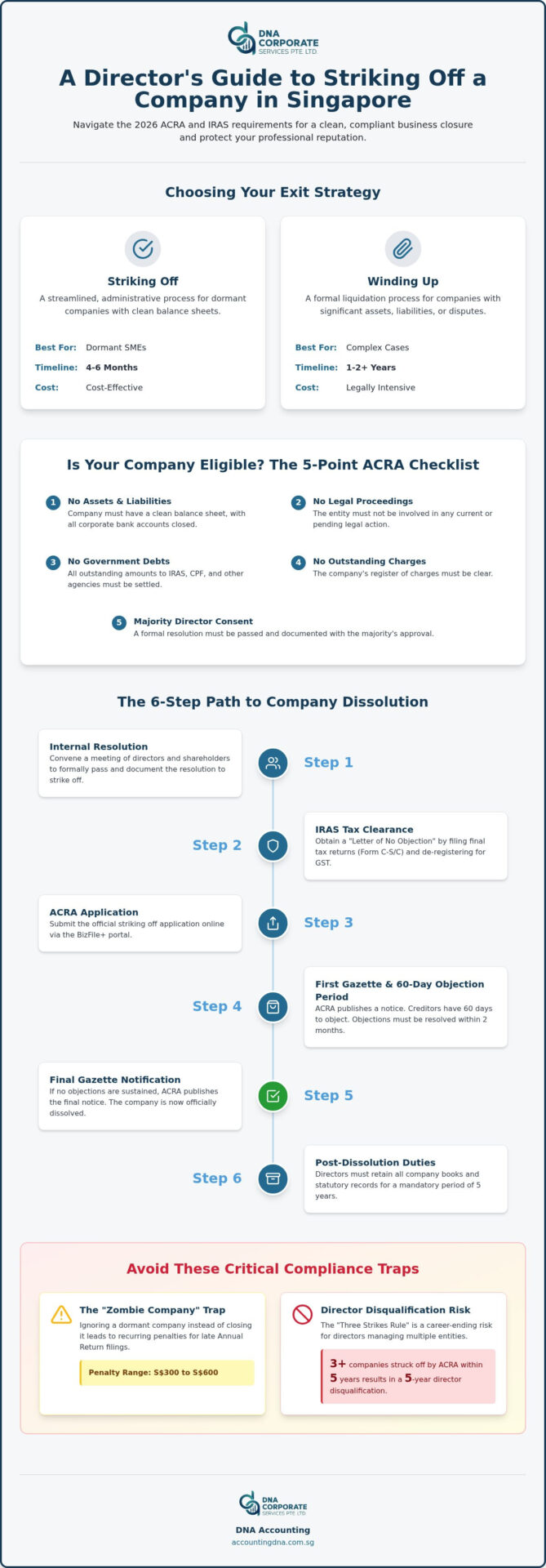
Deciding to close your business is a significant milestone that requires careful regulatory handling. If you’re exploring how to strike off a company in Singapore, it’s essential to understand the basics. Striking Off is the administrative deregistration of a company from the ACRA register. While winding up involves a formal liquidation process for entities with complex assets or debts, striking off serves as a streamlined, “stress-free” route for SMEs with clean balance sheets. It’s often the preferred method because it avoids the high costs and legal intensity associated with formal Corporate dissolution.
When is Your Company Eligible to be Struck Off?
To successfully apply, your company must meet five strict ACRA criteria. You must have no outstanding assets or liabilities, no involvement in legal proceedings, and no debts owed to government agencies like IRAS or CPF. Additionally, there must be no outstanding charges in the company’s register and you must obtain the consent of the majority of directors. The company must also be dormant, meaning it has ceased all business activities. Before starting, ensure you’ve closed all corporate bank accounts and settled inter-company debts. Our corporate secretarial services can help you verify these prerequisites to prevent application rejection.
Striking Off vs. Winding Up Comparison
The primary appeal of learning how to strike off a company in Singapore is the efficiency. The process typically takes four to six months, whereas winding up can drag on for years. It’s significantly more cost-effective for small business owners. However, don’t mistake this for a total liability shield. A common misconception is that striking off erases past legal issues; in reality, directors can still be held liable for past breaches even after the name is removed. If you’re wondering how to manage the cleanup without hitches, focus on a thorough financial reconciliation first.
The Step-by-Step Procedure to Strike Off a Company in 2026
Executing a clean exit requires strict adherence to the Companies Act 1967. Many directors assume they can simply stop filing returns, but this neglect often leads to heavy penalties. To understand how to strike off a company in Singapore correctly, you must start with internal consensus. First, convene a meeting of directors and shareholders to pass a formal striking off resolution. Once documented, your primary focus shifts to obtaining a ‘Letter of No Objection’ from IRAS, which confirms you have no lingering tax liabilities.
Achieving Tax Clearance with IRAS
Tax clearance is the most common bottleneck in the dissolution process. You’ll need to file your final Form C-S/C and ensure all GST accounts are officially de-registered. From August 1, 2026, IRAS only accepts these submissions through their digital portal at mytax.iras.gov.sg. You must also manage the ‘Estimated Chargeable Income’ (ECI) for your final financial period. Any oversight here will cause ACRA to reject your application immediately. If your accounts are complex, our Corporate Tax & GST Filing Services provide the proactive support needed to clear these hurdles.
The ACRA Timeline: From Application to Dissolution
After your BizFile+ submission, ACRA issues the First Gazette Notification. This starts a 60-day objection period where any interested party can raise concerns. If a creditor or the CPF Board lodges an objection, you have two months to resolve the issue before the application lapses. If the window passes quietly, the Second Gazette Notification confirms the final dissolution. The entire process takes a minimum of three to four months. If you want to ensure a smooth transition, speak with our team for bespoke care throughout the filing cycle.
Compliance Risks: Avoiding Director Disqualification and Penalties
Are you aware that a simple administrative oversight could end your career as a director? Many business owners fall into the ‘Zombie Company’ trap, where they ignore dormant entities instead of formally closing them. Since late 2025, ACRA has intensified efforts to strike off defunct companies, making compliance more critical than ever. While the application to strike off a company with ACRA is free of charge, the cost of neglect is steep. Late filing penalties for Annual Returns currently range from S$300 to S$600. When you weigh these recurring fines against the one-time effort of learning how to strike off a company in Singapore, the choice is clear.
The most severe risk involves the ‘Three Strikes’ rule. If you’re a director of three or more companies that ACRA strikes off within a five-year period, you’ll be disqualified for five years. This prevents you from managing any business and can seriously damage your professional standing. Understanding how to strike off a company in Singapore correctly is the only way to avoid this trap. Even after the company is gone, your duties continue:
- Record Retention: You must keep all company books and statutory records for five years post-dissolution.
- Director Liability: Struck-off status doesn’t protect you from legal action regarding past breaches.
- Restoration Risks: Creditors can apply to restore the company via a court order within six years of the strike-off date.
The Role of a Professional Company Secretary
How do you ensure your exit is legally airtight? A corporate secretary plays a vital role in drafting the necessary resolutions and ensuring every ACRA filing is precise. At DNA Accounting, we provide bespoke care to manage the daunting regulatory landscape for you. We handle the technical heavy lifting, from shareholder meetings to final gazette monitoring. Our Corporate Secretarial Services are designed to protect your reputation and ensure a smooth, professional closure of your business affairs.
Secure Your Professional Legacy with a Compliant Exit
Closing a business chapter requires more than just stopping operations; it’s about safeguarding your professional future. By understanding how to strike off a company in Singapore, you transition from the anxiety of ACRA penalties to the confidence of a clean corporate break. Whether you’re navigating the 60-day objection period or securing IRAS tax clearance, every detail matters for your reputation.
Our team offers the bespoke care and expert ACRA compliance you need to avoid the “Three Strikes” rule. We’re here for you during evenings and weekends, providing a personalized boutique service that larger firms simply can’t match. Ready to close your company the right way? Contact DNA Accounting for a stress-free striking off consultation and move forward with total peace of mind. We’re ready to help you succeed.
Frequently Asked Questions
Can I strike off a company if it still has outstanding debts or liabilities?
No, you cannot. A core requirement for the ACRA striking off process is that the company has no outstanding assets or liabilities. This includes debts to creditors, the CPF Board, or IRAS. If your company still has unsettled financial obligations, you must pursue formal winding up instead. Settling all debts is the first hurdle in learning how to strike off a company in Singapore.
How long does the entire striking off process take in Singapore?
The process typically takes a minimum of three to four months from the date of application. This timeline accounts for the 60-day objection period following the First Gazette Notification. If any party raises an objection, you’ll have an additional two months to resolve the matter. Assuming no hurdles arise, the Second Gazette Notification will officially confirm your company’s dissolution.
Do I still need to file Annual Returns if I plan to strike off my company?
Yes, your company’s filings must be entirely current. You’re required to file all outstanding Annual Returns and pay any late filing penalties before ACRA will accept your application. Neglecting these duties is a common mistake for those wondering how to strike off a company in Singapore. We recommend a full compliance check to ensure your statutory records are spotless before you begin.
What happens to the company’s bank account and assets after it is struck off?
Any assets or bank balances remaining at the time of dissolution automatically vest in the State. This is known as bona vacantia. To avoid losing your business property, you must close all corporate bank accounts and distribute assets to shareholders before the final gazette. Once the company is struck off, you’ll no longer have the authority to transact on its behalf.
Can a struck-off company be restored to the ACRA register later?
Yes, a struck-off company can be restored within six years. This requires an application to the High Court, often initiated by creditors or directors who’ve discovered forgotten assets. While restoration is possible, it’s a costly and legally intensive process. It’s much better to ensure all affairs are completely finalized before you proceed with the initial striking off application.
Is a director personally liable for company debts after a strike off?
Striking off doesn’t erase a director’s legal or personal liabilities. If you’ve provided personal guarantees for corporate debts, those remain active. Additionally, the court can still hold you accountable for any breaches of duty committed while the company was active. Dissolution provides an administrative exit, but it doesn’t offer a “get out of jail free” card for past mismanagement or negligence.
Disclaimer
The information provided on this website is for general informational purposes only and is not intended to constitute professional accounting, tax, legal, or financial advice. While we strive to ensure that the content is accurate and up to date, regulations in Singapore, including those administered by ACRA, IRAS, CPF Board, and MOM, may change from time to time and may differ depending on individual circumstances.
Readers should not act or rely on any information contained on this website without seeking specific advice from a qualified professional based on their individual situation.
DNA Corporate Services and its affiliates accept no responsibility or liability for any loss or damage arising from reliance on the information provided in this website or any linked materials.
For tailored advice relating to accounting, taxation, corporate secretarial, or compliance matters in Singapore, please contact us directly for professional consultation.



