

It’s 11 PM on the 31st of July, and you’re staring at a spreadsheet of input tax claims, wondering if a single oversight will trigger an IRAS audit. We know that for many Singaporean SMEs, the quarterly GST cycle feels less like a routine task and more like a high-stakes hurdle. Between managing daily operations and keeping up with the new 2026 InvoiceNow requirements, the pressure to maintain perfect records can be overwhelming.
You shouldn’t have to choose between growing your business and staying in the good books of IRAS. This guide is designed to help you master your quarterly obligations, ensuring you never miss a deadline or leave money on the table through unclaimed input tax. We will explore the nuances of the current 9% tax rate, common pitfalls that lead to $200 monthly late fees, and how expert GST filing services Singapore can transform your compliance from a burden into a strategic advantage for your cash flow. By the end of this article, you will have a clear roadmap for navigating IRAS expectations with total confidence.
Key Takeaways
- Understand why the S$1 million turnover threshold and the new 2026 InvoiceNow mandate are foundational to your company’s compliance health.
- Identify the technical differences between IRAS Forms F5, F7, and F8 so you always submit the correct paperwork for your business situation.
- Protect your cash flow by mastering quarterly deadlines to avoid the S$200 monthly late filing penalties and 5% late payment charges.
- Discover how professional GST filing services Singapore provide the bespoke care and evening accessibility that founders need to stay audit-ready.
Singapore GST Filing: 2026 Requirements for SMEs
Think of GST filing as your quarterly health check with IRAS. It is the process where you report the 9% tax you’ve collected on sales (output tax) and offset it against the tax you’ve paid on business purchases (input tax). For many growing firms, utilizing specialized GST filing services Singapore ensures that every dollar is accounted for correctly. This reporting isn’t just a ledger exercise; it’s a legal obligation that keeps your company in good standing with the authorities.
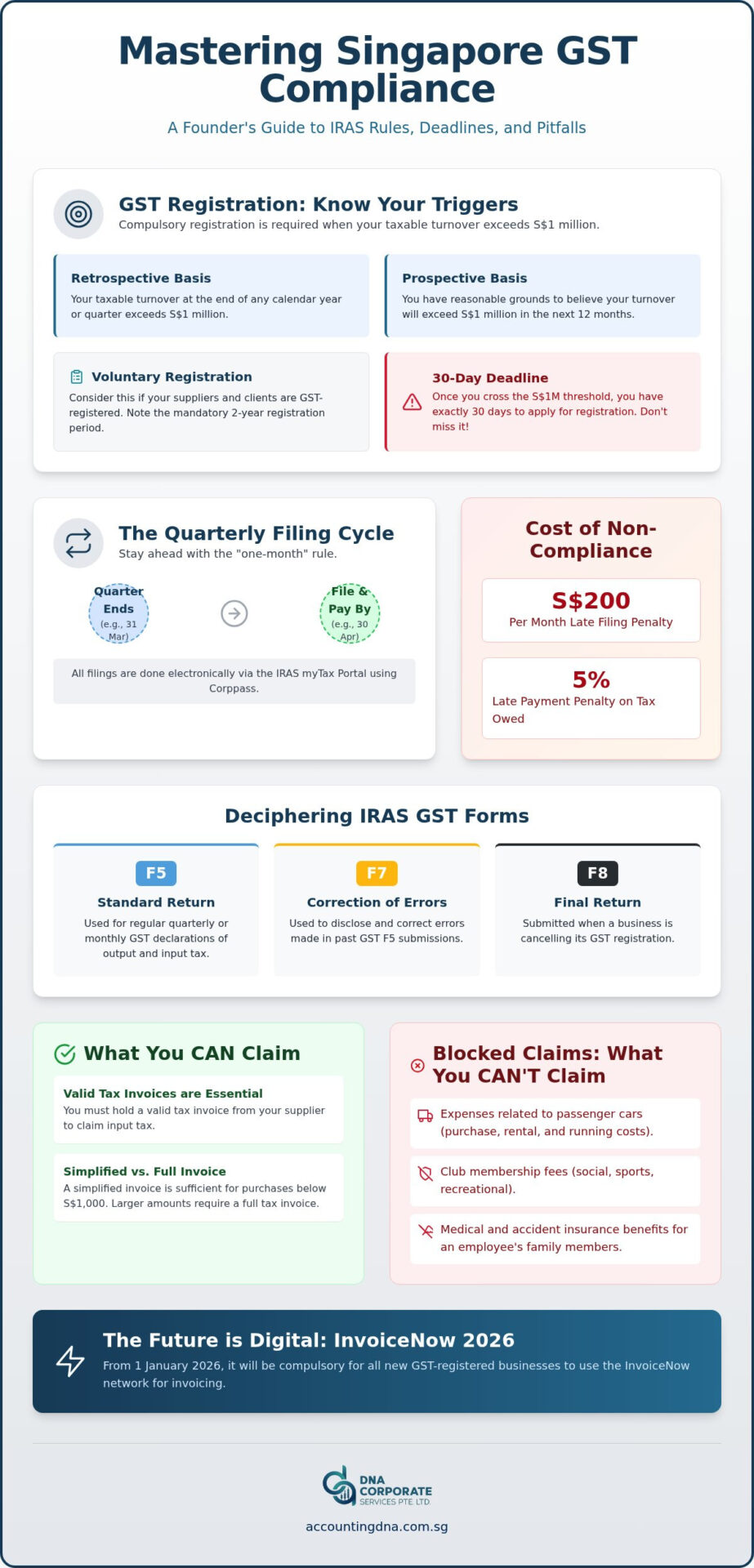
The law is clear: you must register for Singapore’s Goods and Services Tax if your taxable turnover exceeds S$1 million. This is calculated in two ways:
- Retrospective Basis: Your taxable turnover at the end of any calendar year (since 1 Jan 2019) or quarter exceeds S$1 million.
- Prospective Basis: You have reasonable grounds to believe your turnover will exceed S$1 million in the next 12 months.
Even if you haven’t hit the limit, voluntary registration can be a smart move if your clients are mostly GST-registered businesses. It allows you to recover the 9% you pay to your own vendors, which can be a significant boost to your bottom line. We often help clients integrate this into their broader professional accounting services in Singapore to ensure tax efficiency across the board.
Compulsory vs. Voluntary GST Registration
Timing is everything. Once you breach the S$1 million threshold, you have exactly 30 days to apply for registration. Missing this window is a common pitfall that leads to heavy penalties and the stress of paying retrospective taxes out of your own pocket. If you choose to register voluntarily, remember there’s a two-year lock-in period. It’s a commitment that requires a clear view of your long-term margins and customer base before you sign on the dotted line.
The Link Between Bookkeeping and GST Accuracy
Messy records are the primary cause of what we call “GST leakage.” This happens when businesses lose out on valid input tax claims simply because their receipts are missing or their ledgers are disorganized. Reliable monthly bookkeeping services provide the structural foundation needed for a clean filing. When your books are kept in real-time, the quarterly transition to IRAS reporting becomes a seamless exercise. Our approach to providing GST filing services Singapore focuses on identifying these gaps early, ensuring you never pay more than you truly owe.
The GST Filing Process: Deadlines, Forms, and IRAS Best Practices
Submitting your returns doesn’t have to be a source of quarterly anxiety. The e-filing process is conducted through the IRAS myTax Portal, where you’ll need Corppass authorization to act on behalf of your company. Most businesses utilize GST filing services Singapore to ensure this digital handshake with the tax authorities is handled with technical precision. While the portal is user-friendly, the data entry requires absolute accuracy to match your internal ledgers.
Understanding which form to use is your first step toward compliance. The Form F5 is the standard return used for your regular quarterly declarations. If you discover an error in a past submission, the Form F7 allows for corrections, while the Form F8 is reserved for the final return when a business deregisters. Standard Rated Supply requires you to collect 9% tax on local sales, whereas Zero-Rated Supply applies a 0% rate specifically to exported goods and international services.
The “one-month” rule is the most critical date in your calendar. For a quarter ending 31 March, your filing and payment must be completed by 30 April. Missing this window triggers an immediate 5% late payment penalty, which can quickly erode your margins. Staying on top of these IRAS GST responsibilities is easier when you have a partner monitoring the clock for you.
Maximizing Your Input Tax Claims Safely
To claim input tax, you must hold a valid tax invoice. For transactions below S$1,000, a simplified tax invoice is sufficient, but larger amounts require a full tax invoice detailing the vendor’s GST number. Be careful with “blocked” items; IRAS does not allow claims on passenger car expenses, club memberships, or medical benefits for your staff’s family members. If you’re unsure about a specific expense, it’s always best to speak with a consultant to avoid future audits.
Avoiding Common Compliance Pitfalls
Digital services and cross-border transactions often lead to confusion regarding “Place of Supply” rules. If you incorrectly treat a local service as an export, you risk under-declaring output tax. Many firms rely on GST filing services Singapore to help clarify these complex international tax treatments. If you do find a mistake from a previous year, the IRAS Voluntary Disclosure Programme (VDP) is a vital tool. It allows businesses to come forward and correct errors, often resulting in significantly reduced penalties compared to those found during a surprise audit.
Why Partner with DNA Accounting for GST Filing Services?
At DNA Accounting, we view your regulatory obligations as the vital code that defines your business health. We don’t just process numbers; we provide bespoke care that treats your company’s compliance as if it were our own. Choosing the right GST filing services Singapore means finding a partner who understands that entrepreneurship doesn’t always happen between 9 AM and 6 PM. That’s why our team remains accessible for urgent evening consultations, ensuring you have expert guidance exactly when you need it most.
Our approach is built on integrated compliance. We manage everything from your corporate secretarial duties to your quarterly GST and tax filing. This centralized model eliminates the risk of communication gaps between different service providers. By staying close to your daily operations, we provide proactive advisory, alerting you to shifting IRAS regulations or the nuances of the GST e-Filing Process before they impact your specific industry.
Bespoke Care vs. Mass-Market Accounting
Why settle for an automated platform when your business deserves a dedicated human advisor? While mass-market apps might offer speed, they often miss the technical nuances that lead to missed input tax claims or incorrect coding. Our boutique model ensures you have a seasoned expert who knows your business history. This level of customization is what allows us to identify strategic opportunities to optimize your tax position that a generic algorithm would simply overlook.
Seamless Transition for New Startups
If you’ve recently crossed the S$1 million threshold, the transition to being a GST-registered entity can be daunting. We assist new registrants in updating their invoicing software to meet the 2026 InvoiceNow mandates and adjusting pricing structures to maintain margins. Don’t let the paperwork slow your growth. We encourage you to reach out for a direct consultation to assess your readiness and secure your company’s financial future with GST filing services Singapore that truly care.
Secure Your Company’s Financial Health Today
Navigating the S$1 million threshold and the 2026 InvoiceNow mandate doesn’t have to be a solo journey. By mastering the distinction between standard and zero-rated supplies and respecting the strict one-month filing window, you protect your business from unnecessary penalties and cash flow leaks. Remember that accurate bookkeeping is the DNA of a successful tax position; it ensures every valid input tax claim is recovered and every audit risk is mitigated before it becomes a problem.
At DNA Accounting, we’ve been specialists in Singapore SME compliance since 2016. As a boutique firm, we provide the personalized, partner-level attention that larger agencies often overlook. We understand that your schedule as a founder is demanding. This is why we remain available for evening and weekend consultations to suit your needs. We are here to be your protective partner in a complex regulatory environment, ensuring you can focus on growth while we handle the technical details.
Contact DNA Accounting for a Stress-Free GST Consultation and let us manage your GST filing services Singapore with the precision your business deserves. You’ve built something great. Let’s work together to keep it protected and compliant for the long term.
Frequently Asked Questions
What happens if my business has no sales this quarter? Do I still need to file GST?
Yes, you must still submit a GST return even if you have zero transactions for the period. This is known as a “Nil” return. Failing to file simply because there was no business activity is a common mistake that still triggers late filing penalties from IRAS. Keeping your status active requires consistent reporting, regardless of your revenue for that specific quarter.
Can I claim GST on expenses incurred before my company was GST-registered?
You can claim GST on business expenses incurred before your registration date, provided they meet specific IRAS criteria. For goods, you must still hold them at the time of registration. For services, they must not have been fully consumed or related to goods already sold. This “Pre-registration Input Tax” claim is a valuable way to recover costs, but it requires meticulous record-keeping to satisfy a potential audit.
What is the penalty for late GST filing or payment in Singapore?
IRAS imposes a $200 penalty for every month a GST return remains outstanding, capped at $10,000 per return. Late payments attract an immediate 5% penalty on the tax amount due. If the tax isn’t paid within 60 days, an additional 2% monthly penalty is applied, capped at 50% of the unpaid tax. Many businesses use GST filing services Singapore to avoid these compounding costs and ensure total compliance.
How do I change my GST filing frequency from quarterly to monthly?
Most businesses file quarterly, but you can apply to switch to a monthly cycle through the myTax Portal if you are consistently in a net refund position. This is often beneficial for exporters who want to improve cash flow by receiving refunds faster. Our GST filing services Singapore can help you assess if this transition is right for your business model and assist with the formal application to IRAS.
Disclaimer
The information provided on this website is for general informational purposes only and is not intended to constitute professional accounting, tax, legal, or financial advice. While we strive to ensure that the content is accurate and up to date, regulations in Singapore, including those administered by ACRA, IRAS, CPF Board, and MOM, may change from time to time and may differ depending on individual circumstances.
Readers should not act or rely on any information contained on this website without seeking specific advice from a qualified professional based on their individual situation.
DNA Corporate Services and its affiliates accept no responsibility or liability for any loss or damage arising from reliance on the information provided in this website or any linked materials.
For tailored advice relating to accounting, taxation, corporate secretarial, or compliance matters in Singapore, please contact us directly for professional consultation.



