

Did you know that while Singapore saw over 77,000 new business registrations last year, many founders still feel overwhelmed by the technicalities of the law? It’s a common worry. You have a brilliant vision, but the fine print of private limited company Singapore requirements can feel like a maze of legal jargon and potential ACRA penalties. We know that defining a “locally resident director” or deciding on your initial share capital feels daunting when you’re trying to build a brand. It’s natural to want certainty that your foundation is solid.
This guide provides a clear, expert-led roadmap to ensure your setup is legally sound from day one. We’ll walk through mandatory ACRA criteria, share capital rules, and the specific tax exemptions available in 2026. You’ll gain a jargon-free checklist that transforms complex regulations into a simple, manageable path for your new venture.
Key Takeaways
- Identify the five fundamental ACRA criteria you must meet before registration to avoid immediate rejection or costly naming errors.
- Master the specific private limited company Singapore requirements regarding local directors and physical office addresses to ensure your business is legally sound.
- Uncover the mandatory post-incorporation deadlines for secretarial filings and share issuance that many new founders accidentally overlook.
- Learn how to leverage 2026 tax incentives and exemptions by establishing the right corporate structure from the very beginning.
The 5 Core ACRA Requirements for Singapore Private Limited Companies
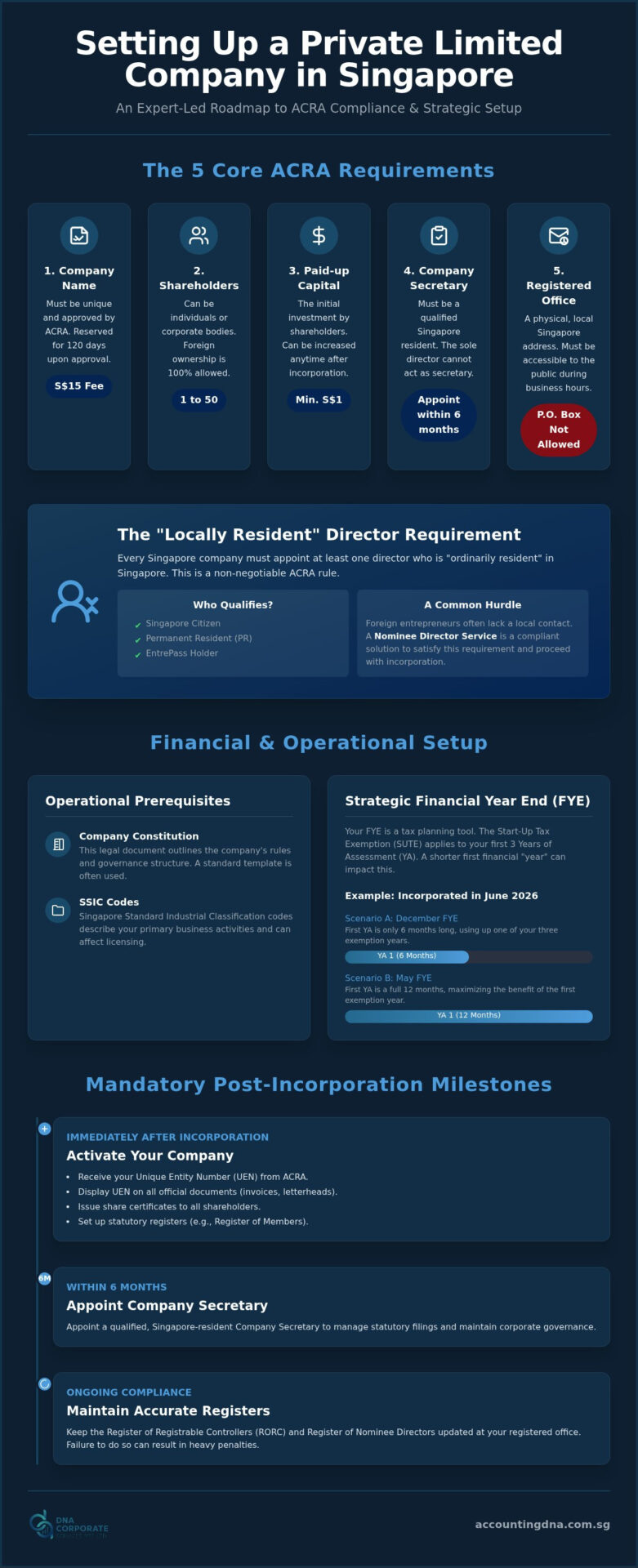
Setting up a private limited company in Singapore is remarkably efficient, but ACRA’s gatekeeping is strict. To pass the first hurdle, you need a name that isn’t just catchy; it must be unique and free from trademark infringements. ACRA charges a S$15 fee for name applications. Once approved, that name is yours for 120 days. It’s the first step in meeting the formal private limited company Singapore requirements.
Your corporate foundation rests on these specific pillars:
- Shareholders: You need at least one, but no more than 50. These can be individuals or corporate entities.
- Paid-up Capital: Start with as little as S$1. You can increase this amount as your business scales.
- Company Secretary: A qualified resident secretary must be appointed within six months of incorporation.
- Registered Office: You must provide a physical local address. P.O. boxes aren’t permitted.
Defining the Locally Resident Director Requirement
Who exactly qualifies as “ordinarily resident”? In the eyes of ACRA, this means a Singapore Citizen, a Permanent Resident, or an EntrePass holder. Employment Pass holders can also serve as directors, but they often need a Letter of Consent from the Ministry of Manpower. This is a common hurdle for international entrepreneurs trying to satisfy private limited company Singapore requirements.
If you don’t have a local partner, a nominee director service Singapore ensures you remain fully compliant while you focus on growth. Every director shares the same legal liabilities. You’re responsible for the company’s statutory health. We act as a protective partner, ensuring you understand these duties before you sign any documents.
Financial and Operational Prerequisites for a Successful Setup
Beyond the basic registration, your operational setup dictates how smoothly you’ll scale. A physical registered office address is mandatory. While virtual offices are popular for startups, ACRA strictly forbids P.O. boxes. You’ll also need to adopt a Company Constitution. This document governs how your firm is managed, and getting it right is a vital part of meeting private limited company Singapore requirements.
You must also select Singapore Standard Industrial Classification (SSIC) codes. These codes describe your business activities and can impact your eligibility for specific government grants or licensing needs. Most founders stick to the default Singapore Dollar for share capital, though other currencies are allowed. According to the World Bank’s Doing Business guide, these clear procedural steps contribute to Singapore’s reputation as a premier business destination.
Strategically Choosing Your Financial Year End (FYE)
Your FYE isn’t just a date on a calendar; it’s a strategic tax tool. Singapore’s Start-Up Tax Exemption (SUTE) applies to your first three consecutive Years of Assessment. If you incorporate in June and choose a December FYE, your first “year” is only six months long. In 2026, maximizing these exemption windows is more critical than ever for lean startups. Many firms choose 31 March or 31 December to align with tax seasons. If you’re unsure which path maximizes your cash flow, speaking with a corporate tax consultant Singapore can prevent you from missing out on significant savings. We’re here to help you align these dates with your actual business cycle. If you need help mapping out your compliance timeline, feel free to reach out to our team for a chat.
Mandatory Post-Incorporation Compliance Milestones
You also have a strict six-month deadline to appoint a qualified Company Secretary. This role is vital for maintaining your firm’s legal standing. They handle the heavy lifting of board resolutions and annual filings, acting as a bridge between your operations and ACRA’s regulatory demands. You must also maintain a Register of Nominee Directors if your structure includes them.
A common pitfall for new founders is neglecting the Register of Registrable Controllers (RORC). ACRA requires you to maintain this register at your registered office to identify those with significant interest or control. It’s a transparency measure that carries heavy penalties if ignored. By using professional corporate secretarial services, you ensure these records remain accurate and up to date. We act as your protective partner, managing these filings so you can avoid the stress of ACRA late fees. These tasks are fundamental to meeting private limited company Singapore requirements over the long term, ensuring your business remains in good standing through every growth phase.
Secure Your Singapore Business Foundation Today
Mastering the private limited company Singapore requirements is the first vital step toward building a resilient business in a world-class economy. By securing a unique name, appointing a resident director, and strategically selecting your financial year end, you set a foundation for long-term tax efficiency. Don’t let the technicalities of RORC filings or statutory registers slow your momentum. Our boutique team provides the bespoke care your startup deserves, offering availability during evenings and weekends to handle your urgent compliance questions.
We ensure your business stays aligned with all ACRA and IRAS regulations so you can focus entirely on your vision. Ready to turn your business plan into a legal reality? Get a Personalised Incorporation Quote from DNA Accounting today. We’re excited to partner with you and help your business thrive in Singapore’s vibrant landscape.
Frequently Asked Questions
Can a foreigner be the sole director of a Singapore company?
No, a foreigner cannot be the sole director. Singapore law requires at least one director who’s “ordinarily resident” here. This includes Singapore Citizens, Permanent Residents, or EntrePass holders. If you’re based overseas, we provide nominee director services to help you meet these private limited company Singapore requirements while you maintain full control over your business operations and strategy.
How much paid-up capital is actually required for a Singapore Pte Ltd?
The minimum paid-up capital is just S$1. While this makes it easy to start, it’s often wise to consider a higher amount if you’re applying for specific work passes or corporate bank accounts. You can increase this capital at any time after incorporation. We’ll guide you on the best starting point based on your 2026 growth plans.
What are the main differences between a Private Limited Company and a Sole Proprietorship?
The biggest difference is legal liability. A private limited company is a separate legal entity, so your personal assets aren’t at risk if the business faces debts. Sole proprietorships don’t offer this protection. Additionally, companies enjoy corporate tax exemptions that aren’t available to sole proprietors, who are taxed at higher personal income rates as their business grows.
Do I need to be physically present in Singapore to incorporate my company?
You don’t need to be in Singapore to register your business. We handle the entire process digitally through ACRA’s BizFile+ system. Document signing is done electronically, making it seamless for international founders. The only time you might need to visit is for opening a corporate bank account, as some local banks still require a brief face-to-face meeting.
Disclaimer
The information provided on this website is for general informational purposes only and is not intended to constitute professional accounting, tax, legal, or financial advice. While we strive to ensure that the content is accurate and up to date, regulations in Singapore, including those administered by ACRA, IRAS, CPF Board, and MOM, may change from time to time and may differ depending on individual circumstances.
Readers should not act or rely on any information contained on this website without seeking specific advice from a qualified professional based on their individual situation.
DNA Corporate Services and its affiliates accept no responsibility or liability for any loss or damage arising from reliance on the information provided in this website or any linked materials.
For tailored advice relating to accounting, taxation, corporate secretarial, or compliance matters in Singapore, please contact us directly for professional consultation.



