

What if a missed CPF deadline or an IR8A filing error distracted your team from decisions that drive business growth? For Singapore SMEs, payroll is more than an administrative task: it involves CPF contributions, MOM Employment Act requirements and accurate income reporting to IRAS. The outsourced payroll benefits go beyond saving time. A well-managed process can help reduce routine errors and keep statutory responsibilities on track.
Payroll can become difficult to manage alongside the other demands on a growing business, particularly when your team must keep up with CPF calculations, payslip requirements and annual reporting. This article explains how outsourcing can support consistent processing, strengthen your controls and free up time for other priorities. It also covers the practical benefits for Singapore SMEs and what to consider before handing payroll administration to a provider.
Key Takeaways
- See how local payroll support can help your SME manage MOM Employment Act requirements and CPF deadlines more consistently.
- Understand how outsourcing can free leadership time for business development while helping reduce routine processing risks.
- Learn what to consider when protecting payroll data and setting clear handling procedures for sensitive employee information.
- Understand how a Singapore-focused partner familiar with ACRA and IRAS can add context beyond payroll software, particularly around filing periods.
Strategic Advantages of Outsourced Payroll in the Singapore Context
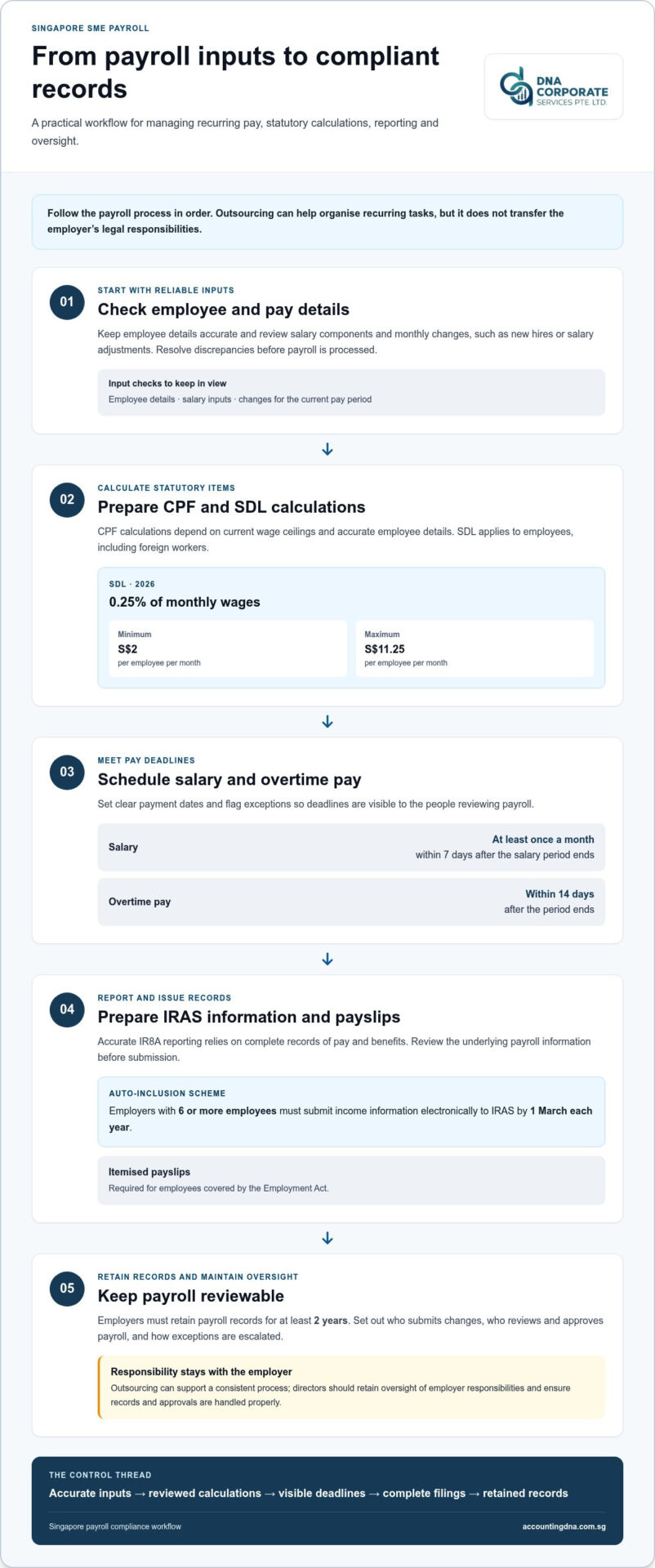
Payroll compliance in Singapore involves more than paying salaries on time. Employers must follow the Employment Act, calculate CPF contributions and Skills Development Levy (SDL), and meet IRAS reporting requirements. Outsourcing can bring these recurring tasks into a consistent process, but it does not transfer the employer’s legal responsibilities. Directors should retain oversight and ensure payroll records and approvals are handled properly.
For example, salaries must generally be paid at least once a month and within seven days after the salary period ends. Overtime pay has a separate deadline: within 14 days after the period ends. A payroll provider can schedule these steps and flag exceptions, helping reduce the risk that a busy finance team overlooks a deadline.
CPF calculations require current wage ceilings and accurate employee details. SDL applies to employees, including foreign workers. In 2026, SDL is 0.25% of monthly wages, subject to a minimum of S$2 and a maximum of S$11.25 per employee per month. Outsourced payroll benefits include structured calculations and payment preparation, not immunity from errors or penalties. A general overview of Understanding Outsourcing also illustrates why delegating a function still calls for clear controls.
Navigating Statutory Reporting: From IR8A to Itemised Payslips
IR8A reporting depends on complete and accurate records of pay and benefits. Employers with six or more employees must submit income information electronically to IRAS by 1 March each year under the Auto-Inclusion Scheme. Itemised payslips are required for employees covered by the Employment Act. A consistent payroll process can help keep these records in order, but the underlying information still needs to be reviewed. Employers must retain payroll records for at least two years. This is separate from ACRA’s requirements for accounting records.
Operational Efficiency and the Real ROI of Outsourcing
For a Singapore SME director, payroll costs more than the monthly processing fee. It also takes time to check salary inputs, correct records and maintain software and processes as requirements change. If a founder spends 10 to 15 hours a month on manual payroll tasks, that is time not spent on client development, hiring or growth planning. Outsourcing can return some of that capacity, although the actual value depends on how your team uses the time saved.
As headcount grows, payroll workload usually changes too. Outsourcing gives an SME access to an established processing function without necessarily hiring a dedicated payroll employee. GovTech’s Singapore’s One-Stop Payroll Initiative also reflects local efforts to streamline payroll-related submissions.
Beyond the Service Fee: The Hidden Costs of In-House Payroll
In-house payroll can involve software subscriptions, staff training and time spent adjusting workflows when requirements change. Consider the full cost, not just the licence: who checks calculations, manages exceptions and maintains continuity when the payroll lead is away? Comparing these demands with payroll service pricing can help you assess the options. The right approach depends on your headcount, payroll complexity and internal capacity. For a discussion of your requirements, speak with the team.
Choosing a Local Partner: Why Boutique Expertise Matters
Payroll software can calculate figures, but Singapore SMEs also need processes that fit local reporting requirements and business records. A partner familiar with IRAS reporting and ACRA requirements can help connect payroll information with the wider compliance picture. This gives your team more context than a software output alone, and a point of contact for discussing exceptions. That practical support is one of the outsourced payroll benefits to weigh when comparing a provider with a software-only approach.
Integration matters. Payroll figures feed into business expenses and financial reports, while employee income data is relevant to annual IRAS reporting. When payroll, accounting and tax processes work together, directors can review staffing costs alongside the company’s wider financial position. DNA Accounting provides payroll and accounting support for Singapore SMEs.
Look for clear responsibilities, reporting schedules and an accessible point of contact during important filing periods. A direct working relationship can make it easier to discuss your company’s processes and resolve exceptions than relying on generic software prompts alone.
A Seamless Transition to Outsourced Payroll
A careful handover starts with accurate records and clear routines. Use these steps to prepare:
- Review employee records. Check current staff details, salary components and historical CPF contributions. Resolve discrepancies before the first outsourced payroll cycle.
- Agree on communication and reporting. Set out how monthly changes, such as new hires or salary adjustments, will be submitted, reviewed and approved.
- Clarify support and oversight. Establish who handles questions, who approves payroll and how exceptions are escalated. A consistent adviser can explain compliance considerations, while directors retain oversight of their responsibilities.
Make Payroll a Stronger Foundation for Growth
Start by assessing whether your current payroll process can keep pace as your Singapore business changes. The right support should fit your team’s needs, connect payroll with wider financial administration and give you a clear point of contact when questions arise. Outsourcing works best when the arrangement reflects your business’s payroll needs rather than applying a one-size-fits-all process.
DNA Accounting provides payroll services alongside accounting, tax and corporate support for Singapore SMEs and startups. A more structured payroll process can help your team manage recurring administrative work and focus on planning ahead.
Contact DNA Accounting to discuss payroll support for your business.
Frequently Asked Questions
Is it safe to share my employees’ sensitive data with an outsourced payroll provider in Singapore?
It can be managed responsibly, but no arrangement removes data-security risk. Before transferring records, establish who can access salary and identification details, how files will be shared, how long information will be retained and how suspected breaches will be escalated. Employers should also understand their obligations under Singapore’s Personal Data Protection Act and document the provider’s responsibilities for handling employee information.
Will I lose control over my payroll process if I outsource it to a firm?
No. Your company can retain approval authority while delegating calculations and administration. For example, managers can submit approved overtime and leave changes, then review the payroll register before salaries are released. Set clear cut-off dates and name the staff member who approves adjustments. These controls let you benefit from outsourcing while keeping visibility over decisions that affect employees’ pay.
How does an outsourced provider handle CPF contributions and SDL for foreign employees?
It depends on the employee’s status. CPF generally applies to Singapore Citizens and Permanent Residents, while foreign employees on work passes are not subject to CPF contributions. SDL applies to employees, including foreign workers. A provider can use employee status and wage details to prepare the relevant calculations, while your business supplies accurate records and reviews exceptions such as a change in residency status.
What happens if there is a mistake in the payroll, who is responsible for the IRAS penalty?
Outsourcing does not automatically transfer the employer’s statutory responsibility to the payroll firm. If income information submitted to IRAS is wrong or late, the employer should promptly establish what caused the error, correct the submission where required and address any IRAS notice. The service agreement may set out how the provider supports corrections, but directors should retain oversight of payroll data and filings.
Disclaimer
The information provided on this website is for general informational purposes only and is not intended to constitute professional accounting, tax, legal, or financial advice. While we strive to ensure that the content is accurate and up to date, regulations in Singapore, including those administered by ACRA, IRAS, CPF Board, and MOM, may change from time to time and may differ depending on individual circumstances.
Readers should not act or rely on any information contained on this website without seeking specific advice from a qualified professional based on their individual situation.
DNA Corporate Services and its affiliates accept no responsibility or liability for any loss or damage arising from reliance on the information provided in this website or any linked materials.
For tailored advice relating to accounting, taxation, corporate secretarial, or compliance matters in Singapore, please contact us directly for professional consultation.



