

Did you know that over 7,100 new business entities were formed in Singapore in June 2026 alone? While receiving your BizFile is an exciting milestone, it often marks the beginning of a complex administrative journey. Many founders quickly realize that knowing exactly what to do after incorporating a company in Singapore is the difference between a smooth launch and facing a S$600 penalty for a missed ACRA filing. It’s natural to feel some trepidation about selecting your Financial Year End or setting up a corporate bank account as a foreign director.
We understand that you’d rather focus on growth than getting lost in the fine print of IRAS requirements. This roadmap is designed to give you total peace of mind by breaking down every statutory obligation and tax saving opportunity available this year. You’ll learn how to master your post-incorporation steps to ensure your startup remains compliant and tax efficient from the very start. We will walk you through a prioritized checklist that covers essential appointments, the latest 2026 CPF contribution rates, and how to structure your business to be operationally ready from day one.
Key Takeaways
- Learn exactly what to do after incorporating a company in Singapore to ensure you meet ACRA’s mandatory six-month deadline for appointing a resident Company Secretary.
- Discover how strategically selecting your Financial Year End (FYE) can maximize your eligibility for the Start-up Tax Exemption (SUTE) scheme and improve cash flow.
- Understand how to transition from manual spreadsheets to cloud-based accounting for real-time visibility and seamless IRAS tax compliance in 2026.
- Identify industry-specific licensing requirements and set up your CPF employer account correctly to avoid operational delays or legal friction.
- Get a prioritized checklist of statutory deadlines to protect your company from late filing fees while you focus on scaling your business.
Immediate Administrative and Statutory Requirements
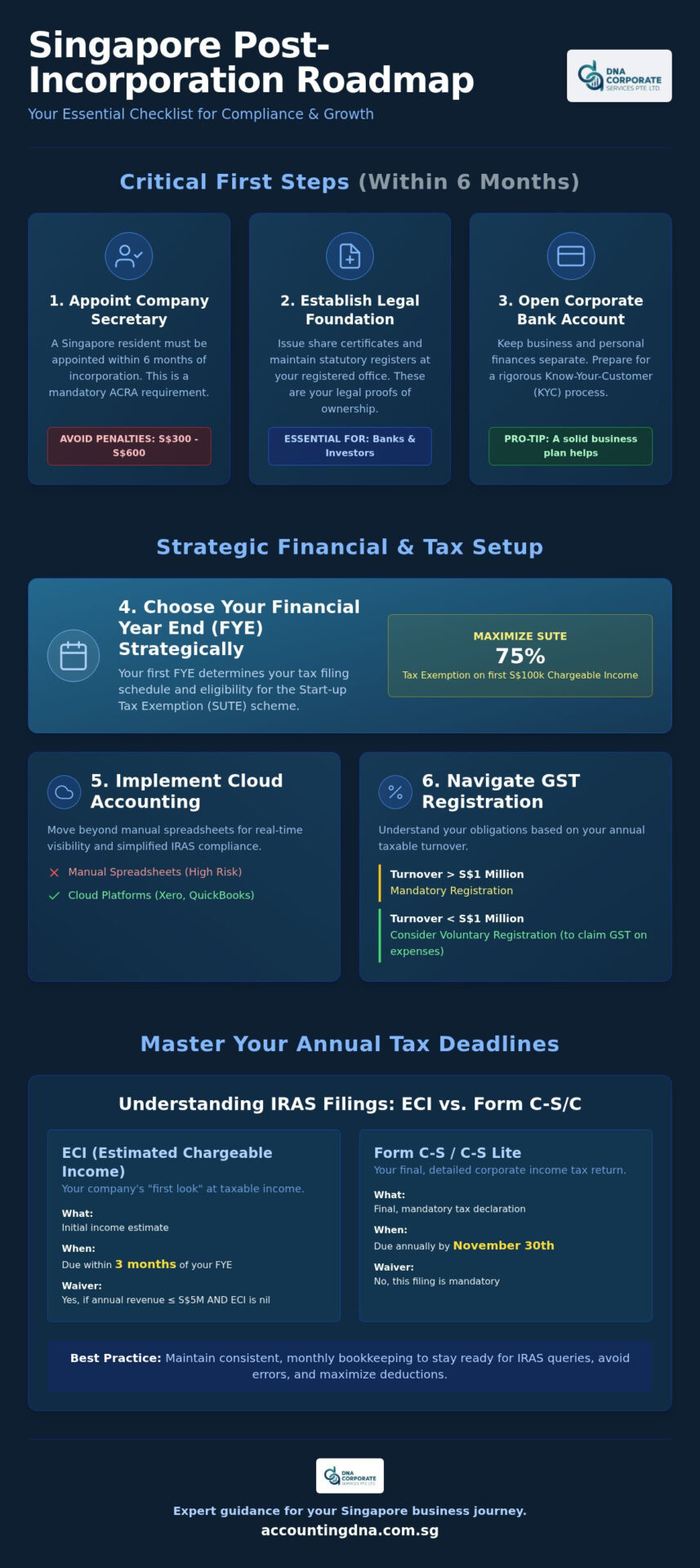
You’ve received your Unique Entity Number (UEN) from ACRA. Now, the real work begins. One of the first things to consider when figuring out what to do after incorporating a company in Singapore is establishing your legal and administrative foundation. This involves more than just a digital record. You must issue physical or digital share certificates to your shareholders and maintain statutory registers at your registered office. These documents provide the legal proof of ownership that banks and investors will demand during due diligence.
Next, you’ll need to open a corporate bank account. In 2026, Singaporean banks have refined their KYC (Know Your Customer) processes to be more rigorous yet digital-friendly. For foreign directors, this often requires a physical meeting or a high standard of notarized documentation. Having a clear business plan and proof of potential local clients can significantly expedite this process. It’s a vital step to keep your personal and business finances separate from day one.
The Strategic Choice of Your Financial Year End
Choosing your Financial Year End (FYE) isn’t a random decision; it’s a strategic move. Your first financial period determines when your tax filing begins and how you access the Start-up Tax Exemption (SUTE) scheme. If you incorporate on July 1, 2026, setting an FYE of June 30, 2027, maximizes your first “year” of operations. This allows you to fully utilize the 75% tax exemption on your first S$100,000 of chargeable income across three full Years of Assessment. You should also consider aligning your FYE with your business cycle or the reporting dates of a parent company to simplify future consolidation.
Corporate Secretarial Obligations
ACRA mandates that every company must appoint a qualified Company Secretary within six months of incorporation. This person must be a Singapore resident. Relying on professional corporate secretarial services ensures your company stays in “good standing” by managing your annual returns and board resolutions. A professional secretary acts as your protective guide, preventing the common filing errors that lead to late penalties. These fines start at S$300 and can escalate to S$600 if you’re more than three months overdue, making early compliance a cost-saving necessity.
Building Your Financial and Tax Infrastructure
Setting up your financial engine is the next vital step in deciding what to do after incorporating a company in Singapore. In 2026, relying on manual spreadsheets is a risk you don’t need to take. Transitioning to cloud accounting platforms like Xero or QuickBooks gives you real-time visibility into your cash flow and makes IRAS compliance far simpler. It’s about building a scalable system that grows with your business while ensuring your records are audit-ready at all times.
You also need to navigate the GST landscape carefully. Mandatory registration is required if your annual taxable turnover exceeds S$1 million. However, many startups choose voluntary registration to claim back GST on their business expenses, such as office rentals or equipment purchases. This is a nuanced decision that affects your pricing and bottom line. You can explore our corporate tax and GST filing services to stay ahead of these IRAS deadlines and ensure your registration strategy aligns with your growth plans.
ECI vs. Form C-S/C: Knowing the Difference
Confusion often arises between Estimated Chargeable Income (ECI) and the final tax return. Think of ECI as your “first look” at taxable income, which is due within three months of your Financial Year End. If your company has an annual revenue of S$5 million or less and a nil ECI, you are exempt from filing this. The final tax return, usually Form C-S or C-S Lite for smaller companies, is a separate requirement due by November 30 each year. Missing these distinct windows can lead to unnecessary friction with tax authorities.
The Importance of Early Bookkeeping
Why wait until the end of the year to sort through a mountain of receipts? Scrambling to fix the books during tax season leads to errors, missed deductions, and higher service costs. Maintaining monthly records ensures you never miss a deadline and stay ready for any potential IRAS queries. Our bookkeeping and accounting services provide the stress-free management you need to stay focused on your core business. If you’re unsure how these requirements apply to your specific industry, feel free to reach out for a quick chat about your setup.
Operational Readiness and Ongoing Governance
Once your financial systems are in place, your focus shifts to the daily mechanics of running your business. A common question regarding what to do after incorporating a company in Singapore is whether you can start trading immediately. For many, the answer depends on industry-specific licenses. If you’re opening a restaurant, a travel agency, or an employment firm, you must secure approval through the GoBusiness portal before your first transaction. Operating without the correct permit can lead to heavy fines or even the forced closure of your new venture.
Maintaining your company’s legal health also requires marking your calendar for the “big two” ACRA deadlines: the Annual General Meeting (AGM) and the Annual Return. For a private company, you must hold your AGM within six months of your Financial Year End. Your Annual Return is then due within seven months of the FYE. Don’t forget that your Registered Office Address isn’t just a mailing point; it’s the legal home for your statutory books. This includes registers of directors, shareholders, and registrable controllers, which must be available for potential ACRA inspections.
Hiring Your First Employee in Singapore
Growing your team is a proud moment, but it brings new compliance layers. You’ll need to set up an employer account with the Central Provident Fund (CPF) Board. For 2026, keep in mind that the Ordinary Wage ceiling is capped at the first S$8,000 of monthly wages. You’re also responsible for the Skills Development Levy (SDL) for all employees. Accurate payroll records are non-negotiable under Ministry of Manpower (MOM) standards. They protect you during disputes and ensure your staff are paid correctly and on time.
Staying Compliant: The Master Guide
Understanding these moving parts is essential for long-term success. For a deeper dive into the technical nuances of local regulations, read The Master Guide to Statutory Compliance in Singapore (2026 Edition). While the rules may seem daunting, you don’t have to face them alone. At DNA Accounting, we believe in providing the bespoke care that larger, more distant firms often miss. We act as your protective partner, offering the accessibility you need to ensure your business remains 100% compliant and ready for growth.
Securing Your Startup’s Future in 2026
We know that the journey of an entrepreneur doesn’t always fit into a nine-to-five schedule. That’s why our ACRA-certified advisors offer after-hours and weekend availability to suit your busy timeline. Whether you need help with corporate secretarial duties or are looking for comprehensive SME pricing packages for your monthly bookkeeping, we’re here to act as your protective partner in this complex environment.
Ready to clear the compliance path for your business? Get a Personalized Post-Incorporation Consultation with DNA Accounting and let us handle the paperwork while you focus on your vision. Your success is our singular priority, and we’re excited to help your business thrive.
Frequently Asked Questions
Can I change my Financial Year End (FYE) after incorporation?
Yes, you can change your Financial Year End through the BizFile+ portal. However, you must notify ACRA before your current filing deadlines for the Annual General Meeting or Annual Return pass. If the change results in a financial period exceeding 18 months, or if you’ve changed your FYE within the last five years, you’ll need specific approval from ACRA. It’s a common step for those refining what to do after incorporating a company in Singapore to better align with business cycles.
How soon must I appoint a company secretary in Singapore?
You must appoint a qualified company secretary within six months of your incorporation date. This person must be a natural person and a resident of Singapore. The role is vital for maintaining your statutory registers and ensuring you meet all ACRA filing deadlines. Missing this window is a breach of the Companies Act; therefore, we recommend securing this appointment early to maintain your company’s good standing and avoid unnecessary friction with regulators.
Is it mandatory to appoint an auditor for a new startup?
Most new startups are exempt from appointing an auditor if they qualify as a “small company” for the financial year. To meet this exemption, your company must fulfill at least two of these three criteria: annual revenue not exceeding S$10 million, total assets not exceeding S$10 million, or having fewer than 50 employees. This exemption significantly reduces administrative costs for early-stage SMEs, allowing you to reinvest those savings into your core business operations.
What are the penalties for late filing with ACRA and IRAS in 2026?
In 2026, ACRA imposes a S$300 penalty for annual returns filed within three months after the deadline, which doubles to S$600 for longer delays. IRAS penalties for late tax returns can be more severe, often starting with a composition fee and potentially reaching S$5,000 per offense. Beyond financial costs, directors may face court summons or disqualification for persistent non-compliance. Following a clear roadmap of what to do after incorporating a company in Singapore is the best way to protect your reputation.
Do I need to register for GST immediately after incorporation?
You don’t need to register for GST immediately unless your annual taxable turnover is expected to exceed S$1 million. This is known as compulsory registration. However, you can choose to register voluntarily if it benefits your business to claim back GST on input costs, such as equipment or professional fees. This decision requires careful thought about your customer base, as voluntary registration commits you to staying in the GST system for at least two years.
What is the “Common Seal” and do I still need one?
A common seal is a metal stamp used to execute documents as a deed, but it’s no longer mandatory for Singapore companies. Since March 2017, companies can execute documents by having them signed by two directors, or one director and the company secretary. While some older institutions or overseas partners might still ask for a seal, most modern businesses find that authorized signatures are legally sufficient for all banking and contractual requirements.
Disclaimer
The information provided on this website is for general informational purposes only and is not intended to constitute professional accounting, tax, legal, or financial advice. While we strive to ensure that the content is accurate and up to date, regulations in Singapore, including those administered by ACRA, IRAS, CPF Board, and MOM, may change from time to time and may differ depending on individual circumstances.
Readers should not act or rely on any information contained on this website without seeking specific advice from a qualified professional based on their individual situation.
DNA Corporate Services and its affiliates accept no responsibility or liability for any loss or damage arising from reliance on the information provided in this website or any linked materials.
For tailored advice relating to accounting, taxation, corporate secretarial, or compliance matters in Singapore, please contact us directly for professional consultation.



