

Why does it feel like you’re paying for simple data entry when what you actually need is a shield against ACRA penalties? For many SME owners, the real cost of managing your own accounts isn’t just the software subscription; it’s the late nights spent wrestling with spreadsheets and the constant worry that a GST reporting error might trigger an IRAS audit. Understanding current bookkeeping fees Singapore shouldn’t feel like a guessing game, especially when you’re trying to scale a business in a fast-moving economy.
It’s true that the administrative burden on Singapore companies is heavier than ever with the 9% GST rate and the mandatory shift toward digital systems like InvoiceNow. You likely want to focus on your customers rather than worrying about whether your annual return is filed correctly. This guide provides a clear roadmap to help you navigate fee structures and find a partner who offers more than just numbers on a page. We’ll explore how transaction volumes impact your costs and how to choose a service that provides reliable compliance and the bespoke care you deserve, specifically from a partner who stays available during evenings and weekends when you actually have time to talk.
Key Takeaways
- Identify the core drivers of your monthly costs, from transaction volumes to the complexities of quarterly GST reporting for IRAS.
- Compare the benefits of monthly retainers versus annual filings to determine the most cost-effective compliance strategy for your current business stage.
- Gain a clear understanding of 2026 bookkeeping fees Singapore to help you budget for professional support that scales with your company’s growth.
- Discover how boutique firms provide superior value through bespoke care and unique accessibility during evenings and weekends when you actually have time to focus.
What Influences Bookkeeping Fees in Singapore?
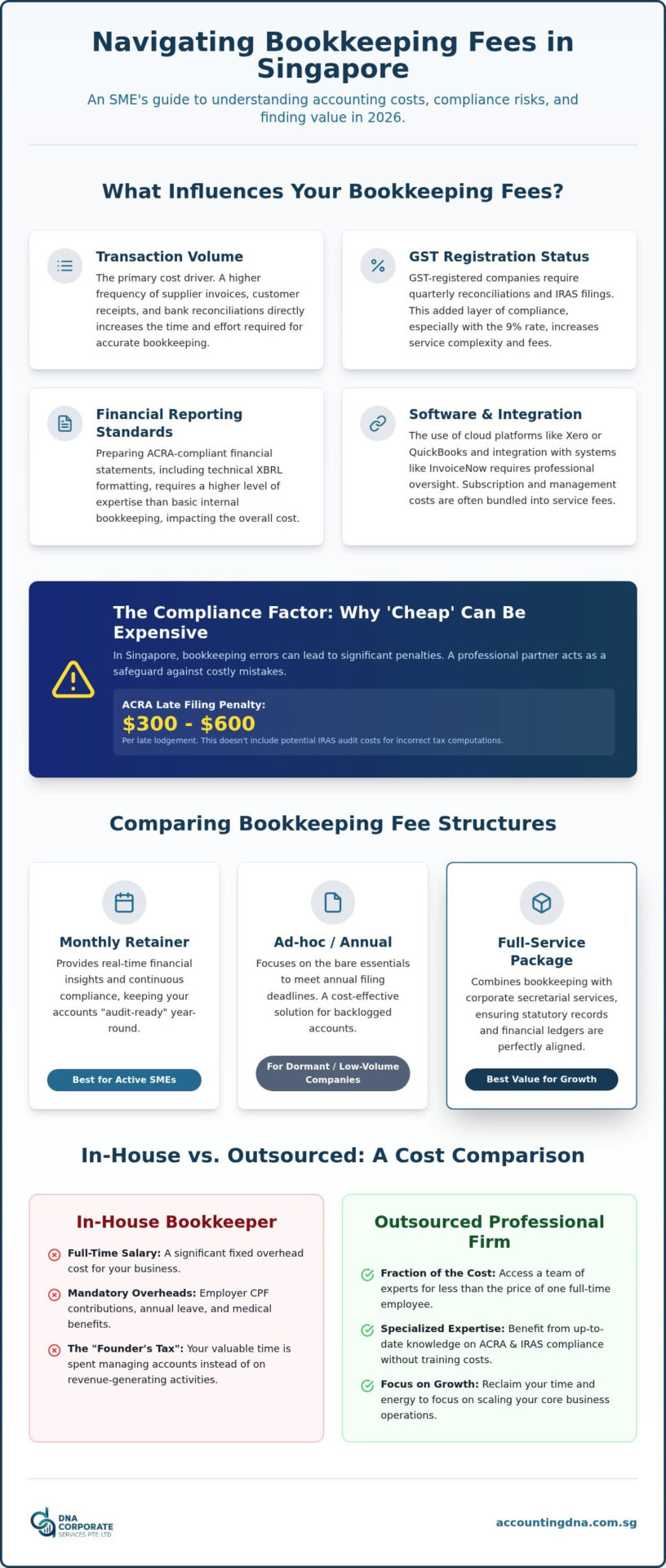
Understanding why bookkeeping fees Singapore vary so widely is the first step in budgeting for your company’s back-office needs. Fees aren’t plucked from thin air; they’re calculated based on the complexity and time required to keep your business in the good books of ACRA and IRAS. Several core factors dictate the monthly or annual investment you’ll need to make.
- Transaction Volume: This is the most direct driver of cost. A high frequency of supplier invoices, customer receipts, and bank transactions naturally increases the manual labor required for data entry and reconciliation. If your business processes hundreds of transactions a month, your bookkeeper spends more time ensuring every cent is accounted for.
- GST Registration Status: Since the GST rate reached 9% in 2024, the stakes for compliance have never been higher. If your business is GST-registered, your bookkeeper must perform quarterly reconciliations and filings. This added layer of IRAS reporting complexity typically increases service fees compared to non-registered entities.
- Financial Reporting Standards: There’s a significant difference between maintaining a basic general ledger for internal tracking and preparing a full set of ACRA-compliant financial statements. If your company requires audited accounts or specific disclosures for shareholders, the level of expertise needed—and the resulting fee—will rise.
- Software Integration: Modern cloud platforms like Xero or QuickBooks are the standard in 2026. While these tools automate some data entry, they require professional oversight to manage integrations like InvoiceNow. The cost of the software subscription is often bundled into your service package.
By identifying where your business sits on this spectrum, you can better evaluate pricing structures that align with your actual operational needs rather than paying for a one-size-fits-all solution.
The Compliance Factor: ACRA and IRAS Requirements
In Singapore, “cheap” bookkeeping can become incredibly expensive if it leads to compliance gaps. ACRA requires most companies to file their financial statements in XBRL format, a technical process that demands specific software and expertise. Skipping these details or filing late can result in statutory penalties ranging from $300 to $600 per late lodgment. A professional partner ensures your tax computations are accurate and your deadlines are met, acting as a safeguard for your company’s reputation and your wallet.
Comparing Bookkeeping Fee Structures in 2026
How do you decide which pricing model fits your current business stage without overpaying? In Singapore, fee structures generally fall into three categories. Choosing the right one depends on how often you need to see your financial data and how close you are to your next IRAS or ACRA deadline.
- Monthly Retainer: This is the gold standard for active SMEs. It provides real-time financial insights and steady compliance support. You won’t have to worry about a massive cleanup job at the end of the year because your accounts stay “audit-ready” every month.
- Ad-hoc or Annual Bookkeeping: This structure is often suitable for dormant companies or startups with very low transaction volumes. It focuses on the bare essentials needed to meet annual filing requirements.
- Full-Service Packages: Many businesses find the best value by combining bookkeeping with corporate secretarial services. Having a single partner manage your board resolutions and your ledgers ensures your statutory records stay perfectly aligned.
When reviewing quotes, keep a sharp eye out for hidden costs. Some providers may offer a low base rate but then add markups on software subscriptions or charge “per-consultation” fees for every phone call. Transparent bookkeeping fees Singapore should be clearly defined so you can budget with confidence.
Internal vs. Outsourced Bookkeeping Costs
Hiring a full-time in-house bookkeeper involves significant overhead. Beyond the basic salary, you’re responsible for employer CPF contributions, annual leave, and medical benefits. For most SMEs, outsourcing to a professional firm provides access to a team of experts for a fraction of that cost. Don’t forget the “founder’s tax” either. Every hour you spend wrestling with a spreadsheet is an hour you aren’t spending on revenue-generating activities. If you’re tired of doing the heavy lifting yourself, it might be time to explore a more efficient way to handle your accounts.
Maximizing ROI: Why Boutique Firms Offer Better Value
Choosing a partner for your accounts isn’t just about finding the lowest bookkeeping fees Singapore has to offer; it’s about the quality of the relationship. Large firms often operate on a “ticket system” where your queries are handled by whoever is available. In contrast, a boutique firm provides a dedicated advisor who understands the unique “DNA” of your business. This personalized approach means your bookkeeper isn’t just crunching numbers. They’re identifying trends and spotting potential compliance issues before they become IRAS problems.
By keeping your bookkeeping and accounting services under one roof, you eliminate the risk of data silos. When your bookkeeper, tax agent, and corporate secretary work as a single unit, information flows seamlessly. This integration ensures that your ACRA filings, IRAS tax computations, and internal ledgers are always in sync. It provides a scalable foundation that grows with you, from your initial incorporation to complex GST registration and beyond.
Getting a Tailored Quote for Your Business
Every SME has different needs, so a “one-size-fits-all” price rarely provides the best value. Before requesting a quote, prepare a brief summary of your monthly invoice volume, the number of bank accounts you operate, and your current GST status. This allows for a more accurate estimate that reflects your actual workload. We encourage you to view our pricing page for a transparent overview of our service tiers. However, a direct consultation is always the best way to secure a bespoke arrangement that balances your budget with the high-level compliance your business requires.
Secure Your Business Growth with Professional Compliance
Managing your company’s accounts shouldn’t be a source of stress or a distraction from your core mission. As we’ve explored, finding a balance between competitive bookkeeping fees Singapore and high-quality service is essential for long-term stability. Whether you’re navigating the complexities of the 9% GST rate or preparing for ACRA’s annual filing requirements, the right partner acts as a protective shield for your business.
Since 2016, we’ve dedicated ourselves to supporting Singapore SMEs with a boutique, personalized approach that integrates everything from incorporation to tax filing. We understand that your business doesn’t stop at 6 PM; that’s why we offer flexibility with consultations during evenings and weekends to suit your actual schedule. You deserve a partner who is as invested in your growth as you are.
Ready to stop worrying about the fine print and start focusing on your next big move? Get a Transparent, Bespoke Quote for Your Bookkeeping Needs today. Let’s work together to build a solid financial foundation for your company’s future.
Frequently Asked Questions
How much are the average monthly bookkeeping fees for a Singapore SME?
Average monthly bookkeeping fees Singapore depend primarily on your transaction volume and the complexity of your business model. Most providers offer tiered pricing based on the number of bank statement pages or invoices processed each month. While entry-level packages exist for startups with minimal activity, active SMEs should budget for a structure that reflects their actual operational scale and compliance needs.
Does the bookkeeping fee include corporate tax and GST filing?
Standard bookkeeping focuses on maintaining your general ledger and reconciling bank statements, but it doesn’t automatically include corporate tax or GST filing. These are specialized statutory requirements that involve technical submissions to IRAS. Most business owners find it more efficient to opt for a comprehensive package that bundles these services, ensuring all tax computations and filings are handled by the same team.
Is it cheaper to hire a freelance bookkeeper or an accounting firm in Singapore?
Hiring a firm is often the more reliable choice for growing businesses compared to a freelancer. While a freelancer might seem cheaper initially, they lack the team support and continuity that a professional firm provides. Boutique firms offer a centralized service model where your bookkeeping, tax, and secretarial needs are integrated, giving you a dedicated partner who is available even during evenings or weekends.
What happens to my bookkeeping fees if my company becomes GST-registered?
Becoming GST-registered increases the complexity and frequency of your financial reporting. Your bookkeeper must transition from basic data entry to performing detailed quarterly reconciliations for the 9% GST rate and filing F5 returns with IRAS. Because this requires more frequent professional oversight and technical verification, you can expect your bookkeeping fees Singapore to increase to reflect the added compliance workload.
Disclaimer
The information provided on this website is for general informational purposes only and is not intended to constitute professional accounting, tax, legal, or financial advice. While we strive to ensure that the content is accurate and up to date, regulations in Singapore, including those administered by ACRA, IRAS, CPF Board, and MOM, may change from time to time and may differ depending on individual circumstances.
Readers should not act or rely on any information contained on this website without seeking specific advice from a qualified professional based on their individual situation.
DNA Corporate Services and its affiliates accept no responsibility or liability for any loss or damage arising from reliance on the information provided in this website or any linked materials.
For tailored advice relating to accounting, taxation, corporate secretarial, or compliance matters in Singapore, please contact us directly for professional consultation.



