

What does a company secretary do for a Singapore SME? The role goes well beyond administration. A company must appoint a secretary within six months of incorporation, and a private company generally has seven months after its financial year-end to file its Annual Return with ACRA.
The Companies Act and statutory registers can be difficult to manage when you’re focused on running your business. This guide explains the secretary’s core duties, including maintaining company records, coordinating meetings and managing ACRA filings. You’ll also learn where directors remain responsible, how compliance oversights can lead to penalties, and how corporate secretarial support can help your business keep its obligations on track.
Key Takeaways
- Understand what does a company secretary do under Singapore’s Companies Act, and why the role involves more than routine administration.
- Learn which statutory registers a company needs to maintain and how accurate records support ACRA compliance.
- See how well-prepared AGM documentation and board resolutions help keep important company decisions on record.
- Find out how to manage company detail changes within ACRA’s 14-day filing window and reduce the risk of compliance oversights.
Understanding the Role: Why Every Singapore Company Needs a Secretary
For a Singapore company, the company secretary is a statutory officer, not simply an administrator. Section 171 of the Companies Act 1967 requires each company to appoint a secretary within six months of incorporation. The position must not remain vacant for more than six months. In practical terms, what does a company secretary do? They help translate legal obligations into timely filings, accurate company records and properly documented decisions.
The secretary also helps connect the company, its directors and ACRA. They can guide directors on corporate filing requirements and help keep statutory information in order. The broader role of a company secretary includes supporting good corporate governance, while Singapore’s Companies Act sets the local obligations.
Legal Requirements and Director Responsibilities
A company secretary must be a natural person ordinarily resident in Singapore. For a private company, the directors must ensure the appointee has the necessary knowledge and experience; the law does not prescribe a specific professional qualification. The sole director cannot also serve as the company secretary, so a one-director SME must appoint another eligible person.
A company secretary helps a Singapore company manage its Companies Act obligations, but the directors remain legally responsible for the company’s compliance. The secretary can manage filings and provide compliance support, but appointing one does not transfer the directors’ legal responsibility. Directors should provide the necessary information and make decisions promptly when requirements arise, rather than assuming every filing can be completed without their input.
This shared responsibility makes an active, knowledgeable secretary valuable. Professional corporate secretarial services can help directors keep obligations visible and organise the required steps, while leaving key decisions and accountability with the company’s directors.
Core Responsibilities: From ACRA Filings to Statutory Records
Between incorporation and the next annual filing, what does a company secretary do? They help keep statutory information current and corporate decisions properly recorded. This includes maintaining registers of members, directors and registrable controllers, updating them when details change, and handling required submissions through ACRA’s BizFile+ portal. For example, if shareholders change or the company issues shares, the company’s records and filings should reflect the change accurately.
The secretary also coordinates AGM and board documentation, including notices, papers, minutes and written resolutions. These records provide a clear account of decisions, such as approving financial statements or appointing a director. If the company keeps a common seal, it should arrange for secure custody of the seal and important corporate documents. A physical common seal is no longer legally mandatory in Singapore.
- Track changes to directors, registered office details and share capital, and identify the relevant ACRA filing.
- Update statutory records so they match the company’s current ownership and officer information.
- Keep meeting and resolution documents organised and accessible for future reference.
Navigating Annual Returns and Compliance Deadlines
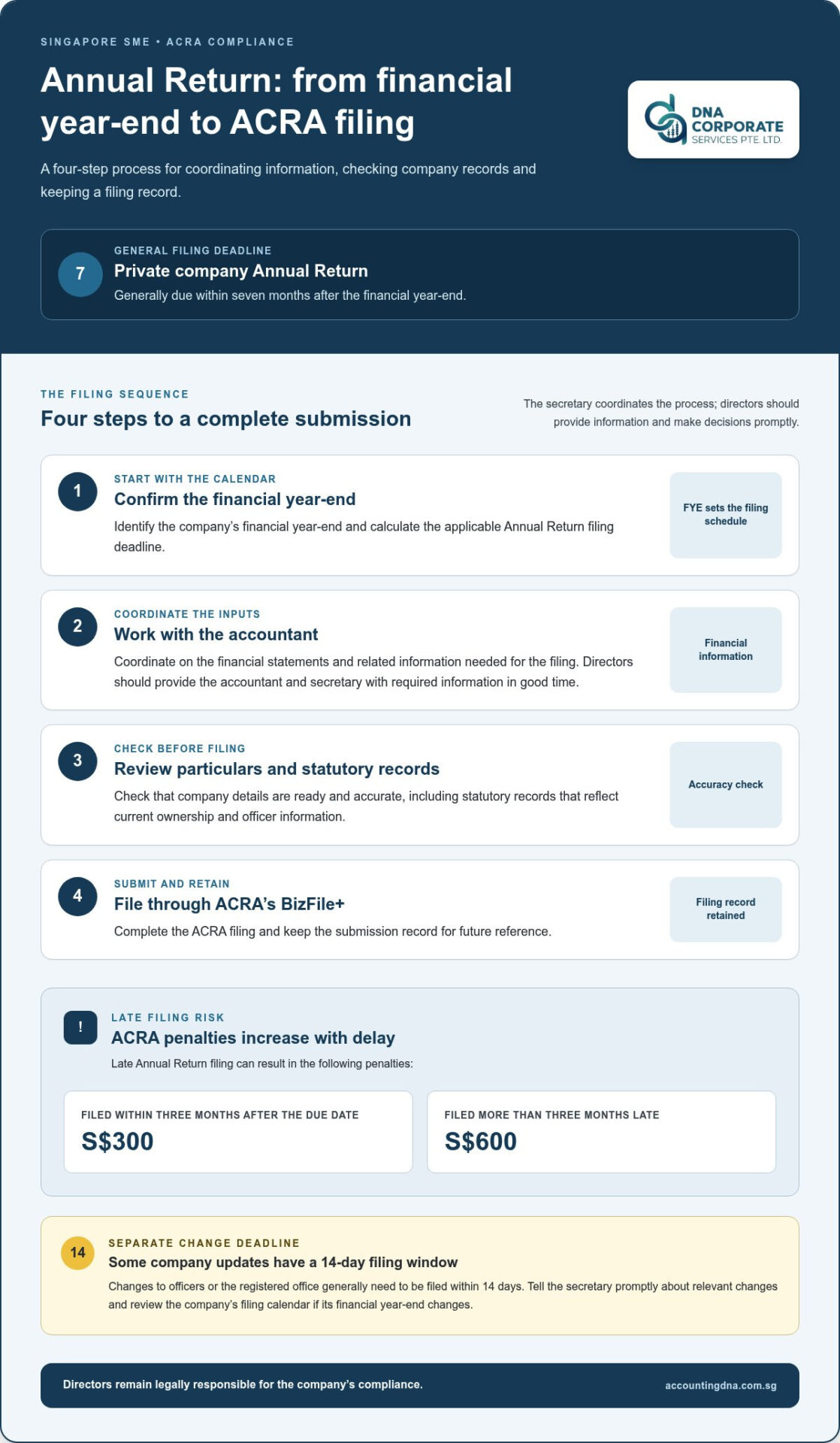
For a private company, the Annual Return is generally due within seven months after its financial year-end. A secretary can coordinate with the accountant to obtain the financial information needed, check that company details are ready and submit the return through BizFile+. Directors should provide the accountant and secretary with the information they need in good time.
- Confirm the company’s financial year-end and calculate the applicable filing deadline.
- Coordinate with the accountant on the financial statements and related information.
- Review the company particulars and statutory records for accuracy.
- Complete the ACRA filing and retain the submission record.
Clear coordination helps prevent a last-minute scramble. DNA Accounting provides corporate secretarial support to help Singapore companies organise records and filings. The company’s accounting services can also support coordination around the financial information used for reporting. Learn more about our services.
The Strategic Value of Professional Secretarial Services for SMEs
Consider a share transfer during a busy trading period. Directors may be focused on approvals and commercial terms, while the secretary coordinates the corporate records and filing steps. During an external audit, organised registers and resolutions can also make it easier to retrieve requested records. The secretary supports preparation, but this does not mean they conduct a statutory audit.
Avoiding ACRA Penalties and Compliance Risks
Don’t assume every ACRA update has a 30-day filing window. Changes to officers or the registered office generally need to be filed within 14 days. A change to the financial year-end should prompt a review of the company’s filing calendar, so the team can confirm which deadlines apply rather than rely on the previous schedule.
- Tell the secretary promptly about director, registered office or shareholding changes.
- Review the company’s financial year-end and upcoming ACRA filing dates.
- Coordinate with the accountant on relevant IRAS tax deadlines, since secretarial and tax responsibilities are related but distinct.
Late Annual Return filing can result in ACRA penalties: S$300 if filed within three months after the due date, or S$600 if filed more than three months late. Professional support can help directors connect company changes with the records, filings and deadlines they affect. For example, a change in officers may require both an update to the company’s records and an ACRA filing. If you’re unsure how a recent change affects your obligations, find out how our team can support your compliance.
Make Compliance a More Confident Part of Your Growth
DNA Accounting provides corporate secretarial support for Singapore startups and SMEs, helping businesses manage ACRA compliance and ongoing statutory duties. Contact DNA Accounting to discuss corporate secretarial support for your company.
With the right support in place, you can focus more confidently on building your business while keeping statutory responsibilities in view.
Frequently Asked Questions
Can a director be the company secretary in Singapore?
Yes, a director may also serve as company secretary if the statutory eligibility rules are met. However, a sole director cannot hold both roles. Before combining the roles in a company with more than one director, decide who will track filing notices, prepare company records and flag upcoming decisions. This helps prevent secretarial tasks from getting lost among operational priorities, particularly in a small business where the same people often handle several responsibilities.
What happens if my company fails to appoint a secretary within 6 months?
If the company leaves the secretary’s office vacant beyond the statutory period, its directors may face a fine of up to S$1,000. Address the gap promptly by arranging an eligible appointment and updating the company’s officer records with ACRA. Keep the appointment documentation and filing confirmation with the company’s records so the change is easy to verify later.
Does a dormant company still need a company secretary?
Yes. A company doesn’t stop having corporate obligations simply because it has paused trading or has no current business activity. For example, if a dormant company remains registered while its owners decide whether to resume operations or wind it down, they should continue to keep its corporate appointments and records in order.
What is the typical cost of corporate secretarial services in Singapore?
Fees vary according to the support a Singapore company needs. Before comparing proposals, identify whether you need ongoing assistance with routine corporate matters or help with events such as a share transfer or director change. Ask for the scope and any transaction-based charges to be set out clearly, so you can assess what the service covers against your company’s needs.
Disclaimer
The information provided on this website is for general informational purposes only and is not intended to constitute professional accounting, tax, legal, or financial advice. While we strive to ensure that the content is accurate and up to date, regulations in Singapore, including those administered by ACRA, IRAS, CPF Board, and MOM, may change from time to time and may differ depending on individual circumstances.
Readers should not act or rely on any information contained on this website without seeking specific advice from a qualified professional based on their individual situation.
DNA Corporate Services and its affiliates accept no responsibility or liability for any loss or damage arising from reliance on the information provided in this website or any linked materials.
For tailored advice relating to accounting, taxation, corporate secretarial, or compliance matters in Singapore, please contact us directly for professional consultation.



