

Did you know that a simple administrative oversight could now lead to a $20,000 fine or even a 12-month prison sentence under the latest 2026 regulatory amendments? It’s completely normal to feel overwhelmed by the volume of statutory paperwork and the fear of an unexpected ACRA penalty landing on your desk. You’ve worked hard to build your business, and the last thing you need is the stress of complex compliance requirements pulling your focus away from growth.
We understand that navigating the Companies Act can feel like a full-time job in itself. This guide simplifies the essential corporate secretary duties Singapore requires, showing you exactly how these responsibilities safeguard your company from heavy penalties and director disqualification. We’ll walk you through the 2026 compliance landscape, covering everything from mandatory digital registers to the critical filing deadlines that maintain your company’s good standing. By the end, you’ll have a clear roadmap to manage ACRA’s requirements with total confidence, giving you the peace of mind to lead your business without looking over your shoulder.
Key Takeaways
- Understand the mandatory six-month window for appointing a secretary to ensure your company stays in good standing with ACRA from day one.
- Explore the core corporate secretary duties Singapore directors must oversee, including the maintenance of mandatory digital registers and statutory record-keeping.
- Learn how structured board meeting agendas and accurate minute-taking provide a vital legal shield for your corporate decisions and director liabilities.
- See why outsourcing compliance tasks is a cost-effective strategy that shields your SME from “compliance creep” and heavy late filing penalties.
- Discover the strategic value of a secretary who acts as a protective partner, helping you navigate the stricter 2026 regulatory landscape with total confidence.
Statutory Compliance: The Mandatory Corporate Secretary Duties in Singapore
Under the Companies Act 1967, every company must appoint a qualified individual to oversee their legal obligations. This isn’t just an administrative suggestion; it’s a legal requirement. A Company Secretary is a named officer responsible for ensuring your business stays on the right side of the law. If you’ve just incorporated, you must fill this role within six months. Leaving this position vacant for longer than six months is a punishable offense that can lead to heavy fines and legal repercussions for directors.
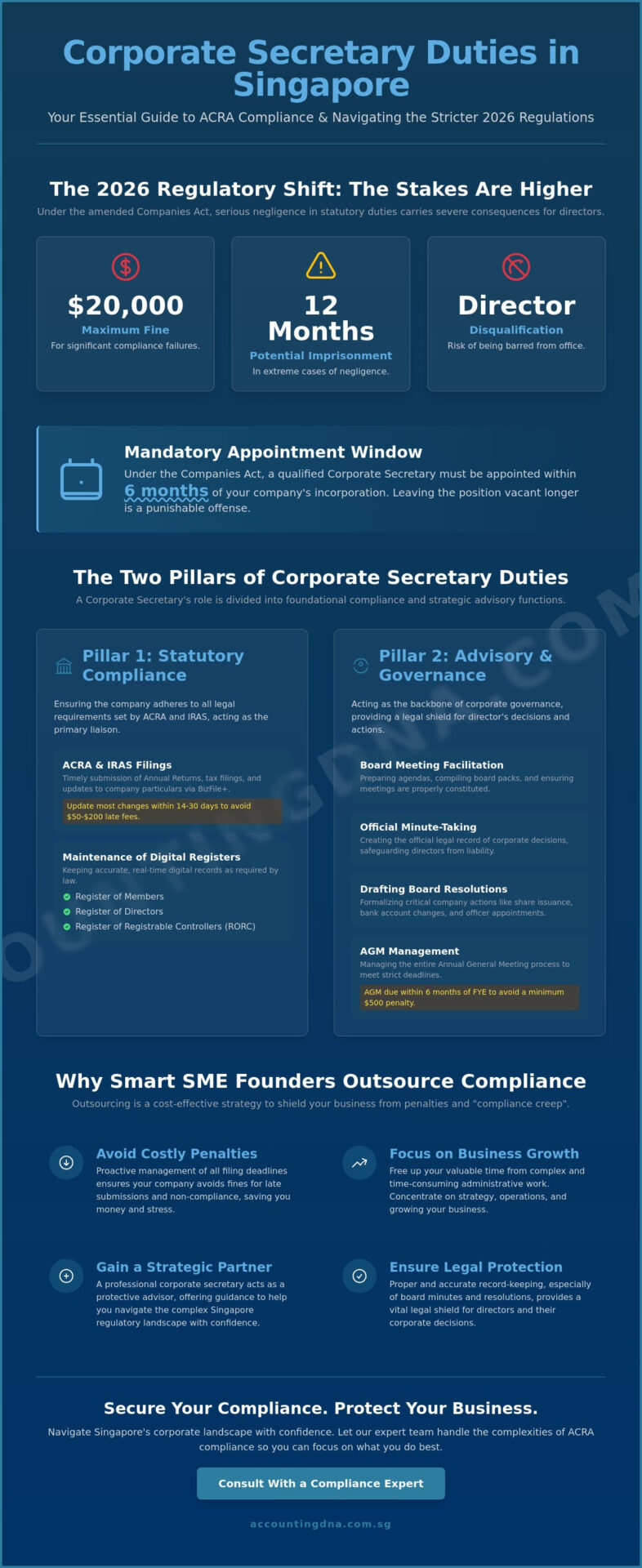
The primary corporate secretary duties Singapore business owners need to know involve acting as the main bridge between your company and the Accounting and Corporate Regulatory Authority (ACRA). Your secretary manages all statutory filings via the BizFile+ portal to keep your company’s profile accurate and updated. This includes the timely submission of Annual Returns, updating changes in company officers, and recording share transfers. With the 2026 Corporate and Accounting Laws (Amendment) Bill now in full effect, the stakes are higher than ever. Serious negligence in these duties can lead to fines of up to $20,000 or even 12 months of imprisonment for directors in extreme cases.
Maintaining Statutory Registers and Records
In 2026, compliance isn’t just about having the right papers; it’s about maintaining accurate digital records. Your secretary must manage the Register of Members, the Register of Directors, and the critical Register of Registrable Controllers (RORC). These aren’t static documents. They must reflect real-time changes to your company structure to avoid ACRA penalties. For a deeper look at how to manage these documents, you can explore our corporate secretarial services. Keeping these registers in a secure, digital format is now the expected standard for Singapore SMEs to ensure transparency and quick retrieval during inspections.
ACRA and IRAS Liaison Responsibilities
Timing is everything when it comes to Singaporean regulations. Most corporate changes, such as a change in registered office address or the appointment of a new director, must be updated on ACRA within 14 or 30 days. Your secretary ensures these windows aren’t missed, preventing the $50 to $200 late filing fees that quickly add up. They also play a vital role in coordinating with your tax agents to ensure that your corporate tax and GST filing align perfectly with the statutory records held by ACRA. This holistic approach prevents discrepancies that often trigger unnecessary audits or queries from IRAS.
Beyond Paperwork: Administrative and Advisory Duties
While filing forms is vital, the true value of a professional lies in how they facilitate your company’s high-level decision-making. Thinking of a secretary as just a “filing clerk” is a common mistake that leaves many directors exposed. In reality, corporate secretary duties Singapore professionals handle involve acting as the backbone of your corporate governance. They ensure every board meeting is properly constituted by drafting clear agendas and preparing comprehensive board packs. This preparation allows you to focus on strategy rather than wondering if the proper notice was sent to all directors in accordance with your company’s Constitution.
When the meeting begins, the secretary’s role as a minute-taker becomes your legal safeguard. These minutes aren’t just notes; they are the official legal record of your corporate decisions. If a director’s action is ever questioned, these records prove the board acted within its authority. Beyond meetings, your secretary drafts formal board resolutions for critical milestones, including:
- Allotment and issuance of new shares to investors
- Opening or closing of corporate bank accounts
- Changes in business activity or registered office address
- Appointment or resignation of company officers
Understanding the full scope of ACRA requirements for a company secretary helps you see them as a protective shield for your business interests. They provide the necessary guidance to ensure that every resolution is technically sound and legally binding.
Managing General Meetings and AGMs
One of the most stressful periods for any SME founder is the Annual General Meeting (AGM) season. For private companies, the AGM must be held within six months of your Financial Year End (FYE). Missing this deadline triggers a minimum composition sum of $500 per breach. Your secretary manages this entire process, from coordinating with shareholders to handling proxy forms and voting procedures for Extraordinary General Meetings (EGMs). Following a structured compliance schedule ensures these deadlines never catch you off guard.
The Secretary as a Strategic Consultant
A seasoned secretary does more than record history; they help you shape it. They act as a strategic consultant when your business reaches a crossroads, such as considering complex corporate restructuring or needing guidance on striking off a company that has served its purpose. They serve as a gatekeeper for ethical standards, ensuring your growth never compromises your corporate integrity. If you’re feeling overwhelmed by these administrative demands, you might find it helpful to speak with a specialist about streamlining your board processes.
Why SME Founders Outsource Corporate Secretary Duties
Managing a business in Singapore is demanding enough without the shadow of ACRA penalties looming over your head. For most SMEs, the most practical solution is to delegate the corporate secretary duties Singapore requires to a specialized firm. This move isn’t just about avoiding paperwork; it’s a strategic decision to mitigate “compliance creep,” where small missed deadlines snowball into heavy fines or even court summons. By outsourcing, you gain immediate access to experts who live and breathes the 2026 regulatory shifts, removing the need for expensive in-house training or full-time salaries.
Delegating these tasks allows you to reclaim your most valuable asset: time. Instead of navigating the complexities of BizFile+ updates or worrying about statutory timelines, you can focus entirely on revenue-generating activities and business growth. It’s about moving from a state of administrative overwhelm to one of total confidence, knowing your corporate foundation is being managed by proactive professionals who act as your protective partners.
The Risks of Non-Compliance
ACRA’s tiered penalty system is designed to discourage delays, and the costs of being late are significant. For example, filing an Annual Return just one day late results in a $300 fine, which doubles to $600 if you exceed the three-month mark. To fully understand the exact timelines, fees, and extension options that apply to your company, it’s worth reviewing the ACRA annual return filing requirements for 2026 so you never miss a critical deadline. A common misconception among founders is that “dormant” companies don’t need a secretary. They absolutely do. Even if your company isn’t currently trading, you’re still required to fulfill statutory obligations. Failing to do so doesn’t just cost money; three technical breaches within five years can lead to ACRA disqualifying you from holding any directorships.
Choosing a Bespoke Secretarial Partner
The most efficient way to manage your business is through a centralized service model. Having your secretary, accounting, and tax needs handled under one roof prevents data silos and ensures your filings are always consistent. Before committing to any provider, it’s worth understanding the cost of corporate secretarial services Singapore firms typically charge, so you can budget accurately and avoid hidden fees. At DNA Accounting, we pride ourselves on being a flexible, boutique partner. We offer the high-level expertise of a large firm with the personalized, warm care your SME deserves. We’re here to make sure you feel secure and understood in this complex regulatory environment.
Ready to streamline your compliance? View our transparent secretarial pricing or contact us for a consultation to see how we can safeguard your business future.
Future-Proof Your Singapore Business Compliance
You’ve seen how the regulatory landscape is shifting in 2026. A secretary isn’t just a name on a form; they’re the guardian of your company’s legal standing. From managing digital registers to navigating strict AGM timelines, the scope of corporate secretary duties Singapore has evolved into a strategic necessity. By centralizing these tasks with a partner who understands the nuances of ACRA, IRAS, and MOM regulations, you eliminate the risk of “compliance creep” and protect your personal directorship status.
Since 2016, we’ve helped Singapore SMEs navigate these complexities with a boutique approach that prioritizes direct access to senior advisors. You don’t have to carry the burden of administrative paperwork alone. Our team provides the bespoke care your business needs to stay agile and fully compliant. Secure your company’s compliance with DNA’s Corporate Secretarial Services and get back to what you do best: growing your business. We’re ready to help you lead with total peace of mind.
Common Questions About Corporate Secretarial Compliance
What are the requirements to be a company secretary in Singapore?
To serve as a company secretary in Singapore, an individual must be a natural person and a resident of the country. For private limited companies, there is no strict requirement for professional certifications, but the appointee must possess the requisite knowledge to fulfill their legal obligations. Most SMEs choose to engage a professional firm to ensure this expertise is met, as the role involves complex corporate secretary duties Singapore law demands.
Can a sole director also be the company secretary?
No, a sole director cannot also serve as the company secretary under the Singapore Companies Act. This regulation is designed to maintain a system of checks and balances within the corporate structure. If you are the only director, you must appoint a separate individual or a professional service provider to handle the secretarial role to remain compliant with ACRA’s governance standards.
What happens if a company fails to appoint a secretary within 6 months?
Failing to appoint a secretary within six months of incorporation is a serious legal offense. ACRA will impose composition sums or fines on both the company and its directors for this breach. If the position remains vacant for an extended period, directors risk facing court prosecution or being disqualified from managing any companies in Singapore for up to five years.
What is the difference between a corporate secretary and an administrative assistant?
The primary difference lies in legal liability and statutory authority. A corporate secretary is a formal legal officer of the company with specific corporate secretary duties Singapore legislation mandates, and they can be held personally liable for certain compliance failures. In contrast, an administrative assistant handles general office tasks without the weight of statutory responsibility or the requirement to act as a liaison with ACRA.
Disclaimer
The information provided on this website is for general informational purposes only and is not intended to constitute professional accounting, tax, legal, or financial advice. While we strive to ensure that the content is accurate and up to date, regulations in Singapore, including those administered by ACRA, IRAS, CPF Board, and MOM, may change from time to time and may differ depending on individual circumstances.
Readers should not act or rely on any information contained on this website without seeking specific advice from a qualified professional based on their individual situation.
DNA Corporate Services and its affiliates accept no responsibility or liability for any loss or damage arising from reliance on the information provided in this website or any linked materials.
For tailored advice relating to accounting, taxation, corporate secretarial, or compliance matters in Singapore, please contact us directly for professional consultation.



