

What if that “S$1 registration” deal you saw online actually ends up costing you thousands in hidden compliance penalties by the end of the year? It’s a common trap for many founders. Navigating the actual cost of company incorporation in Singapore often feels like trying to read a map in the dark, especially when you’re juggling ACRA fees, service provider markups, and the mandatory requirement for a resident director. You want a clear, honest number to put in your 2026 budget, not a surprise invoice six months down the line.
We believe in providing bespoke care that goes beyond a simple transaction. This guide provides a transparent breakdown of every dollar required to get your Singapore startup off the ground, from the standard S$315 government fees to the essential compliance costs that many providers leave in the fine print. We’ll walk through the specific expenses for both locals and foreigners, explore the 2026 tax rebates available to you, and show you how a dedicated partner helps you avoid the late filing fees that often plague new directors.
Key Takeaways
- Break down the mandatory S$315 ACRA registration fees so you can distinguish government costs from professional service markups.
- Navigate the true cost of company incorporation in Singapore by comparing basic filing packages with integrated compliance support for your first year.
- Pinpoint mandatory post-incorporation expenses, such as appointing a corporate secretary within six months to stay on the right side of the law.
- Learn why bundling secretarial and accounting services is a proactive way to avoid the “penalty trap” of late ACRA or IRAS filings.
- Gain clarity on the unique requirements for foreign entrepreneurs, including the role of nominee directors and why you can’t incorporate without a filing agent.
Government Fees vs. Professional Incorporation Packages
Understanding the base cost of company incorporation in Singapore starts with the government’s mandatory outlay. Every entrepreneur, whether local or foreign, must pay these fees to the Accounting and Corporate Regulatory Authority (ACRA). While the numbers are fixed, the way you manage the process can either set you up for success or lead to expensive corrections later.
The ACRA Statutory Fee Breakdown
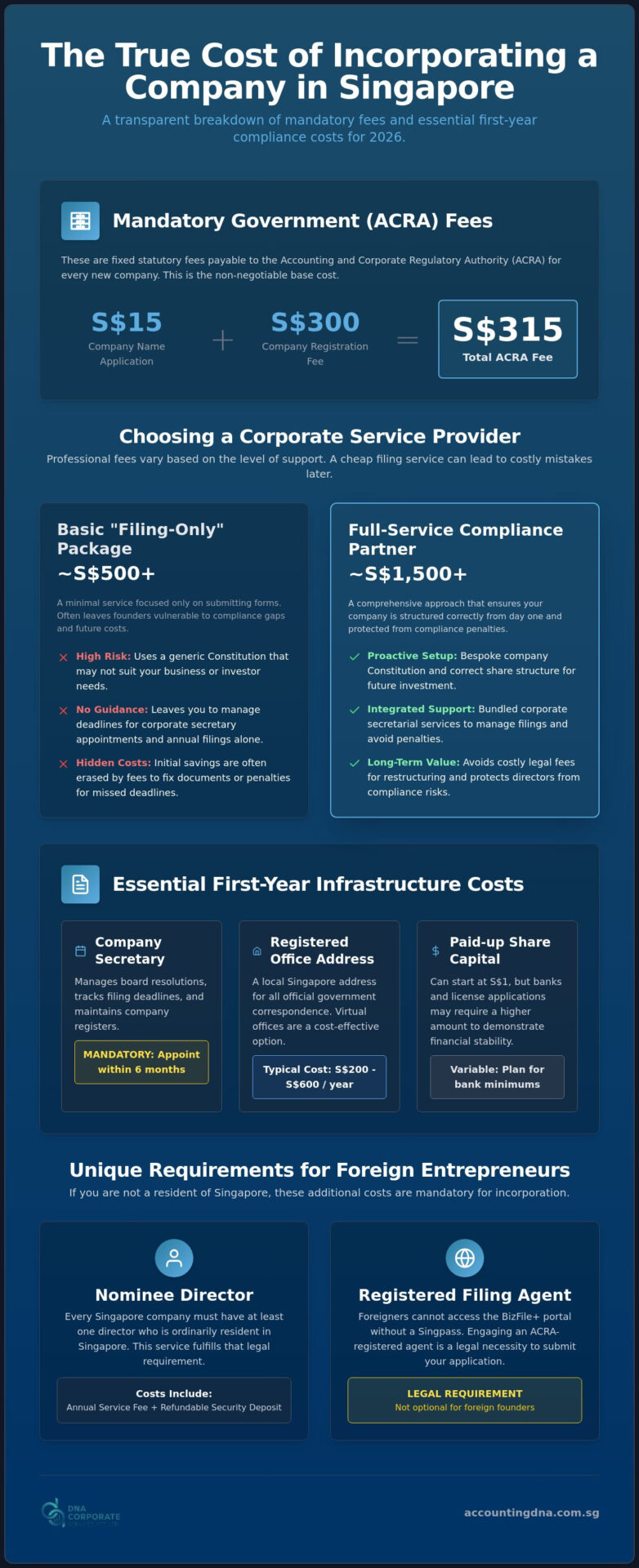
The total mandatory government fee is S$315. This is split into two parts: a S$15 fee to apply for your company name and a S$300 registration fee to officially incorporate. Once ACRA approves your name, it’s reserved for 60 days. If your business plans hit a snag, you can extend this for another 60 days. Missing this window means starting over and paying the S$15 fee again. It’s a small amount, but these tiny administrative lapses are often the first sign of a disorganized compliance strategy.
Choosing a Corporate Service Provider (CSP) in 2026
Why do professional fees vary so much? You’ll see packages ranging from S$500 to over S$1,500. A “filing-only” service is essentially a data entry task. It’s cheap, but it often leaves you with a generic Constitution that might not fit your business model. In contrast, a full-service boutique firm provides bespoke care, ensuring your Unique Entity Number (UEN) and internal documents are structured correctly from day one. For foreign entrepreneurs, engaging an ACRA-registered Filing Agent isn’t just a choice; it’s a legal requirement because you cannot access the BizFile+ portal without a Singpass.
Think about the long-term impact of your setup. We’ve seen founders choose the cheapest registration option only to realize their company Constitution didn’t allow for the specific share classes their first major investor required. Fixing this mistake later involved significant legal fees and board resolutions that far outweighed the initial savings. You can view a clear breakdown of how we structure these essential services on our pricing page to help you plan a realistic budget for your first year.
Essential Post-Incorporation and Infrastructure Costs
Your journey doesn’t end once you receive your UEN. While the initial S$315 fee is a one-time payment, the total cost of company incorporation in Singapore includes the mandatory infrastructure required to keep your business active and legal. Many founders overlook these setup costs, leading to budgeting errors in the first quarter.
One of your first decisions involves share capital. While you can technically start with just S$1, this isn’t always practical. If you’re planning to apply for specific licenses or open a corporate bank account with a major institution, a higher paid-up capital might be necessary to demonstrate financial stability. Most banks also require an initial deposit and a minimum monthly balance, which can range from a few thousand to tens of thousands of dollars depending on the bank’s tier. This is a vital part of your cash flow planning that happens immediately after the paperwork is filed.
You’ll also need a local registered office address. If you don’t have a physical office yet, a virtual office service is a cost-effective way to comply with the law, typically ranging from S$200 to S$600 per year. This address is where all official government correspondence from ACRA and IRAS will be sent, so reliability is key. It’s a small but non-negotiable expense that ensures you never miss a legal notice.
The Mandatory Company Secretary
Singapore law is very clear: you must appoint a company secretary within six months of your incorporation date. This isn’t just a “paper” role. A professional secretary manages your board resolutions, tracks filing deadlines, and ensures your company register is always up to date. Choosing a qualified firm for Corporate Secretarial Services protects you from the oversight that leads to heavy fines. It’s about having a partner who watches the calendar so you can focus on your product.
Foreigner-Specific Costs: Nominee Directors and Employment Passes
If you’re a foreign entrepreneur without a local resident partner, your budget will look different. Every Singapore company must have at least one director who is ordinarily resident in Singapore. If you aren’t relocating immediately, you’ll need to engage a nominee director. This service usually involves an annual fee and a refundable security deposit to mitigate the director’s legal risks, which can be a significant upfront cost.
For those planning to move to Singapore, you’ll need to factor in the costs of an EntrePass or Employment Pass. You can find detailed requirements for various business activities on the GoBusiness portal. These immigration and residency requirements are foundational to your setup and shouldn’t be left to the last minute. If you’re feeling overwhelmed by these moving parts, it’s often helpful to speak with a local advisor who can map out a timeline tailored to your specific situation.
Strategic Budgeting: Optimizing Your Year-One Compliance Spend
How do you ensure your initial investment doesn’t balloon into a financial headache? Smart founders look at the cost of company incorporation in Singapore as a long-term compliance strategy rather than a one-off filing fee. While you might save a few hundred dollars today by choosing a bargain-bin provider, the real “penalty trap” lies in the missed deadlines that follow. ACRA and IRAS don’t accept ignorance as an excuse for late filings, and the fines can quickly outpace your initial savings.
Avoiding ACRA Late Filing Penalties
Missing your Annual General Meeting (AGM) or Annual Return (AR) deadline is an expensive mistake. ACRA’s late filing penalties start at S$300 per breach and can escalate if left unaddressed. By bundling your secretarial and bookkeeping services, you create a centralized compliance hub. This prevents the communication gaps that occur when your accountant and secretary don’t talk to each other, ensuring every deadline is met without you having to micromanage the calendar.
The DNA Accounting Approach to Transparent Pricing
We’ve found that startups thrive when they have direct access to experts who understand their pace. Unlike “factory-style” agencies where you’re just another ticket number, we offer bespoke care tailored to your specific growth stage. We’re even available during evenings and non-working days because we know that the best business ideas don’t always happen between nine and five. You can explore our integrated packages on our pricing page to see how we help you manage the total cost of company incorporation in Singapore while protecting your venture from unnecessary compliance risks.
Build Your Singapore Business on a Solid Foundation
Managing the cost of company incorporation in Singapore isn’t just about the initial filing. It’s about building a sustainable infrastructure that survives the first year without surprise penalties. You now know the difference between basic ACRA fees and the essential compliance services, like a professional company secretary, that keep your business in good standing. By leveraging tax exemptions and bundling your year-one services, you turn a mandatory expense into a strategic investment for your startup’s growth.
At DNA Accounting, we’ve provided bespoke care for SMEs and startups since 2016. We understand that your business doesn’t stop at 6 PM; that’s why we offer unique availability during evenings and non-working days to fit your schedule. Our deep expertise in ACRA and IRAS compliance ensures your company structure is robust from day one, giving you the peace of mind to focus on what you do best. Ready to get started with a partner who values your time as much as you do? Get a Transparent Incorporation Quote from DNA Accounting Today and let’s map out your path to success in Singapore together.
Frequently Asked Questions
Can I incorporate a Singapore company without a professional service provider?
Locals with a Singpass can technically DIY the registration via the BizFile+ portal, but foreigners are legally required to engage a registered filing agent. Even for local founders, a professional provider ensures your constitution and share structure are handled correctly from the start. This prevents costly amendments later when you need to bring on investors or change your business activities. It’s about getting the foundation right to avoid future administrative headaches.
Is the S$315 ACRA fee inclusive of GST?
Statutory fees paid directly to ACRA, including the S$15 name application and S$300 registration fee, are outside the scope of GST. However, the service fees charged by your Corporate Service Provider (CSP) will be subject to the prevailing GST rate if the firm is a GST-registered entity. It’s helpful to clarify this when reviewing your total cost of company incorporation in Singapore to avoid minor budgeting discrepancies in your initial setup phase.
How much should I budget for a professional Nominee Director service?
You should budget for both an annual service fee and a refundable security deposit, which is standard practice for this role in Singapore. This deposit protects the nominee from potential legal liabilities and is a requirement for most foreign entrepreneurs. While industry prices vary, this remains a key component of the cost of company incorporation in Singapore for those who do not yet have a local resident director available.
Are there ongoing monthly costs after incorporation if my company is dormant?
Yes, even a dormant company must meet mandatory annual obligations that incur costs. You are still required to maintain a registered office address and a company secretary throughout the life of the business. Additionally, you must fulfill your annual filing duties with both ACRA and IRAS. Many founders choose a simplified maintenance package to ensure these statutory deadlines aren’t missed, as late penalties apply regardless of your level of business activity.
Disclaimer
The information provided on this website is for general informational purposes only and is not intended to constitute professional accounting, tax, legal, or financial advice. While we strive to ensure that the content is accurate and up to date, regulations in Singapore, including those administered by ACRA, IRAS, CPF Board, and MOM, may change from time to time and may differ depending on individual circumstances.
Readers should not act or rely on any information contained on this website without seeking specific advice from a qualified professional based on their individual situation.
DNA Corporate Services and its affiliates accept no responsibility or liability for any loss or damage arising from reliance on the information provided in this website or any linked materials.
For tailored advice relating to accounting, taxation, corporate secretarial, or compliance matters in Singapore, please contact us directly for professional consultation.



