

What if your tax deadline wasn’t just a hurdle to jump, but a strategic tool to improve your company’s liquidity? For many local business owners, ECI filing Singapore feels like a stressful race against the clock, often clouded by confusion over the S$5 million waiver rule and the fear of IRAS penalties. It’s completely natural to feel a bit of weight on your shoulders when trying to balance these statutory requirements with the daily demands of running a business.
We believe that compliance should provide peace of mind, not a headache. That’s why this guide is designed to help you master the essentials of Estimated Chargeable Income filing while maximizing your cash flow through interest-free installments. You’ll learn how to confirm your waiver eligibility, secure up to 10 payment installments, and stay 100% compliant with the latest 2026 regulations. We’re going to break down the technical steps and YA 2026 tax rebates so you can focus on growth, knowing your tax obligations are handled with precision and care.
Key Takeaways
- Identify if your company qualifies for the ECI waiver based on the S$5 million revenue threshold and nil income criteria for the financial year.
- Learn how proactive ECI filing Singapore can secure up to 10 interest-free installments, significantly easing your company’s monthly cash flow.
- Understand the critical three-month filing window and the risks of receiving a high Estimated Notice of Assessment from IRAS.
- Explore the YA 2026 Corporate Income Tax (CIT) Rebate of 50% to ensure your tax estimates are both accurate and optimized.
- Discover why an active GIRO arrangement is the foundational requirement for accessing flexible tax payment plans.
Understanding ECI Filing in Singapore: Requirements and Waivers for 2026
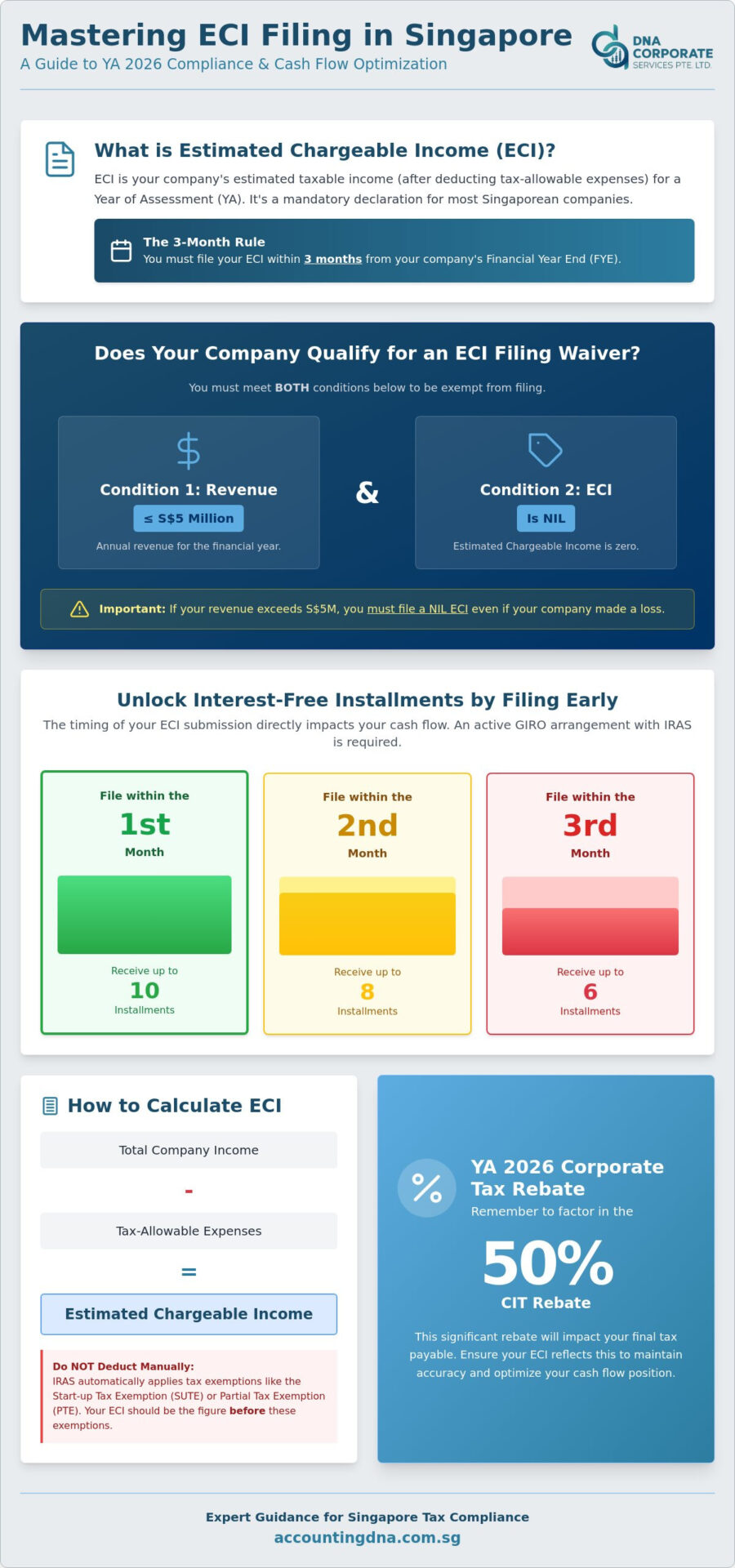
What exactly is Estimated Chargeable Income? Simply put, ECI is your company’s estimate of its taxable income, after deducting tax-allowable expenses, for a specific Year of Assessment (YA). It’s a foundational part of Taxation in Singapore that serves two main purposes. First, it gives the government a macro-level view of the economy’s performance in real-time. Second, it ensures that corporate tax collection is timely and predictable. For the 2026 Year of Assessment, all companies must perform their ECI filing Singapore electronically through the IRAS myTax Portal. The golden rule to remember is the “3-month rule”: your filing must be submitted within three months from the end of your financial year (FYE).
The S$5 Million Waiver: Does Your Company Qualify?
Many SMEs hope to skip this step, but you only qualify for a waiver if you meet a strict two-prong test. Your company’s annual revenue must be S$5 million or below for the financial year, and your ECI must be NIL. If your revenue is low but you still expect even one dollar of chargeable income, you’re legally required to file. For new startups, your first ECI due date depends entirely on your chosen FYE. If you incorporated in October 2025 and your first financial year ends in September 2026, your filing window closes in December 2026. Getting this right from day one prevents unnecessary friction with IRAS.
The ‘NIL’ ECI Misconception: When Filing is Still Mandatory
A common mistake we see involves directors who ignore the deadline because their company is in a loss position. If your annual revenue exceeds S$5 million, you must file an ECI even if your estimated income is zero. In this scenario, you’ll submit a “NIL” ECI to remain compliant. Assuming that a lack of profit equals a lack of responsibility is a risky move that can lead to estimated assessments from the authorities. For comprehensive support with these requirements, our corporate tax and GST filing services ensure you never miss a deadline or a waiver opportunity. Understanding these distinctions is the first step toward a stress-free tax season.
Deadlines, Installments, and the Step-by-Step Filing Process
Did you know that the timing of your submission directly impacts your bank balance? IRAS rewards proactive companies by offering a generous installment plan for tax payments. If you complete your ECI filing Singapore within the first month after your financial year-end, you can qualify for up to 10 interest-free installments. Filing in the second month reduces this to 8, and the third month offers only 6. To access this flexibility, your company must have an active GIRO arrangement with IRAS. Without GIRO, the full tax amount is typically due within one month of the Notice of Assessment.
Before logging into the myTax Portal, ensure you have three specific details ready: your Financial Year End (FYE) date, your total revenue, and your estimated chargeable income. For ECI purposes, “Revenue” refers to your gross receipts from trade or business. You should exclude capital gains, such as profit from selling a company vehicle or office property. If you’re unsure about specific line items, you might want to speak with a tax advisor to ensure your figures are accurate from the start.
Calculating Your ECI: A Practical Framework for Directors
The math is relatively straightforward: take your total income and subtract your tax-allowable expenses. This gives you your ECI before tax exemptions. It’s vital to remember that you shouldn’t deduct the S$125,000 startup tax exemption or other partial exemptions yourself. IRAS applies these automatically when they process your final tax bill. We always recommend “Safe Estimates.” Underestimating your income just to lower immediate tax payments can trigger IRAS queries or audits later when your final figures are submitted.
Reconciling ECI with Form C-S: Handling Discrepancies
Your ECI is just an estimate. The final word on your tax liability comes later when you file Form C-S or Form C. If your actual profit ends up being significantly higher than your initial estimate, you don’t need to panic. You can revise your ECI through the myTax Portal before your final tax filing deadline. Our Corporate Tax & GST Filing Services specialize in this exact reconciliation, ensuring that your initial estimates and final filings align perfectly to avoid penalties.
Common ECI Pitfalls and Professional Compliance Strategies
What happens if the deadline slips your mind? It’s the number one fear for many company directors. If you miss the window for ECI filing Singapore, IRAS doesn’t just wait for you to catch up. They’ll issue an Estimated Notice of Assessment (NOA) based on their own calculations. Since IRAS doesn’t have your internal data yet, these estimates are frequently much higher than your actual profit. This isn’t just a paperwork issue; it’s a direct threat to your liquidity. Beyond the higher tax bill, you also lose the privilege of paying in installments, making the entire sum due at once.
Why IRAS Estimates (NOA) Can Hurt Your Cash Flow
When IRAS issues an estimated assessment, they assume a healthy profit margin and demand the tax immediately. You’re legally required to pay the full amount stated on that NOA within one month, even if you disagree with the numbers. You can’t just ignore it while you prepare your objection. This can drain your operating capital overnight. If you find yourself in this situation, we help you file an “Objection to Assessment” to correct the record, but prevention is always the better strategy. Missing the deadline also triggers an immediate 5% late payment penalty, which compounds further if the debt remains unpaid.
Streamlining Compliance with DNA Accounting
Managing your statutory obligations shouldn’t feel like a second job. As a boutique firm, we offer a level of personalized care that larger firms often overlook. We don’t just wait for you to send us numbers; we actively track your FYE and ECI deadlines to ensure you never face an estimated assessment. By linking our bookkeeping and accounting services directly to your tax preparation, we provide real-time accuracy. This integrated approach means your estimate is based on actual performance, not a guess. Let us handle the technicalities while you focus on scaling your business. Contact DNA Accounting for a Stress-Free Tax Season to secure your compliance and your cash flow.
Taking Control of Your 2026 Tax Strategy
Staying ahead of your statutory obligations doesn’t have to be a source of stress. By mastering your ECI filing Singapore, you’re not just checking a box for IRAS; you’re actively protecting your company’s liquidity through interest-free installments. Filing within the first month unlocks the maximum of 10 installments, whereas missing the window entirely risks a heavy-handed Estimated Notice of Assessment that can drain your cash reserves overnight.
Get a Professional Review of Your Corporate Tax Obligations and enjoy a truly stress-free tax season.
Frequently Asked Questions
What is the difference between ECI and Form C-S?
ECI is your preliminary estimate of taxable income filed within three months of your financial year-end. In contrast, Form C-S is the final tax return where you declare your actual income and expenses. Think of ECI as a good faith estimate that allows for early payment installments. The final return reconciles everything once your accounts are finalized for the year.
Can I change my ECI after I have already submitted it to IRAS?
Yes, you can revise your ECI filing Singapore if you discover your initial estimate was inaccurate. You simply need to log in to the IRAS myTax Portal and submit a revised figure before you file your final Form C-S. It’s best to be as accurate as possible from the start. This prevents significant discrepancies that might prompt additional questions from the tax authorities later on.
My company is dormant; do I still need to file an ECI?
Dormant companies that have been granted a waiver from filing income tax returns by IRAS are generally exempt from filing an ECI. If your company hasn’t applied for this specific waiver yet, you’re still technically required to submit a NIL ECI. It’s always safer to check your company’s status on the myTax Portal to ensure you’re meeting all current compliance obligations without any surprises.
What happens if I cannot pay the ECI tax amount in one go?
You don’t have to worry about a single large payment if you file on time and have an active GIRO arrangement. IRAS allows you to spread your tax payments over several months. Up to 10 installments are available for those who file within the first month after their financial year-end. If you miss the filing deadline, this installment option is usually withdrawn, making the full sum due immediately.
Disclaimer
The information provided on this website is for general informational purposes only and is not intended to constitute professional accounting, tax, legal, or financial advice. While we strive to ensure that the content is accurate and up to date, regulations in Singapore, including those administered by ACRA, IRAS, CPF Board, and MOM, may change from time to time and may differ depending on individual circumstances.
Readers should not act or rely on any information contained on this website without seeking specific advice from a qualified professional based on their individual situation.
DNA Corporate Services and its affiliates accept no responsibility or liability for any loss or damage arising from reliance on the information provided in this website or any linked materials.
For tailored advice relating to accounting, taxation, corporate secretarial, or compliance matters in Singapore, please contact us directly for professional consultation.



