

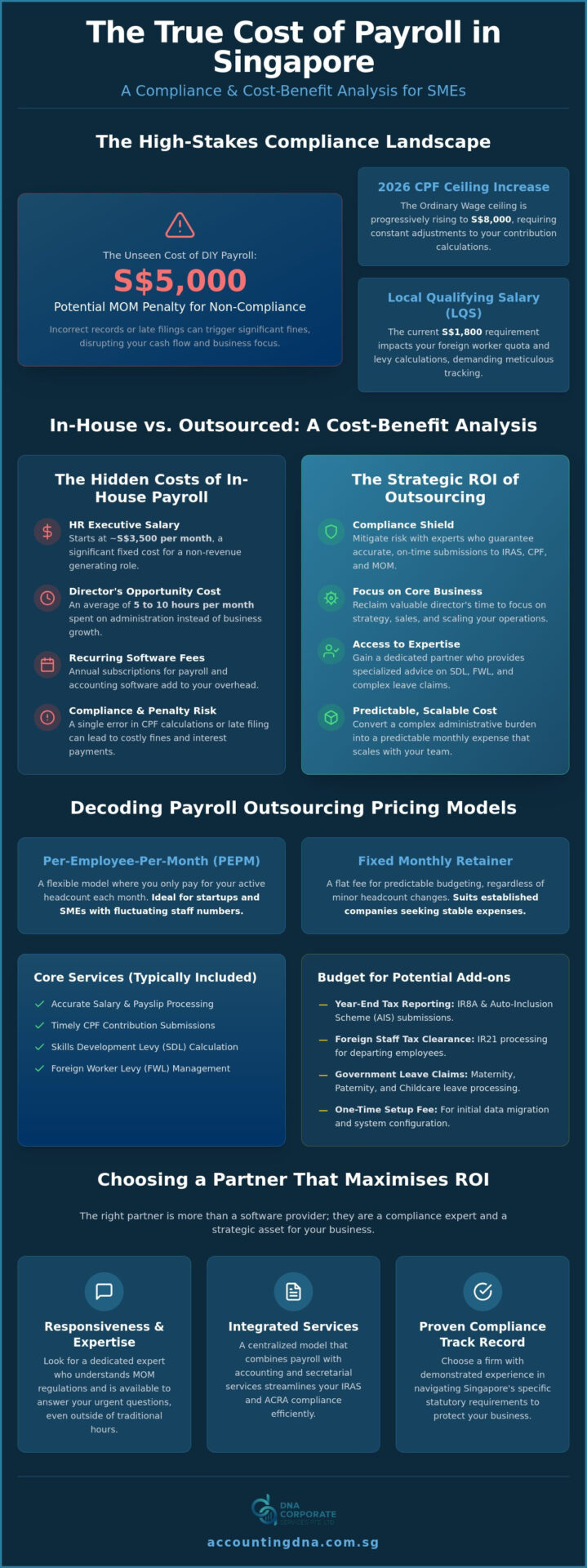
What if the true cost of managing your own payroll isn’t the expensive software license, but the S$5,000 MOM penalty you didn’t see coming? Between the 2026 CPF Ordinary Wage ceiling increase to S$8,000 and the S$1,800 Local Qualifying Salary requirement, staying compliant in Singapore has become a high-stakes balancing act. We understand how exhausting it is to spend your weekends wrestling with manual salary calculations and IR8A preparation when you should be focused on scaling your business operations.
Key Takeaways
- Compare per-employee per-month pricing against fixed monthly retainers to determine the most cost-effective structure for your SME’s specific headcount.
- Gain clarity on the payroll outsourcing cost Singapore firms charge and how it factors in the 2026 CPF ceiling increases and new Local Qualifying Salary requirements.
- Evaluate the significant “opportunity cost” of manual payroll administration and learn how outsourcing frees up 5 to 10 hours of a director’s time every month.
- Discover the efficiency of a centralized service model that integrates your payroll with accounting and secretarial services to streamline your IRAS and ACRA compliance.
- Identify the critical importance of choosing a partner based on their responsiveness and expertise in MOM regulations rather than just their software capabilities.
Understanding the Cost Structure of Payroll Outsourcing in Singapore
Payroll outsourcing is a comprehensive compliance service that ensures your business meets every statutory obligation, from salary disbursement to precise tax reporting. It isn’t just about moving money; it’s about protecting your company from the S$5,000 penalties that come with late CPF filings or incorrect MOM records. When evaluating the payroll outsourcing cost Singapore providers charge, you’ll find that headcount is the primary driver. This is because Singapore’s regulatory framework requires individual calculations for CPF contributions, the Skills Development Levy (SDL), and various foreign worker levies for every single employee. Before signing an agreement, verify that the base fee includes these essential monthly submissions, as some firms might treat them as billable extras.
Variable vs. Fixed Pricing: Which Suits Your Business?
Most SMEs adopt the per-employee-per-month (PEPM) model. It’s highly flexible; you only pay for the active headcount on your books each month. This is ideal for micro-SMEs or startups with fluctuating staff numbers. Conversely, established companies often prefer fixed monthly retainers for better budget predictability. Regardless of the model, ask about setup fees. These one-time costs cover the migration of historical payroll data into the provider’s system, ensuring your year-to-date figures remain accurate for IRAS reporting. Adopting the business practice of outsourcing allows you to convert these complex administrative tasks into a predictable monthly expense while you focus on scaling your operations.
Common Add-on Costs to Factor into Your Budget
While monthly processing is the core service, specific annual or ad-hoc events usually incur additional fees. Year-end tax reporting is a major one. Your provider will charge for preparing IR8A forms and managing the Auto-Inclusion Scheme (AIS) submissions. If you employ foreign talent, you must factor in IR21 processing for departing staff to ensure tax clearance. Additionally, handling government-paid leave claims, such as maternity or paternity leave, often falls outside the standard scope. These specialized filings require meticulous documentation to ensure your SME successfully recovers the funds from the government. You can often reduce the total payroll outsourcing cost Singapore by integrating these tasks with your accounting services under a centralized service model.
In-House vs. Outsourced: A 2026 Cost-Benefit Analysis
Is it truly cheaper to manage everything yourself? Many SME directors ask this when they first look at the payroll outsourcing cost Singapore providers present. When you factor in the salary of a dedicated HR executive, which often starts at S$3,500 per month, the math quickly shifts. For a small team, the monthly outsourcing fee is a fraction of that cost. Even if you handle it personally, you’re likely sacrificing 5 to 10 hours every month on administrative grunt work. That is time you could spend on high-level strategy or closing new deals. You can see how we structure our services to maximize this value on our pricing page.
Hidden Costs of In-House Payroll Management
The Compliance ROI: Why Outsourcing Pays for Itself
Outsourcing transforms a stressful monthly chore into a seamless, automated process. Professional providers ensure you never miss the critical CPF submission deadline on the 14th of every month. They offer specialized advice on the Skills Development Levy (SDL) and complex foreign worker levy (FWL) calculations, ensuring you don’t overpay or under-report. This ultimate guide to payroll outsourcing highlights how the right partner acts as a protective shield for your business. By moving to a professional model, you gain access to a team that is available even during non-traditional hours to answer your urgent questions. If you’re ready to reclaim your time and secure your compliance, feel free to reach out for a chat about your specific needs.
How to Choose a Payroll Partner that Maximises Your ROI
How do you distinguish between a simple service provider and a true business partner? When you’re evaluating the payroll outsourcing cost Singapore firms present, it’s easy to get caught up in the price per payslip. However, the real ROI comes from technical expertise and extreme accessibility. A centralized service model, where your payroll is integrated with your secretarial services and bookkeeping, eliminates the stress of managing multiple vendors. We believe in boutique care, which means you get direct access to senior advisors rather than being passed around a call center. Our team stays available during evenings and non-working days because we know that urgent payroll queries don’t always happen between nine and five.
Scalability: Will the Cost Grow with You?
Is your provider ready to support your expansion? As your SME grows from five employees to fifty, you need transparent pricing tiers that don’t penalize you for success. Your partner should handle everything from onboarding new hires to managing your corporate tax filing as your revenue increases. This holistic oversight ensures your business remains perfectly aligned with the Singapore Ministry of Manpower payroll regulations. By choosing a scalable partner now, you avoid the disruptive costs of switching providers later.
Security and Data Protection Standards
Can you trust your provider with your team’s most sensitive data? In a landscape where the payroll outsourcing cost Singapore varies wildly, some “cheap” overseas-based virtual assistants might cut corners on security. Local expertise is vital for PDPA (Personal Data Protection Act) compliance and secure data encryption. We focus on protecting your information within Singapore’s jurisdiction, ensuring that every salary detail and CPF contribution is handled with the highest level of confidentiality. This local focus provides a level of security that generic, offshore platforms simply can’t match.
Securing Your SME’s Compliance Future
Our boutique, 100% Singapore-based expert team specializes in bespoke payroll solutions that scale alongside your SME. We understand that compliance questions don’t stop at 6 PM, which is why we’re available during evenings and weekends to provide urgent support when you need it most. Ready to simplify your administrative overhead? Get a Tailored Payroll Quote for Your SME today and experience the peace of mind that comes from professional, centralized care. Your business deserves a partner that is as invested in your success as you are.
Frequently Asked Questions
What is the average monthly cost of payroll outsourcing for a Singapore SME?
The monthly payroll outsourcing cost Singapore SMEs encounter typically scales with headcount and the complexity of your pay structure. For a small business with 10 or fewer employees, industry data suggests a typical range between S$70 and S$220 per month, though this varies based on your specific requirements. Most providers use a base fee plus a per-headcount charge to ensure you only pay for the staff you actually have on your books.
Does payroll outsourcing include CPF submission and SDL calculations?
Yes, comprehensive payroll services always include CPF submissions and Skills Development Levy (SDL) calculations as part of the monthly cycle. Your provider ensures that the mandatory 0.25% SDL is calculated accurately and that CPF contributions are submitted before the 14th of every month. This removes the stress of tracking the latest 2026 contribution rates for different age groups and ensures you remain fully compliant with the Central Provident Fund Act.
Can I outsource payroll if I only have 1 or 2 employees?
You can absolutely outsource your payroll even if you only have one or two employees. Many startups and micro-SMEs choose this route to avoid the high cost of specialized software licenses and the time wasted on manual salary calculations. It’s a proactive way to ensure your compliance is perfect from day one, which is vital if you plan to hire more staff or apply for foreign worker quotas in the future.
What are the penalties for late CPF or MOM filings in Singapore?
Late filings carry significant financial risks, including a 1.5% monthly interest charge for late CPF payments. Under the Employment Act, failing to pay salaries within seven days after the salary period can result in MOM fines of up to S$5,000 per offense. Outsourcing acts as a protective hedge, ensuring these deadlines are met so you never face avoidable statutory penalties or damage your company’s standing with the Ministry of Manpower.
How does the Auto-Inclusion Scheme (AIS) affect my outsourcing costs?
The Auto-Inclusion Scheme (AIS) is a mandatory requirement for employers to submit employment income information to IRAS electronically. While it simplifies the tax filing process for your employees, it involves a specialized year-end filing for the business. Most providers charge a nominal annual fee to manage these submissions, ensuring your data is transmitted securely and accurately before the March deadline each year.
Is it possible to switch payroll providers in the middle of the financial year?
It is entirely possible to switch your payroll provider at any point during the financial year. The process involves a migration phase where your new partner transfers historical year-to-date data into their system. This step is critical to ensure that your year-end IR8A forms reflect accurate total earnings and CPF contributions across the entire calendar year, preventing any discrepancies in your employees’ tax assessments.
Disclaimer
The information provided on this website is for general informational purposes only and is not intended to constitute professional accounting, tax, legal, or financial advice. While we strive to ensure that the content is accurate and up to date, regulations in Singapore, including those administered by ACRA, IRAS, CPF Board, and MOM, may change from time to time and may differ depending on individual circumstances.
Readers should not act or rely on any information contained on this website without seeking specific advice from a qualified professional based on their individual situation.
DNA Corporate Services and its affiliates accept no responsibility or liability for any loss or damage arising from reliance on the information provided in this website or any linked materials.
For tailored advice relating to accounting, taxation, corporate secretarial, or compliance matters in Singapore, please contact us directly for professional consultation.



