

If you’re searching for “how to convince my boss to outsource payroll,” start with the work your team already does. The payroll fee is only one part of the decision. In Singapore, payroll can involve CPF contributions, MOM requirements and IRAS income reporting, so the work continues beyond paying salaries. Show how much time goes into collecting updates, processing pay, checking figures and handling payroll administration, along with the risks of errors or missed requirements.
Key Takeaways
- To explain how to convince my boss to outsource payroll, base your proposal on the company’s actual workload and make a clear decision request.
- Use anonymised examples of recurring payroll tasks to show where finance or HR time goes. Avoid claiming savings you cannot support.
- Before a handover, map who supplies and checks payroll inputs, approves outputs and handles exceptions.
- Plan a staged transition, review the first payroll cycles and consider how payroll records connect with accounting workflows.
Why outsource payroll? Build a business case your boss can assess
Does outsourcing improve the business enough to justify the service fee? Your boss needs a comparison based on your company’s workload, not a generic claim that outsourcing is cheaper. Payroll involves more than calculating salaries. For a broader overview of the process, see What is Payroll?
Track the time spent collecting employee changes, processing pay, reviewing figures, correcting errors and completing recurring administration. Note related software and other direct costs, using figures your team can explain and labelling estimates clearly. Then compare those costs with the proposed service fee. Keep possible benefits, such as redirecting staff time to finance or HR work, separate from measurable costs. Do not present them as guaranteed savings. You can compare the fee with your company’s needs through DNA Accounting’s accounting and payroll pricing.
Compare total effort, cost and control, not just the invoice
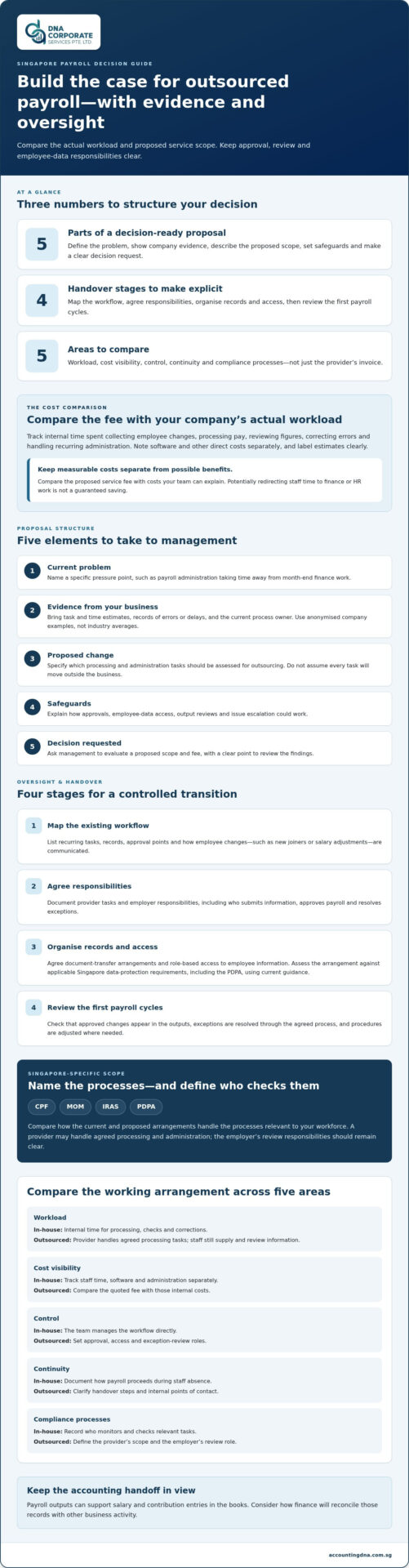
| Decision area | In-house payroll | Outsourced payroll |
|---|---|---|
| Workload | Internal time for processing, checks and corrections | Provider handles agreed processing tasks; staff still supply and review information |
| Cost visibility | Track staff time, software and administration separately | Compare the quoted fee with those internal costs |
| Control | Team manages the workflow directly | Set approval, access and exception-review roles |
| Continuity | Document how payroll proceeds during staff absence | Clarify handover steps and internal points of contact |
| Compliance processes | Record who monitors and checks relevant tasks | Define the provider’s scope and the employer’s review role |
Convince Your Boss to Outsource Payroll: A Proposal
A persuasive proposal makes the decision manageable. Identify the problem, support it with evidence from your business and ask for a clear next step. Instead of presenting outsourcing as an automatic way to cut costs, explain what your company would evaluate and how it would decide whether the arrangement fits.
- Current problem: Identify a specific pressure point, such as payroll administration taking time away from month-end finance work.
- Evidence: Bring a task and time estimate, records of errors or delays, and the name of the current process owner. Use anonymised examples from company records, not industry averages.
- Proposed change: Describe the processing and administrative tasks you want assessed for outsourcing. Do not assume every task will move outside the business.
- Safeguards: Set out how approvals, access to employee data, output reviews and issue escalation could work.
- Decision requested: Ask to evaluate a proposed scope and fee, and give management a clear point to review the findings.
Prepare evidence and answer the objections before the meeting
Bring a concise example of the work involved. For instance, describe an anonymised payroll correction: what information needed follow-up, who handled it and what other task was delayed. This gives your boss a concrete basis for discussion without claiming a specific saving. Be ready to explain how approval authority and access to employee records would work after a change.
List the CPF, IRAS and MOM processes relevant to your workforce, then compare the proposed scope with current requirements using the authorities’ guidance. A provider can handle agreed payroll processing and administration, but your proposal should distinguish those tasks from the employer’s review responsibilities.
For a practical view of payroll support and its scope, see DNA Accounting’s payroll services.
How to outsource payroll while keeping clear oversight
A smooth handover depends on clear responsibilities at each stage. Your team should know who provides information, who processes it and who approves the final figures.
- Map the existing workflow. List recurring tasks, required records and approval points. Include how your team communicates changes such as new joiners or salary adjustments.
- Agree responsibilities. Document which tasks the provider handles and which stay with the employer. Identify who submits information, approves payroll and resolves exceptions.
- Organise records and access. Agree how documents will be transferred and who can access employee information. Assess the arrangement against applicable Singapore data-protection requirements, including the PDPA, using current guidance.
- Review the first payroll cycles. Check that approved changes appear in the outputs and that exceptions were resolved through the agreed process. Record any procedures that need adjustment.
Set responsibilities, data handling and review points
Write down submission and approval steps, review points, escalation contacts and the channel for raising issues. For example, the employer can retain approval of salary changes and review of final payroll, while the provider handles agreed processing and administration. Limit access to employee records according to each person’s role so that oversight does not require broad access.
Plan the accounting handoff too. Payroll outputs can support salary and contribution entries in the books, giving the finance team records to reconcile with other business activity. If that connection matters to your workflow, learn more about bookkeeping and accounting services.
DNA Accounting provides payroll support for Singapore businesses as part of its business services.
Turn your proposal into a practical next step
A sound decision does not need to be all-or-nothing. Recommend a focused evaluation, agree what a successful transition would look like and set a point for your boss to review the findings before making a longer-term decision. Then “how to convince my boss to outsource payroll” becomes less about winning an argument and more about presenting a manageable option for the business.
DNA Accounting supports SMEs and startups in Singapore with payroll processing and related administrative support. Its payroll services can be considered alongside your company’s existing accounting workflows, with responsibilities and oversight agreed as part of the proposed arrangement.
Discuss your payroll requirements with DNA Accounting to explore a suitable next step for your team.
Frequently Asked Questions
Can a small business in Singapore outsource payroll?
Yes. A Singapore small business can outsource payroll, including one with a small team or no dedicated payroll specialist. The practical question is whether external processing fits your pay arrangements and internal approval process. If you are considering how to convince my boss to outsource payroll, explain which recurring tasks need support and what the business will retain in-house.
Will outsourcing payroll remove my company’s responsibility for payroll compliance?
No. Engaging a payroll provider does not automatically remove the employer’s responsibilities. Treat outsourcing as a way to delegate agreed processing and administration, not as a transfer of accountability. Assign an internal owner to oversee the arrangement, and use current authority guidance to identify which CPF, IRAS and MOM requirements apply to your employees. This helps prevent gaps between the provider’s scope and the company’s obligations.
What employee information should we prepare before outsourcing payroll?
Prepare the information needed for the agreed payroll scope, such as employee names and relevant identifiers, employment terms, salary components, approved changes and payment details. Depending on your workforce, the provider may also need information relevant to CPF treatment or employment income reporting. Start with a complete, current employee list and resolve missing or inconsistent records before transferring them through an agreed method.
How can we protect employee data when payroll is handled by an external provider?
Share only the information needed for the service, restrict internal access to people with a clear role, and agree how records will be transferred, stored, retained and deleted. Document who can access payroll information and how to raise a suspected data incident. Review the arrangement against current Personal Data Protection Commission guidance and the company’s applicable PDPA obligations before sharing employee records.
Disclaimer
The information provided on this website is for general informational purposes only and is not intended to constitute professional accounting, tax, legal, or financial advice. While we strive to ensure that the content is accurate and up to date, regulations in Singapore, including those administered by ACRA, IRAS, CPF Board, and MOM, may change from time to time and may differ depending on individual circumstances.
Readers should not act or rely on any information contained on this website without seeking specific advice from a qualified professional based on their individual situation.
DNA Corporate Services and its affiliates accept no responsibility or liability for any loss or damage arising from reliance on the information provided in this website or any linked materials.
For tailored advice relating to accounting, taxation, corporate secretarial, or compliance matters in Singapore, please contact us directly for professional consultation.



