

Singapore’s GST InvoiceNow requirement is a phased mandate, not a single deadline for every business. From 1 April 2026, all new voluntary GST registrants must adopt an InvoiceNow-Ready Solution. From 1 April 2028, the requirement extends to all new compulsory GST registrants and existing GST-registered businesses with annual supplies of S$200,000 or less, with further phases continuing through 1 April 2031.
Keeping track of which rules apply to your business can feel like another compliance task on an already full list. This guide explains Singapore’s GST InvoiceNow rollout, the invoice data businesses must transmit to IRAS, and how to get started with a suitable solution. You’ll also see how timing depends on GST registration and annual supplies, helping you plan for the transition and prepare your accounting workflow.
Key Takeaways
- The GST rollout is phased: according to the Inland Revenue Authority of Singapore, existing GST-registered businesses with annual supplies of S$1,000,000 or less must comply from 1 Apr 2029.
- To connect to InvoiceNow, businesses use an IMDA-accredited solution and register through an Access Point to exchange structured invoice data.
- Understand which prescribed invoice data InvoiceNow requires businesses to send to IRAS and how submission timing relates to the GST return.
- Accounting & Bookkeeping and GST Services can help businesses manage records and GST obligations alongside their InvoiceNow transition.
Getting started with InvoiceNow
Start by matching your GST registration status and annual supplies to Singapore’s rollout timeline. Then choose an accredited solution that works with your accounting system and supports the required invoice-data submission. Planning ahead helps you identify changes needed to staff workflows and recordkeeping.
Benefits and Limitations
InvoiceNow exchanges structured invoice data between finance systems, reducing manual entry compared with email or PDF invoicing. This can reduce rekeying errors and streamline invoice processing. It does not replace the need to check transaction details or keep proper GST records, so reliable review procedures remain essential. Before implementation, consider how the workflow will handle corrections and staff access.
How InvoiceNow Works
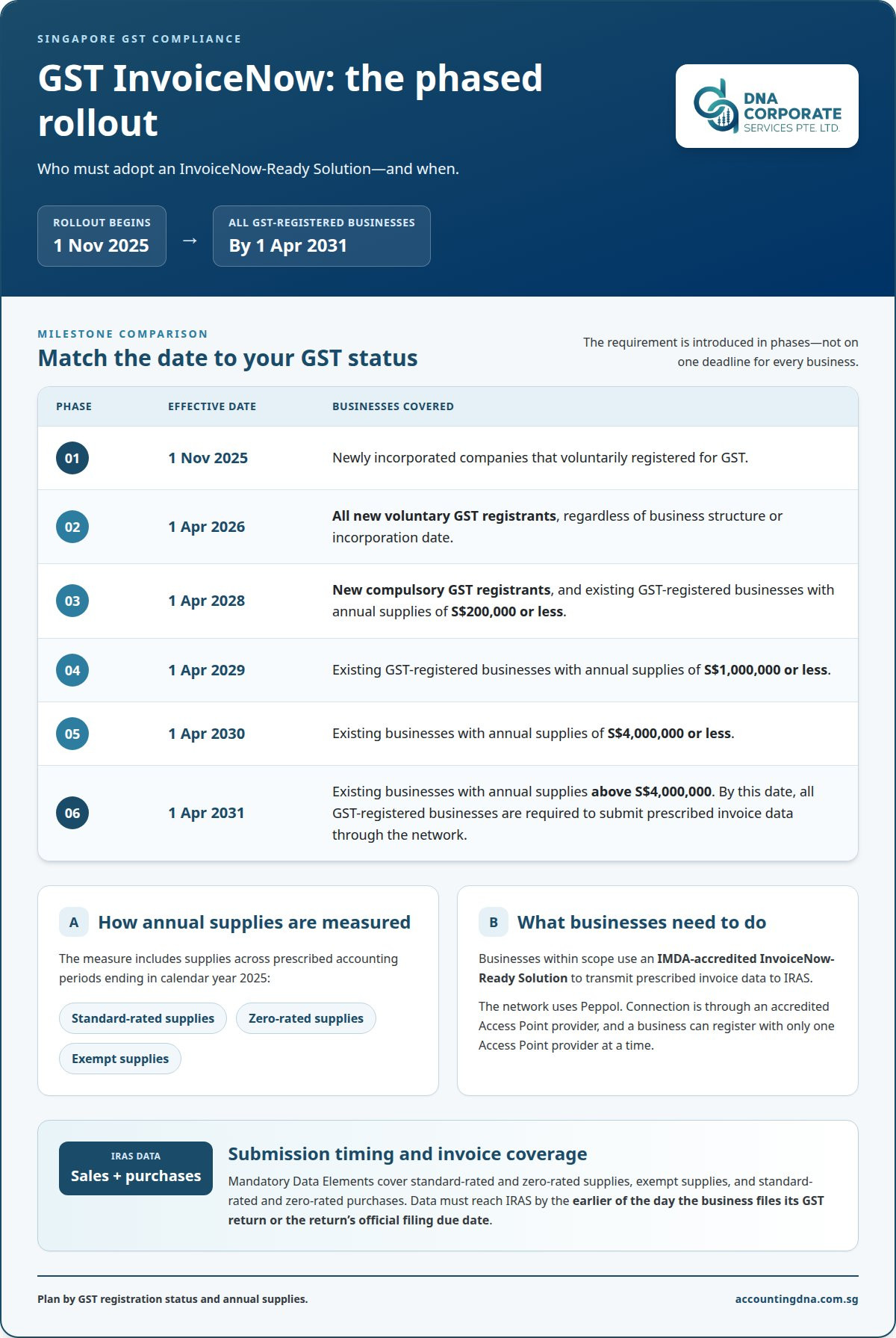
A business connects through an Access Point provider accredited by Singapore’s Infocomm Media Development Authority (IMDA) and receives a Peppol ID through the SG Peppol Directory. It can register with only one Access Point provider at a time. Businesses within the GST requirement’s scope use an IMDA-accredited InvoiceNow-Ready Solution to transmit prescribed invoice data to IRAS.
Singapore’s InvoiceNow-Ready Solutions are available through IMDA-accredited providers. Compare compatibility with your accounting system and the invoice-data workflows your business needs. The network is designed to support secure transmission of invoice data. Businesses should also restrict system access to authorised users and manage invoice records carefully.
Eligible GST-registered businesses can receive a S$1,000 GST InvoiceNow Transition Grant. It is available from 1 July 2026 to 31 March 2030, or until fully claimed, whichever is earlier. Free-of-charge InvoiceNow-Ready Solutions are another option for businesses getting started.
Singapore’s GST InvoiceNow mandate and rollout
Singapore’s GST InvoiceNow requirement phases in structured invoice-data reporting according to GST registration and annual supplies. The nationwide invoicing network uses Peppol to exchange transaction data in a consistent format, connecting business accounting systems with IRAS reporting.
The rollout began on 1 November 2025 for newly incorporated companies that voluntarily registered for GST. From 1 April 2026, all new voluntary GST registrants must adopt an InvoiceNow-Ready Solution, regardless of business structure or incorporation date. From 1 April 2028, the requirement covers new compulsory GST registrants and existing GST-registered businesses with annual supplies of S$200,000 or less.
Existing GST-registered businesses in Singapore with annual supplies of S$1,000,000 or less must comply with the GST InvoiceNow requirement from 1 Apr 2029, according to the Inland Revenue Authority of Singapore. The rollout sets 1 Apr 2030 for existing businesses with annual supplies of S$4,000,000 or less, and 1 Apr 2031 for those above S$4,000,000.
Total annual supplies are calculated using standard-rated, zero-rated and exempt supplies across prescribed accounting periods ending in calendar year 2025. This measure helps businesses identify their implementation phase. By 1 April 2031, all GST-registered businesses are required to submit prescribed invoice data through the network.
There is no single fixed cost: some providers charge monthly or annual subscriptions based on usage tiers and features. Free-of-charge InvoiceNow-Ready Solutions are also available to GST-registered businesses.
For support aligning the rollout with your accounting processes, discuss your GST timeline.
How does InvoiceNow work for businesses?
Singapore’s InvoiceNow network uses Peppol to exchange structured invoice data between finance systems. To connect, a business uses an Access Point provider accredited by the Infocomm Media Development Authority (IMDA).
The connection links a business to the SG Peppol Directory, where it receives a Peppol ID. This identifier supports sending and receiving invoices through the network. A business can register with only one Peppol Access Point provider at a time.
- Connect: Use an accredited Access Point provider and register for a Peppol ID through the SG Peppol Directory.
- Exchange: Send structured invoices through the connected platform, rather than relying only on email attachments or manual re-entry.
- Transmit: If the business is within the GST requirement’s scope, use an IMDA-accredited InvoiceNow-Ready Solution to transmit prescribed invoice data to IRAS.
The prescribed data, known as Mandatory Data Elements, covers standard-rated and zero-rated supplies, exempt supplies, and standard-rated and zero-rated purchases. Reporting therefore includes purchase as well as sales records. Ensure your accounting workflow captures the relevant invoice information.
Data must reach IRAS by the earlier of the day the business files its GST return or the return’s official filing due date. If an invoice is sent incorrectly, the supplier can cancel it by issuing a credit note that refers to that invoice.
These system and recordkeeping steps can affect GST reporting workflows. Discuss your accounting process and how it can support the transition.
DNA Accounting
DNA Accounting helps Singapore businesses connect GST obligations with accurate accounting records. If you’re assessing how the InvoiceNow rollout affects your reporting, its Accounting & Bookkeeping and GST Services can support your recordkeeping and GST processes. This can be particularly useful when invoice data passes through different systems or your team needs a clearer view of how transactions feed into GST reporting.
Support is also useful when reviewing accounting procedures, maintaining records, and managing related tax responsibilities. The right focus depends on your current processes and the compliance work your business needs to manage.
Contact DNA Accounting to discuss support for your business.
Prepare Your Finance Process for the Next Step
Use the transition as a prompt to map how invoice information moves through your business. Identify who handles incoming and outgoing invoices, where records are stored, and how your team will manage exceptions and corrections.
A clear internal process helps directors and finance managers plan responsibilities before implementation. Consider whether staff need updated procedures and how invoice records will be reviewed as part of routine financial reporting.
Set a practical transition plan that fits your business’s workflow and compliance needs. Contact DNA Accounting to discuss your next steps, and move forward with a clearer plan.
Frequently Asked Questions
What is the GST InvoiceNow Requirement?
The requirement applies to GST-registered businesses within scope, but some categories may be excluded. A business that accounts for GST only under the Reverse Charge regime may be excluded, as may entities registered under the Overseas Vendor Registration pay-only or full regime. GST registration alone therefore does not establish whether the requirement applies to a particular business.
Who can register for a Peppol ID/InvoiceNow on behalf of the company?
A person authorised by the company can coordinate registration with its chosen provider. A director or finance administrator may handle the process if authorised to act. The company should use its own details and retain control of the account, keeping responsibility for network access clear when staff or finance roles change.
What is InvoiceNow in Singapore?
It is Singapore’s national e-invoicing initiative for businesses exchanging invoice information digitally. Singapore launched e-invoicing in 2019, and more than 63,000 businesses are on the network. For a business, participation can mean less manual handling of transaction information and a more consistent digital process for sending invoices to connected trading partners.
What are Singapore’s InvoiceNow and Peppol requirements?
Peppol is the framework used for exchanging e-invoices, while the GST reporting obligation applies to businesses that fall within its scope. This distinction matters: joining an e-invoicing network for ordinary business transactions and meeting IRAS’s prescribed GST data-transmission requirement are related, but they are not interchangeable obligations. Certain GST registration regimes may be excluded from the latter.
When does InvoiceNow become mandatory for Singapore businesses?
There isn’t one start date for every business; the applicable phase depends on registration category and annual supplies. Existing GST-registered businesses registered before 2026 were to be informed by IRAS of their respective implementation dates by mid-2026. Use the phase schedule in this guide to identify the deadline relevant to your business, rather than assuming all GST registrants share one date.
Disclaimer
The information provided on this website is for general informational purposes only and is not intended to constitute professional accounting, tax, legal, or financial advice. While we strive to ensure that the content is accurate and up to date, regulations in Singapore, including those administered by ACRA, IRAS, CPF Board, and MOM, may change from time to time and may differ depending on individual circumstances.
Readers should not act or rely on any information contained on this website without seeking specific advice from a qualified professional based on their individual situation.
DNA Corporate Services and its affiliates accept no responsibility or liability for any loss or damage arising from reliance on the information provided in this website or any linked materials.
For tailored advice relating to accounting, taxation, corporate secretarial, or compliance matters in Singapore, please contact us directly for professional consultation.



