

Is your nominee director just a name on a piece of paper, or a ticking legal time bomb for your Singapore company? Many foreign entrepreneurs feel a sense of dread when they realize that a nominee director carries the exact same legal weight as any board member under the Companies Act 1967. Meeting the nominee director requirements Singapore enforces is critical now that the 2024 Corporate Service Providers Act is in full force. You want to focus on growth, not worry if you’re risking a $25,000 penalty for a filing oversight.
This guide helps you master these legal obligations for 2026. You’ll learn how to appoint a resident director safely through a registered CSP while protecting your business from interference. We’ll walk you through the new ROND obligations and show you how to maintain a compliant, secure structure that satisfies every regulatory hurdle.
Key Takeaways
- Understand why every Singapore company must appoint at least one resident director under Section 145 of the Companies Act 1967.
- Discover how the 2024 CSP Act has updated the nominee director requirements Singapore businesses must meet, including mandatory vetting by registered providers.
- Learn how to maintain your Register of Nominee Directors (ROND) and meet the strict two business day ACRA filing deadline to avoid penalties of up to $25,000.
- Identify the legal fiduciary duties of a nominee director to ensure your business remains fully compliant while protecting your operational control.
Understanding Nominee Director Requirements in Singapore (2026 Update)
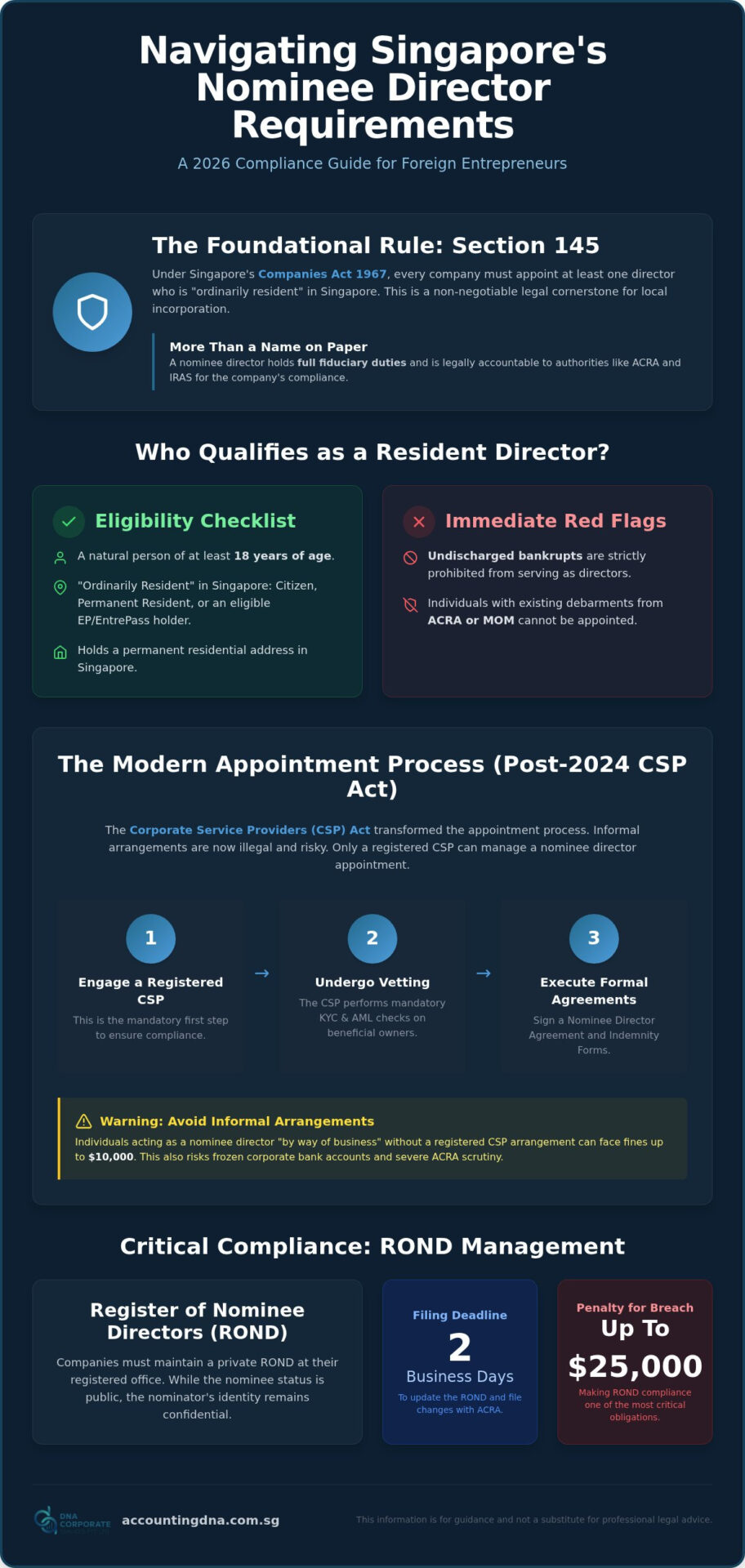
It’s common to think of a nominee as a “sleeping” partner. While they typically don’t touch daily operations, they aren’t invisible to the law. They hold full fiduciary duties. This means they’re legally responsible for the company’s compliance with ACRA and IRAS. Understanding Corporate Governance is vital here; even a non-executive nominee must ensure the company acts honestly and with reasonable diligence. If the company fails to meet its statutory obligations, it’s the resident director who is held accountable.
Who Qualifies as a Resident Director in Singapore?
Not just anyone can fill this role. ACRA has strict criteria to ensure accountability. To qualify, an individual must:
- Be a natural person at least 18 years of age.
- Be “ordinarily resident” in Singapore, which usually means a Singapore Citizen, a Permanent Resident, or an eligible EntrePass or EP holder.
- Have a permanent residential address in Singapore.
Certain red flags will immediately disqualify a candidate. Undischarged bankrupts or individuals with existing ACRA or MOM debarments cannot serve. Choosing the right partner through corporate secretarial services ensures your appointee is properly vetted and reliable, protecting your company from unnecessary compliance risks.
The Appointment Process: Navigating the 2024 CSP Act Obligations
The process of appointing a resident director has shifted from a simple handshake deal to a strictly regulated procedure. Under the Corporate Service Providers (CSP) Act, which came into effect on June 9, 2025, you can’t simply ask a local friend to help out for a fee. It’s now illegal for an individual to act as a nominee director “by way of business” unless the appointment is managed through a registered CSP. This ensures every appointment aligns with the statutory demands of Singapore’s Companies Act 1967 and maintains the integrity of the local business ecosystem.
Your first step involves engaging an ACRA-registered provider. They’ll conduct stringent Know Your Customer (KYC) and Anti-Money Laundering (AML) checks on your company’s beneficial owners. While this might feel like a hurdle, it’s a protective measure for everyone involved. Once cleared, you’ll execute a formal Nominee Director Agreement and Indemnity forms. These documents clearly define the non-executive nature of the role, ensuring the nominee doesn’t interfere with your business while protecting both parties from unforeseen legal liabilities. Meeting the nominee director requirements Singapore enforces is easier when you have a partner handling the complex paperwork.
The End of Informal Arrangements: Why Professional CSPs are Mandatory
Why avoid informal setups? Relying on a friend or an employee to meet nominee director requirements Singapore law sets can lead to absolute disaster. If the arrangement isn’t handled through a licensed CSP, you risk heavy ACRA scrutiny or even having your corporate bank accounts frozen. In fact, individuals acting as nominees without a CSP’s arrangement can face fines of up to $10,000. Professional corporate secretarial services provide a legal buffer, ensuring your company isn’t flagged for non-compliance. If you’re unsure about your current setup, feel free to reach out for a compliance check to keep your business safe.
Mitigating Risks and Managing the Register of Nominee Directors (ROND)
Managing the administrative side of a business can feel heavy, especially when dealing with the Register of Nominee Directors (ROND). Since June 16, 2025, ACRA has mandated that all companies maintain this private register at their registered office. It’s not just about keeping a list; it’s about lightning-fast transparency. If there’s any change in your nominee’s status, you must update your internal ROND and file the change with ACRA’s Central Register within just 2 business days. While the director’s nominee status is public, your identity as the nominator remains confidential. In 2026, penalties for ROND breaches can reach $25,000, making it one of the most critical nominee director requirements Singapore imposes on foreign-owned entities.
You should also understand the “Double Liability” reality. Your nominee director isn’t just a figurehead. They share identical legal responsibilities with you for any ACRA or IRAS defaults. This is why professional providers require security deposits; the nominee is personally on the hook if the company fails to file tax returns or annual declarations. This strictness stems from Section 145 of the Companies Act 1967, which anchors the legal framework for residency and board accountability. Ensuring your company stays compliant protects both your business and the individual standing in for you.
Exit Strategy: Transitioning to Your Own Resident Directorship
Most founders view a nominee as a bridge. Once you secure your Employment Pass and establish residency, you can step into the resident director role yourself. We recommend having a “Letter of Resignation” signed and held in escrow from the start of the engagement. This allows for a seamless transition without operational hiccups. If you’re just starting this journey, our specialized corporate secretarial services can help you structure your board for long-term independence. You may also want to review our Guide to Company Incorporation Singapore as you plan your local expansion.
Future-Proof Your Singapore Business Compliance
You don’t have to navigate these statutory regulations alone. Our team is ready to act as your protective guide in Singapore’s complex regulatory environment. Secure your Singapore compliance with our professional Nominee Director services; contact us today. We look forward to helping your business thrive in the Lion City.
Frequently Asked Questions
Can a nominee director access my company bank account?
A nominee director typically does not have access to your company bank accounts. In a professional arrangement, the nominee is a non-executive director who doesn’t involve themselves in daily operations or financial transactions. You remain the sole bank signatory. This setup ensures you maintain full control over your business funds while meeting the mandatory nominee director requirements Singapore law dictates for residency.
What is the standard security deposit for a nominee director in Singapore?
Security deposits are standard practice in Singapore to protect the nominee director from potential legal and financial liabilities. While amounts vary across the industry, these funds are generally refundable and held as a safeguard against statutory defaults or unpaid government fines. It’s best to check with your Corporate Service Provider for their specific terms to ensure there are no hidden surprises in your agreement.
Does a nominee director have the power to sign contracts for the business?
Legally, any director has the authority to bind a company, but a nominee director’s powers are strictly limited by your service agreement. Most professional arrangements include an indemnity clause and a clear understanding that the nominee will not sign contracts or make operational decisions. This structure allows you, as the beneficial owner, to manage all commercial negotiations and legal commitments independently.
What happens if my company fails to file annual returns with a nominee director?
Failing to file annual returns triggers immediate ACRA penalties and can lead to the prosecution of all directors, including the nominee. In 2026, late filing penalties can escalate quickly; persistent non-compliance might result in a director being debarred. Because the nominee shares legal responsibility for these defaults, they must ensure the company meets all nominee director requirements Singapore law establishes to avoid personal liability.
Disclaimer
The information provided on this website is for general informational purposes only and is not intended to constitute professional accounting, tax, legal, or financial advice. While we strive to ensure that the content is accurate and up to date, regulations in Singapore, including those administered by ACRA, IRAS, CPF Board, and MOM, may change from time to time and may differ depending on individual circumstances.
Readers should not act or rely on any information contained on this website without seeking specific advice from a qualified professional based on their individual situation.
DNA Corporate Services and its affiliates accept no responsibility or liability for any loss or damage arising from reliance on the information provided in this website or any linked materials.
For tailored advice relating to accounting, taxation, corporate secretarial, or compliance matters in Singapore, please contact us directly for professional consultation.



