

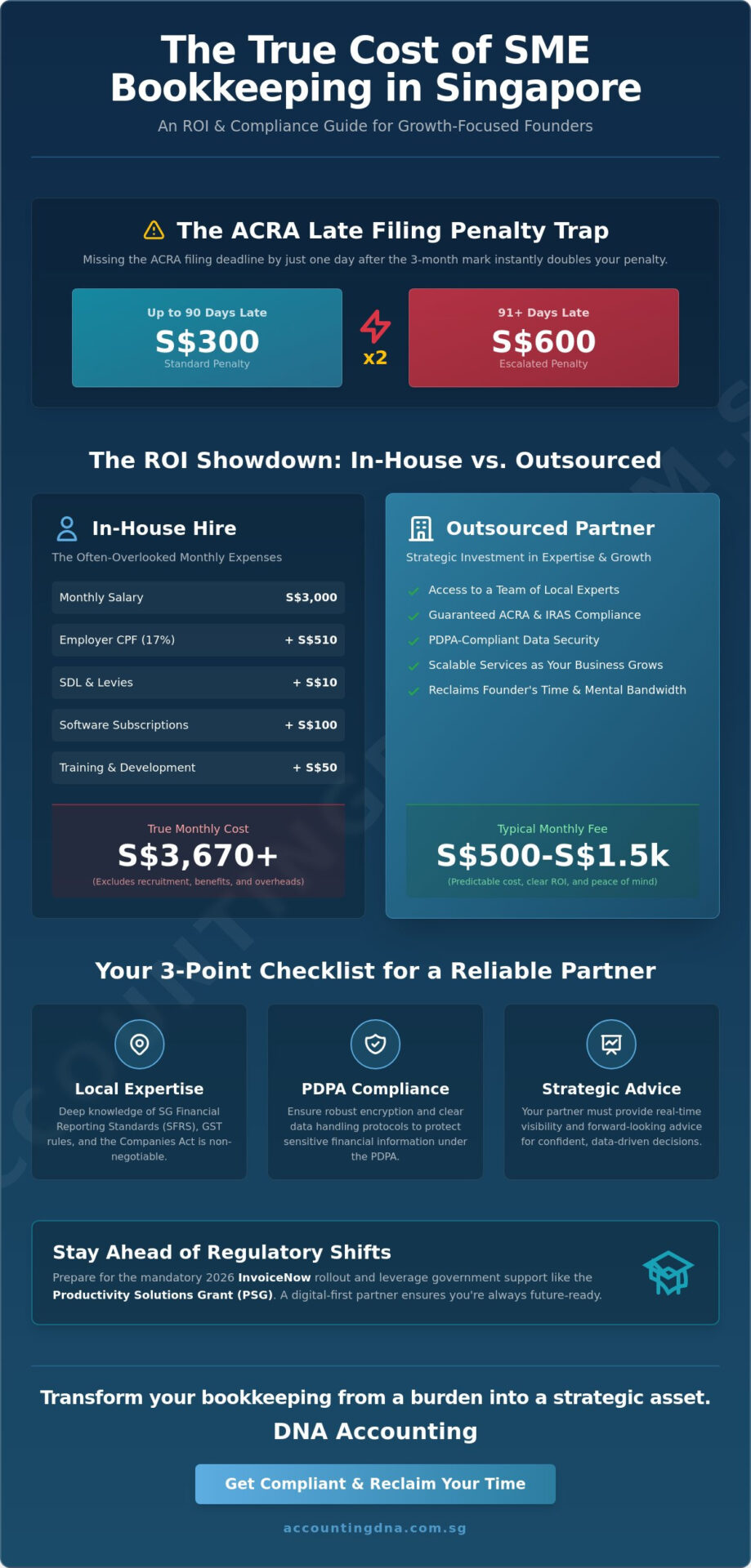
Did you know that missing an ACRA filing deadline by just 91 days can instantly double your late penalty from S$300 to S$600? For many Singaporean business owners, the fear of IRAS audits or late filing fees is a constant, nagging weight that distracts from actual growth. It’s exhausting to spend your evenings reconciling messy accounts or worrying if you’ve correctly applied the 9% GST rate to every transaction. You started your company to innovate and lead, not to get buried under a mountain of administrative paperwork and evolving compliance mandates like the 2026 InvoiceNow rollout.
Finding the right outsourced bookkeeping services Singapore can transform this administrative burden into a strategic advantage for your SME. This guide is designed to help you select a reliable partner who ensures full compliance with Singapore Financial Reporting Standards while optimizing your tax position and reclaiming your precious time. We will explore how to leverage government support like the Productivity Solutions Grant to subsidize your digital transition and provide a clear roadmap for choosing a service that offers real-time visibility into your cash flow for the year ahead.
Key Takeaways
- Safeguard your business from escalating ACRA late filing penalties and IRAS audits by transforming your bookkeeping from a chore into a strategic compliance shield.
- Identify the critical non-negotiables for evaluating outsourced bookkeeping services Singapore, ensuring your partner possesses the local expertise and PDPA compliance necessary for your peace of mind.
- Break down the true ROI of outsourcing versus in-house hiring by accounting for often-overlooked costs like employer CPF contributions and the Skills Development Levy (SDL).
- Learn to avoid common compliance pitfalls and “messy accounts” that trigger costly regulatory scrutiny and unnecessary stress during the tax season.
- Discover how a boutique, personalized approach to financial management provides the real-time visibility needed to make confident, data-driven decisions for your company’s growth.
The Strategic Value of Outsourced Bookkeeping Services in Singapore
Bookkeeping in Singapore has evolved far beyond the simple act of recording expenses in a ledger. For modern SMEs, it’s now a comprehensive financial management solution that acts as the heartbeat of the company. Choosing outsourced bookkeeping services Singapore means you aren’t just hiring someone to punch numbers into a spreadsheet; you’re securing a strategic partner who ensures your business remains resilient against regulatory shifts. In a landscape where the 2026 InvoiceNow mandate is becoming the standard for GST-registered entities, having a digital-first financial foundation is no longer optional. It’s the difference between having real-time visibility into your cash flow and flying blind into tax season.
The shift from traditional paper-based systems to cloud-integrated accounting allows business owners to access digital financial insights from anywhere. This transition is vital because Singapore’s regulatory environment is one of the most efficient, yet strictly enforced, in the world. Professional accounting outsourcing provides a “compliance-first” framework that protects your company from the ground up. By leveraging automated data entry and expert oversight, you transform your back-office from a cost center into a growth catalyst.
Navigating ACRA and IRAS Compliance Requirements
Under the Singapore Companies Act, every company is legally mandated to maintain “proper accounts and records” that sufficiently explain its transactions and financial position. This isn’t a suggestion; it’s a statutory requirement. High-quality bookkeeping and accounting services are essential for preparing the financial statements needed for your Annual Return (AR) with ACRA and your Corporate Tax filing (Form C-S or Form C) with IRAS. If your books don’t align with the Singapore Financial Reporting Standards (SFRS), you risk more than just messy spreadsheets. You risk significant penalties, director disqualifications, and the stress of a full-scale tax audit. A professional partner ensures every entry is “audit-ready” long before a deadline ever appears on the horizon.
Why Startups and SMEs Should Outsource from Day One
Many new founders fall into the “DIY bookkeeping” trap, thinking they’ll save a few dollars by managing the accounts themselves. This is a high-risk gamble. Errors made in the first year often snowball, leading to massive “cleanup” costs when it’s time for the first tax filing or when a potential investor asks to see the books. Outsourcing from the start prevents these expensive headaches. It provides you with a professional point of contact for ACRA inquiries and ensures your statutory records are pristine. By delegating these tasks to a dedicated expert, you reclaim your mental bandwidth to focus on what you do best: building your business and serving your customers.
Key Criteria: How to Choose the Right Bookkeeping Partner
How do you separate a truly reliable partner from a mere data entry clerk? When searching for outsourced bookkeeping services Singapore, the stakes are higher than just balanced ledgers. You’re looking for a guardian for your company’s reputation. The first non-negotiable is local expertise. A firm might understand general accounting principles, but if they aren’t intimately familiar with Singapore’s specific GST rules or the nuances of the Companies Act, your business is at risk. While some business owners focus solely on the benefits of offshore outsourcing to cut costs, the most successful SMEs prioritize a partner who provides a local anchor for compliance.
Data security is another critical pillar. Under the Personal Data Protection Act (PDPA), your firm is responsible for the sensitive financial information of your directors and employees. A professional bookkeeping partner should have robust encryption and clear data handling protocols in place. Beyond security, evaluate their communication style. Are they proactive, or do they only reach out when a deadline has already passed? A “cheap” service often feels like a bargain until you’re hit with an ACRA late filing penalty because your provider was too overwhelmed to respond to your emails. True value lies in a partner who is accessible, even during non-traditional hours, to help you make sense of a complex financial situation. If you’re feeling overwhelmed by your current setup, it might be time to speak with a specialist who prioritizes your peace of mind.
Cloud Accounting Expertise: Xero and QuickBooks Integration
In 2026, cloud-based systems are the mandatory standard for efficient Singapore SMEs. Whether you prefer Xero for its user-friendly interface or QuickBooks for its robust reporting, your partner must be an expert in both. These platforms allow for automated bank feeds and seamless InvoiceNow integration, which drastically reduces human error. By linking your invoicing directly to the national e-invoicing network, you ensure your GST records are accurate and ready for the real-time compliance checks that IRAS increasingly favors.
Assessing Professional Accreditation and Advisory Depth
Don’t settle for a firm that only offers basic bookkeeping. Look for a team led by qualified Chartered Accountants (CA Singapore) who understand the full lifecycle of a business. Your partner should be able to scale with you, moving effortlessly from simple monthly accounts to complex GST and corporate tax filings. A great bookkeeper doesn’t just record the past; they provide proactive advice on tax deductions and cash flow management, helping you keep more of your hard-earned revenue within the business.
The ROI Analysis: Outsourcing vs. In-house Hiring in Singapore
Have you ever calculated the true price of a single desk in your office? When you hire an in-house accountant, the monthly salary is just the tip of the iceberg. In Singapore’s competitive labor market, the total cost of employment includes mandatory employer CPF contributions of up to 17% and the Skills Development Levy (SDL). By the time you add in medical insurance, annual leave, and office equipment, your junior accountant’s salary has ballooned by nearly 30%. Opting for outsourced bookkeeping services Singapore eliminates these overheads instantly. It allows you to convert fixed labor costs into a variable expense that scales with your business.
The financial benefit isn’t just about avoiding a salary. It’s about the elimination of recruitment fees, training time, and the recurring costs of software subscriptions for platforms like Xero or QuickBooks. When you outsource, your provider absorbs the cost of keeping their team updated on the latest ACRA regulations and IRAS tax changes. You’re paying for an outcome, such as accurate and audit-ready books, rather than just paying for someone to sit at a desk for 40 hours a week. This shift in perspective turns your accounting function from a heavy administrative burden into a lean, efficient operation.
Calculating the Real Cost of a Full-time Accountant
A junior accountant in Singapore typically expects a monthly salary between S$3,500 and S$4,800. A senior professional can easily command S$6,500 or more. Beyond the paycheck, you’re also paying for their idle time during slow months. There’s also the significant factor of key man risk. If your sole accountant resigns right before the November tax filing deadline, your company faces a compliance crisis. Outsourcing removes this vulnerability by providing a dedicated team. This ensures your books are updated even during peak holiday seasons and year-end rushes, providing a level of continuity that one person simply cannot match.
Scalability: Paying Only for What Your SME Needs
Why pay for a full-time resource when your transaction volume fluctuates? Most SMEs experience seasonal peaks and valleys. An outsourced model allows you to pay based on your actual activity level. You can start with basic monthly reporting and seamlessly add GST filing or XBRL conversion only when your turnover crosses the mandatory threshold. This flexibility is a core part of how DNA Accounting’s pricing is structured. It ensures that startups don’t overpay for services they don’t yet require. Growing firms get the robust support they need without the friction of a new hire. You gain access to high-level expertise without the high-level price tag.
Avoiding Common Compliance Pitfalls and ACRA Penalties
What happens when a small bookkeeping error turns into a full-scale IRAS audit? For many Singaporean entrepreneurs, the reality of “messy books” only hits home when a letter from the tax authorities arrives. Relying on outsourced bookkeeping services Singapore is often the most effective way to prevent these stressful scenarios. IRAS frequently flags businesses with inconsistent profit margins or mismatched figures between their GST returns and annual financial statements. Without a professional eye, you might accidentally claim input tax on “blocked” items, such as passenger cars or medical insurance for non-employees, which can lead to heavy fines and a tarnished reputation.
Disorganized financial records don’t just attract penalties; they also block your path to growth. If you’re planning to apply for a bank loan or a government grant like the Enterprise Development Grant (EDG), your books must be pristine. Banks and government agencies require at least two to three years of clear, audit-ready financial statements to assess your creditworthiness. If your records are a tangle of missing receipts and unrecorded expenses, you’re essentially leaving money on the table. If you’re worried your current records wouldn’t pass a professional review, it’s time to consult with an expert before your next filing deadline.
Late Filing Risks: Annual Returns and GST Deadlines
Private limited companies in Singapore must file their Annual Return (AR) with ACRA within seven months of their Financial Year End (FYE). Additionally, GST-registered businesses are required to submit their F5 returns every quarter. A common pitfall is forgetting to file the Estimated Chargeable Income (ECI) within three months of the FYE, even if the company has zero income. ACRA imposes a late filing penalty of S$300 for delays up to three months, which doubles to S$600 for longer delays, while IRAS penalties for missing tax deadlines can reach up to S$5,000 per offense.
The Danger of Manual Data Entry and Disorganized Records
The era of “shoebox accounting” is over. Stashing physical receipts in a drawer leads to missing tax deductions because ink fades and paper gets lost. Even worse is the habit of commingling personal and business expenses, which makes it nearly impossible to defend your tax position during an audit. Professional bookkeeping services eliminate these risks by creating a digital, audit-ready trail. Every transaction is categorized and supported by digital documentation, ensuring that you only pay the tax you actually owe while maintaining full transparency for any future regulatory inquiries.
DNA Accounting: Personalized Bookkeeping for Singapore Entrepreneurs
Why settle for a faceless service provider when your business deserves a dedicated guardian? At DNA Accounting, we believe that outsourced bookkeeping services Singapore should be as unique as the companies they serve. We position ourselves as the boutique alternative to large, impersonal firms where your account is often lost in a sea of thousands. To us, your financial records aren’t just data points; they’re the foundational code that determines your company’s health and longevity. We don’t just “do the books”; we integrate into your business to provide the stability you need to scale.
Our “DNA” philosophy is built on the idea that bookkeeping is the vital, foundational support necessary for business life. We understand that entrepreneurship doesn’t follow a 9-to-5 schedule. That’s why our team makes a point of being available during evenings and non-working days for urgent support. Whether you have a burning question about a late-night transaction or need immediate clarity before an early morning meeting, we’re here to provide the reassurance you need to sleep soundly. Our centralized service model ensures that you have one dedicated point of contact who understands every facet of your compliance needs, from incorporation to your final tax submission.
The Boutique Advantage: Direct Access to Senior Advisors
Most large firms rely on complex ticketing systems that can leave you waiting days for a simple answer. At DNA Accounting, we provide direct access to senior advisors who know your business by name, not by a case number. This personalized approach leads to better tax planning and business insights, as we can spot trends and opportunities that automated systems might miss. We take the time to explain your financial position in plain English, helping you make confident decisions. If you’re ready for a more attentive partnership, we invite you to get in touch with our experts for a bespoke consultation.
Comprehensive Support Beyond Just Bookkeeping
Your business needs change as you grow, and our support is designed to evolve with you. We offer a holistic view of your company’s “DNA” by integrating corporate secretarial and tax filing services into our core offerings. This ensures that no compliance gap is left open and that your filings with ACRA and IRAS are always perfectly synchronized. By removing the administrative burden from your shoulders, we empower you to focus entirely on growth. We’re committed to helping Singapore SMEs thrive by providing the expert oversight and proactive care that every ambitious founder deserves.
Secure Your Company’s Financial Future
Choosing the right outsourced bookkeeping services Singapore is about more than just balancing monthly ledgers; it’s about building a resilient compliance shield for your business. You’ve seen how outsourcing eliminates the heavy overhead of employer CPF contributions and the Skills Development Levy (SDL) while keeping your records audit-ready for ACRA and IRAS. By moving away from disorganized manual records and embracing real-time digital insights, you reclaim the mental bandwidth needed to focus on your core mission and business growth.
Ready to transform your back-office into a strategic asset? Get a Personalized Bookkeeping Consultation Today and let us help you simplify your path to success. We’re here to ensure your business thrives in the 2026 landscape and beyond.
Frequently Asked Questions
Is it better to hire a freelance bookkeeper or an accounting firm in Singapore?
Hiring an accounting firm is generally more reliable than a freelancer because it offers team redundancy and professional accountability. Freelancers might be cheaper initially, but they often lack the bandwidth to handle complex ACRA inquiries or provide support if they fall ill. A firm ensures your compliance doesn’t stop just because one person is away, providing a stable foundation for your business.
What are the typical fees for outsourced bookkeeping services in Singapore?
Most providers in Singapore offer tiered pricing based on your monthly transaction volume and the complexity of your business operations. A simple holding company with few transactions will pay significantly less than a high-volume retail business or a GST-registered firm. You’re paying for the peace of mind that comes with accurate, audit-ready accounts rather than just a flat hourly rate.
What documents do I need to provide to my outsourced bookkeeper monthly?
You should typically provide your bookkeeper with monthly bank statements, sales invoices, supplier bills, and expense receipts. If you have employees, you’ll also need to share payroll records and CPF contribution statements. Using digital tools allows you to upload these documents instantly, ensuring your outsourced bookkeeping services Singapore team stays updated in real-time without the need for physical paperwork.
Can an outsourced bookkeeping service help with my GST registration and filing?
Yes, a professional bookkeeping partner can manage your entire GST lifecycle, from monitoring your S$1 million turnover threshold to submitting quarterly F5 filings. They ensure your input tax claims are legitimate and that your records comply with the latest IRAS mandates. This prevents the heavy fines and interest charges associated with incorrect GST reporting or missed deadlines.
How does cloud accounting software like Xero improve my business security?
What happens if I miss the ACRA filing deadline for my Annual Return?
Missing the ACRA filing deadline results in an immediate late filing penalty of S$300, which increases to S$600 if the return is more than three months late. Beyond the financial cost, persistent non-compliance can lead to a court summons or the disqualification of company directors. It’s a serious matter that can damage your business’s reputation and your ability to secure bank loans in the future.
Do I still need a bookkeeper if my company is currently dormant?
Even dormant companies have statutory obligations that require basic bookkeeping to satisfy ACRA and IRAS requirements. You must still prepare financial statements to file your Annual Return and submit a tax return unless you’ve successfully applied for a waiver. Professional outsourced bookkeeping services Singapore can handle these minimal requirements efficiently so you don’t accidentally trigger penalties while your business is inactive.
How often should I receive financial reports from my outsourced accountant?
Active SMEs should ideally receive financial reports every month to maintain clear visibility into their cash flow and profitability. Monthly reporting allows you to spot potential issues early and make informed decisions before the quarter ends. If your business has very low activity, quarterly reports might suffice, but consistent updates are essential for staying audit-ready and making data-driven growth plans.
Disclaimer
The information provided on this website is for general informational purposes only and is not intended to constitute professional accounting, tax, legal, or financial advice. While we strive to ensure that the content is accurate and up to date, regulations in Singapore, including those administered by ACRA, IRAS, CPF Board, and MOM, may change from time to time and may differ depending on individual circumstances.
Readers should not act or rely on any information contained on this website without seeking specific advice from a qualified professional based on their individual situation.
DNA Corporate Services and its affiliates accept no responsibility or liability for any loss or damage arising from reliance on the information provided in this website or any linked materials.
For tailored advice relating to accounting, taxation, corporate secretarial, or compliance matters in Singapore, please contact us directly for professional consultation.



