

Did you know that IRAS took action against over 4,700 companies in 2023 for failing to meet their filing obligations? It’s a sobering reality that statutory compliance Singapore isn’t just a tedious administrative hurdle; it is the foundational DNA that protects your company’s reputation and your personal standing as a director. We know how draining it is to juggle ACRA deadlines and the new $8,000 CPF wage ceiling while trying to grow a business. The constant fear of a $600 late penalty or a complex tax audit can make even the most seasoned entrepreneur feel overwhelmed.
You deserve to feel confident that your business is on solid ground. This master guide will help you navigate the essential regulatory requirements for 2026 and show you how to maintain a flawless record with zero stress. We’ll walk through the mandatory filing calendar, clarify recent changes to employer contributions, and explain how a trusted partner can handle the boring paperwork so you can get back to what you do best.
Key Takeaways
- Map out your ACRA filing timeline, including how to strategically set your Financial Year End to better manage your company’s cash flow and administrative deadlines.
- Navigate the complexities of IRAS tax submissions and GST thresholds for 2026 with confidence, ensuring you never miss an ECI or Form C-S/C filing date.
- Master the essential requirements for statutory compliance Singapore to safeguard your directors from personal liability and avoid the escalating costs of late filing fees.
- Identify common pitfalls in payroll and CPF management that often lead to regulatory scrutiny and learn how to streamline these foundational administrative tasks.
- Discover the benefits of a centralized compliance partner who offers bespoke, boutique support that adapts to your business’s unique growth journey.
What is Statutory Compliance in Singapore and Why Does It Matter?
At its simplest level, statutory compliance in Singapore refers to the mandatory legal framework that every company must follow under the Singapore Companies Act. It’s the set of rules that governs how you register your business, how you report your finances, and how you conduct your annual meetings. Think of it as the “DNA” of your company. Just as DNA provides the blueprint for a living organism, your compliance record provides the blueprint for your business’s health and longevity. When this foundation is strong, your brand remains protected and your creditworthiness stays intact.
The primary watchdogs overseeing this landscape are ACRA and IRAS. They aren’t just there to collect fees or enforce rules; they ensure that Singapore remains a transparent and trustworthy place to do business. We understand that the weight of these regulations can feel heavy. Many directors spend sleepless nights worrying about missed deadlines or conflicting paperwork. However, compliance shouldn’t be a source of anxiety. It’s actually a tool for professional security. By mastering these requirements, you move from a state of constant “firefighting” to a position of total control and confidence.
The Core Pillars of Singaporean Business Regulation
The regulatory environment is built on the interaction between the Companies Act and the Income Tax Act. While one focuses on corporate governance and transparency, the other ensures the nation’s fiscal health. These Statutory boards of the Government of Singapore work in tandem to create a stable ecosystem. This is why Singapore consistently ranks as a top global startup destination. Investors know that the rules are clear and the data is reliable.
It’s vital to distinguish between your internal governance and these external statutory requirements. Your internal SOPs might dictate how you run your daily operations, but statutory compliance is non-negotiable. It’s the public-facing evidence that your business is legitimate. Whether it’s updating your register of registrable controllers or filing your annual returns, these tasks are the “boring” but essential heartbeat of your enterprise.
Benefits of a Flawless Compliance Record
A clean record is a powerful business asset that opens doors. Have you ever tried to open a corporate bank account or apply for a business loan? The first thing banks and financial institutions check is your compliance history. A single late filing on your ACRA BizFile can raise red flags and delay your expansion plans. Conversely, a flawless record acts as a green light for lenders and partners alike.
During due diligence, potential investors will scrutinize your records. They want to see that you’ve managed your administrative duties with the same care you’ve given to your product. Beyond trust, there are financial perks too. Staying compliant ensures you remain eligible for various government grants and tax exemption schemes. In Singapore, the government rewards transparency. By keeping your house in order, you aren’t just avoiding penalties; you’re actively positioning your business for maximum growth and support.
Core ACRA Compliance: Managing Your Annual Filing Cadence
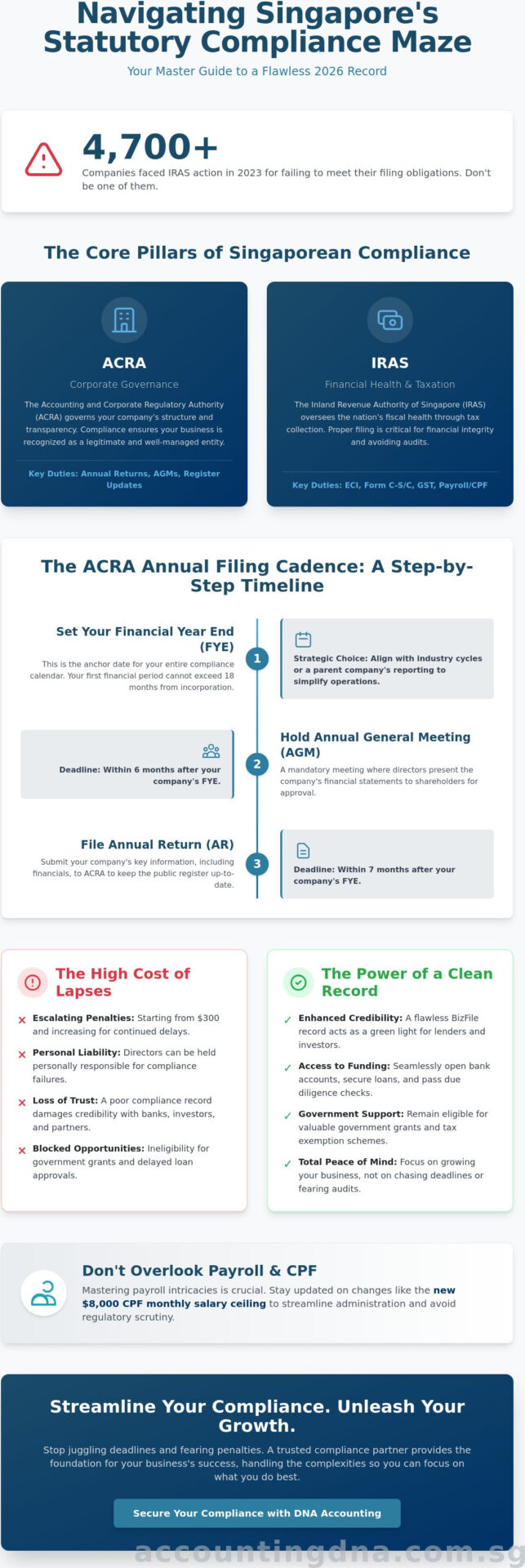
Managing your company’s obligations shouldn’t feel like a guessing game. In Singapore, ACRA compliance follows a logical, sequential rhythm where one event naturally triggers the next. It all begins with your Financial Year End (FYE). This date represents the completion of your accounting cycle and serves as the anchor for your entire compliance calendar. For new startups, choosing an FYE is a strategic decision. You might align it with your industry’s peak season or a parent company’s reporting cycle to simplify your consolidated accounts. If you’re still in the early stages of setting up your business, understanding the full process of company incorporation Singapore can help you make these foundational decisions correctly from day one.
Determining and Changing Your Financial Year End (FYE)
When you incorporate, you must decide on your first FYE. A critical rule to remember is that your first financial period cannot exceed 18 months from the date of incorporation. If you find that your chosen date no longer suits your operations, you can notify ACRA of a change. However, you cannot change your FYE if the current financial year has already ended and the statutory deadlines for meetings or filings have passed. Setting this date correctly is the first step in mastering statutory compliance Singapore, as it dictates when your financial statements must be ready for review.
Once your FYE passes, the clock starts ticking for your Annual General Meeting (AGM). For private companies, you must hold your AGM within six months after your FYE. This meeting is where directors present the company’s financial statements to shareholders, ensuring transparency and accountability. Following the AGM, you have 30 days to file your Annual Return (AR) via the BizFile+ portal. This filing includes essential disclosures such as your company’s share capital, registered address, and the particulars of your directors and officers. Staying on top of these ACRA annual filing requirements prevents the accumulation of late fees, which start at $300 for even a minor delay.
The Vital Role of the Corporate Secretary
You are legally required to appoint a qualified Company Secretary within six months of incorporation. This person is far more than just a name on a form; they are the gatekeeper of your company’s legal standing. They maintain your statutory registers, record minutes of meetings, and ensure that all changes to company officers or shareholdings are reported to ACRA promptly. An unresponsive secretary is a significant risk. If they miss a filing window, it’s the directors who face the penalties and potential disqualification. If you’re feeling the weight of these administrative tasks, our team provides expert corporate secretarial services to ensure your registers are always audit-ready and your filings are submitted well ahead of the deadline.
By treating these requirements as a connected cycle rather than isolated tasks, you create a sustainable rhythm for your business. This proactive approach ensures that statutory compliance Singapore becomes a seamless part of your operations, allowing you to focus on your growth strategy instead of paperwork.
IRAS and Financial Compliance: Tax, GST, and Payroll
While ACRA oversees your corporate identity, IRAS manages your financial footprint. Managing tax and payroll is often where business owners feel the most pressure. It’s not just about the math; it’s about interpreting the specific rules found in the Singapore Statutes Online. Effective statutory compliance Singapore requires a dual focus on both corporate income tax and your obligations as an employer. Missing these deadlines doesn’t just result in 5% late payment penalties; it can damage your standing with the authorities for years. We understand that these numbers can feel daunting, but with a clear roadmap, you can move from anxiety to professional security.
Navigating the Corporate Tax Season
Is your annual taxable turnover approaching $1 million? If so, GST registration becomes mandatory. With the GST rate at 9%, managing these quarterly filings requires precision to avoid heavy fines. Even if you don’t hit the threshold, voluntary registration might be beneficial if you sell primarily to other GST-registered businesses. Additionally, many companies must prepare their financial statements in XBRL format for ACRA. This digital format allows for better data analysis, though it requires specialized knowledge to execute correctly without errors. If you’re unsure about your obligations, our guide on what is XBRL filing Singapore requires for SMEs in 2026 breaks down the exemption criteria, deadlines, and the BizFinx tool in plain language. For a complete breakdown of your ECI and Form C-S deadlines, eligibility for the 40% CIT rebate, and how to use startup exemptions to reduce your tax bill, our corporate tax filing Singapore guide for SMEs in 2026 covers every essential detail in plain language.
Employer Obligations and CPF Contributions
As an employer in 2026, you must navigate the updated CPF Ordinary Wage ceiling of $8,000 per month. This change reflects the government’s push for retirement adequacy, but it also means your monthly payroll calculations must be exact. For employees aged 55 and below, the total contribution rate remains 37%, split between you and your staff. You also need to account for the Skills Development Levy (SDL), which is a mandatory contribution for all employees, capped at $11.25 per month.
Reporting employee earnings through the Auto-Inclusion Scheme (AIS) is now the standard for most businesses. This system automatically uploads salary data to IRAS, making the individual tax filing process easier for your team. These administrative tasks are foundational to your business’s reputation. We provide comprehensive payroll services and tax support to take this weight off your shoulders, ensuring every cent is accounted for and every deadline is met. By letting us handle the “boring” paperwork, you can focus on the growth and success of your company.
The Real Cost of Non-Compliance: Penalties and Pitfalls
Ignoring your administrative duties doesn’t just lead to a slap on the wrist; it can fundamentally derail your business operations. In 2023 alone, IRAS took action against over 4,700 companies for failing to file their taxes. When you miss an ACRA filing deadline, the financial impact is immediate. Late filing of an Annual Return costs $300 if submitted within three months of the due date, but this jumps to $600 for longer delays. These amounts might seem small at first, but when combined with IRAS penalties, the costs escalate quickly. For unpaid corporate tax, IRAS imposes a 5% late payment penalty, followed by an additional 1% penalty for every month the tax remains outstanding.
The stakes go beyond money. If your company consistently fails to file returns, ACRA may eventually “Strike Off” your business, effectively deeming it inactive and legally non-existent. For directors, the consequences are even more personal. If you have at least three companies struck off by ACRA within five years, you face a five-year disqualification from holding any directorships. This personal liability is a critical reason why maintaining statutory compliance Singapore should be your top priority. It’s not just about the company’s bank account; it’s about your professional future and your ability to lead other ventures.
Compliance for Dormant Companies
A common misconception is that a “dormant” company has no obligations. However, ACRA and IRAS have different definitions of what constitutes dormancy. ACRA considers a company dormant if no accounting transactions have occurred during the financial period. IRAS, on the other hand, defines it as having no income or revenue, even if expenses are still being paid. Even if your business is in a “holding” phase, you still need to appoint a Company Secretary and file your Annual Returns. While you may qualify for simplified filing or certain exemptions, you cannot simply walk away from the paperwork. If you’re unsure if your business qualifies as dormant, we can help you strike off your company properly to avoid mounting penalties.
Common Mistakes SME Owners Make
Even well-intentioned directors often fall into traps. One of the most frequent errors is missing the strict 14-day window to notify ACRA of changes to company particulars, such as a change in registered office address or the appointment of a new director. Another pitfall is failing to maintain updated Statutory Registers at your registered office. These aren’t just internal notes; they are legal requirements that must be available for inspection. Finally, many owners underestimate the complexity of XBRL filing. Converting financial statements into this digital format requires precision, and errors can lead to ACRA rejecting your submission. To avoid costly mistakes, it’s worth understanding exactly what is XBRL filing in Singapore and whether your company qualifies for an exemption as a solvent Exempt Private Company. If you want a detailed breakdown of how the ACRA late filing penalty framework works and how to rectify lapses before they escalate, our comprehensive FAQ guide covers every scenario. Staying on top of these details is the only way to ensure your record remains flawless.
Streamlining Your Compliance Strategy: The DNA Accounting Advantage
Why settle for being just another number in a massive corporate database? Many big corporate providers rely on high-volume, automated systems that often lack the professional judgment required for nuanced tax planning or complex secretarial issues. At DNA Accounting, we believe your business deserves better. We provide a “One-Stop” solution that integrates your accounting, secretarial, and tax services into a single, cohesive workflow. This centralized model eliminates the need for you to act as a middleman between different agencies, ensuring your statutory compliance Singapore record remains spotless while you focus on your core growth strategies.
Our boutique size is our greatest advantage. It allows us to offer the kind of personalized attention that large firms simply cannot match. We act as your dedicated expert, proactively managing your deadlines and providing tailored advice that fits your specific business stage. We also know that entrepreneurship doesn’t follow a 9-to-6 schedule. That’s why we’ve committed to being accessible during evenings and weekends. If a compliance question keeps you up at night, we’re available to provide the answers and reassurance you need to move forward with confidence.
Transitioning to a Professional Compliance Partner
Moving your files to a new partner shouldn’t be a source of stress. We’ve refined the process of changing your Company Secretary or Accountant to be completely seamless. Our team manages the entire handover from your previous provider, ensuring that all statutory registers and financial records are transferred accurately. Once you’re onboard, we conduct a comprehensive “Compliance Health Check” to spot any historical errors or missed filings that could trigger future penalties. We then build a stress-free compliance calendar for your 2026 financial year, so you’ll never have to worry about a surprise deadline again.
Why DNA is Your Protective Partner
We approach every client relationship with empathy. We understand the weight of responsibility that comes with being a company director and the anxiety that conflicting regulations can cause. Our role is to be your protective partner, standing between your business and the complexities of ACRA and IRAS requirements. With a proven track record in meticulous tax planning and administrative excellence, we handle the “boring” tasks so you can reclaim your time. You deserve a partner who is as invested in your success as you are. Get a personalised compliance quote from DNA Accounting today and let us take the lead on your regulatory journey.
Secure Your Business Future for 2026 and Beyond
Mastering statutory compliance Singapore isn’t just about avoiding the $600 late filing fees or the stress of an IRAS audit. It’s about building a business that’s resilient, transparent, and ready for its next phase of growth. We’ve seen how a well-managed compliance calendar protects your reputation and keeps your personal record as a director spotless. By treating your ACRA and IRAS obligations as a strategic asset rather than a burden, you ensure your company remains attractive to banks, investors, and government grant schemes.
Since 2016, DNA Accounting has focused on helping SMEs thrive by providing a one-stop boutique service for all accounting and secretarial needs. We know your work doesn’t stop at 6 PM, so we stay available after-office hours and on weekends to support you. You don’t have to manage complex paperwork alone while trying to scale your operations. Let DNA Accounting handle your Singapore compliance—claim your free consultation today! We’re here to be your protective partner, ensuring your business stays on solid ground so you can focus on the vision that started it all.
Frequently Asked Questions
Is statutory compliance mandatory for small companies in Singapore?
Yes, every company registered in Singapore must adhere to the Companies Act regardless of its size. Being a small business doesn’t grant an exemption from foundational requirements like filing annual returns or maintaining statutory registers. Neglecting these duties can lead to penalties that disproportionately impact a startup’s cash flow and professional standing.
What is the penalty for late filing with ACRA in 2026?
In 2026, ACRA’s penalty for the late filing of an Annual Return is $300 if the submission is within three months of the due date. If you exceed this three-month window, the fine increases to $600. These fixed penalties apply to each specific breach, meaning missing both your AGM and your AR filing could result in a combined $1,200 fine.
Can I be the Company Secretary of my own Singapore company?
You can act as your own Company Secretary only if you aren’t the sole director of the company. The law requires a separate individual to hold the secretary position if there’s only one director. Most owners prefer to outsource this role to ensure statutory compliance Singapore is handled by a professional who stays updated on shifting regulatory requirements.
How long must I keep my company’s financial and statutory records?
You must keep your company’s financial and statutory records for at least five years. This requirement covers everything from invoices and receipts to your register of members and minutes of meetings. Proper record-keeping isn’t just a legal duty; it’s your best defense during a potential IRAS tax audit or an ACRA inspection of your corporate registers.
What is the difference between a Financial Year End and a Tax Assessment Year?
Your Financial Year End (FYE) is the final day of your 12-month accounting cycle, while the Year of Assessment (YA) is the year IRAS assesses your tax. In Singapore, the YA is always the calendar year following the one in which your financial year ended. For example, if your FYE is in December 2025, your tax will be assessed in YA 2026.
Does a dormant company still need to file Annual Returns and Tax?
Yes, dormant companies must still file Annual Returns with ACRA to keep their legal status active. While you may apply for a waiver from IRAS to stop filing income tax returns, this is only granted if the company has no assets and no intention to trade. Maintaining statutory compliance Singapore for a dormant entity is simpler but still requires consistent professional oversight.
What is XBRL and does my small business need to file it?
XBRL is a digital language used for filing financial statements that allows for easier data analysis by regulators. Most Singapore companies must file in this format, though solvent Exempt Private Companies (EPCs) are generally exempt. If your small business doesn’t qualify as an EPC, you’ll need to prepare these digital reports alongside your annual filings to meet ACRA’s standards.
How do I change my company’s registered office address?
You can change your registered office address by filing a “Change in Company Particulars” via the ACRA BizFile+ portal. This update must be completed within 14 days of the move to avoid late filing fees. Don’t forget to also update your address with IRAS, the CPF Board, and other relevant authorities to ensure you receive all official government correspondence. If you are still in the process of setting up your business, our 2026 founder’s guide to company incorporation Singapore walks you through every step of establishing a compliant registered office from the start.
Disclaimer
The information provided on this website is for general informational purposes only and is not intended to constitute professional accounting, tax, legal, or financial advice. While we strive to ensure that the content is accurate and up to date, regulations in Singapore, including those administered by ACRA, IRAS, CPF Board, and MOM, may change from time to time and may differ depending on individual circumstances.
Readers should not act or rely on any information contained on this website without seeking specific advice from a qualified professional based on their individual situation.
DNA Corporate Services and its affiliates accept no responsibility or liability for any loss or damage arising from reliance on the information provided in this website or any linked materials.
For tailored advice relating to accounting, taxation, corporate secretarial, or compliance matters in Singapore, please contact us directly for professional consultation.



