

What if a single digital filing error could lead to a S$600 fine and put your directorship at risk? For many local SME owners, understanding exactly what is XBRL filing Singapore requires can feel like a riddle wrapped in a spreadsheet. It isn’t just a technical format; it’s a digital translation of your business health that ACRA uses to ensure transparency across the city-state. As of January 2026, the enforcement of these deadlines has become stricter than ever, leaving no room for informal grace periods.
We know that the complexity of digital financial tagging and the time-consuming nature of the new BizFinx v4.0 tool can feel overwhelming when you’re already managing daily operations. You might be worried about meeting the strict seven-month deadline or triggering a composition fine. This guide will help you master the essentials of XBRL filing, from confirming your exemption status as a solvent EPC to navigating the latest 2026 validation rules. You’ll gain a clear roadmap for successful submission, ensuring your company remains in good standing without the administrative headache.
Key Takeaways
- Understand exactly what is XBRL filing Singapore mandates for your company in 2026 and whether you qualify for the simplified reporting exemptions.
- Learn why ACRA has shifted from traditional PDF reports to standardized digital data and how this impacts your annual compliance routine.
- Compare the Full XBRL and Simplified templates to determine which reporting format aligns with your specific business size and industry requirements.
- Discover the practical steps for mapping your financial statements to SFRS standards using the updated BizFinx Preparation Tool v4.0.
- Identify the strategic advantages of professional accounting support to avoid the common pitfalls of DIY tagging and ensure error-free submissions.
Understanding XBRL: The Digital Language of Financial Reporting in Singapore
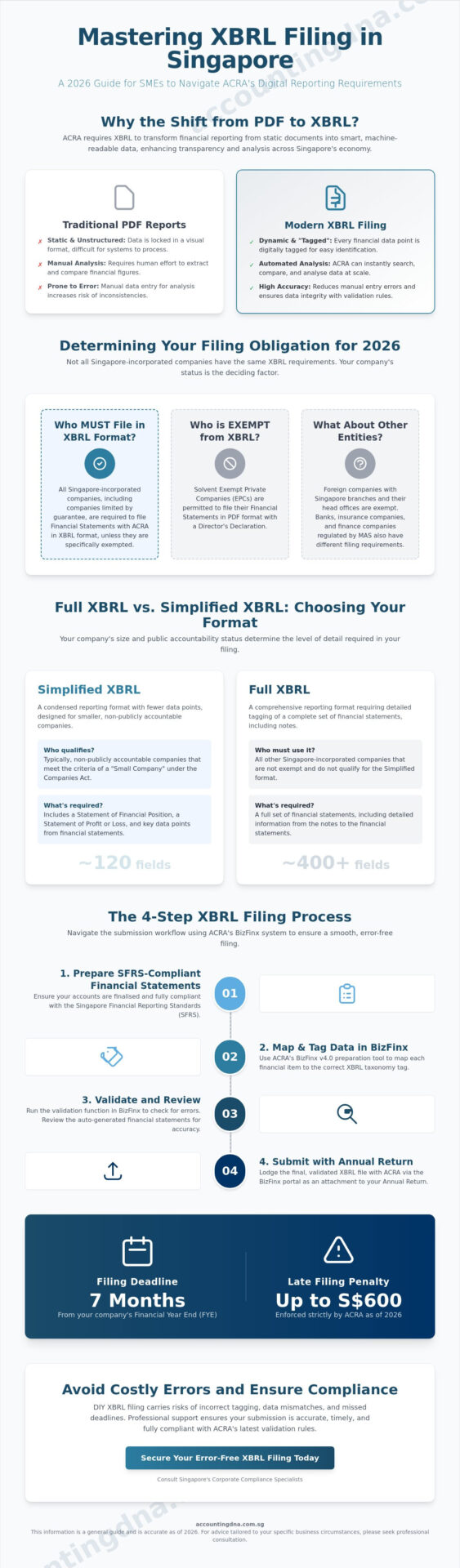
Have you ever wondered why a standard PDF of your financial statements is no longer enough for ACRA? To understand exactly what is XBRL filing Singapore requires today, you have to look at it as a digital language rather than just a file format. Essentially, Extensible Business Reporting Language (XBRL) allows financial data to be “read” by computers automatically. This shift isn’t just about more paperwork; it’s about moving Singapore toward a more transparent and data-driven economy where information flows seamlessly between businesses and regulators.
ACRA transitioned from PDF submissions to XBRL because static documents are difficult to analyze at scale. In the past, if a regulator or investor wanted to compare the debt-to-equity ratios of different SMEs, they had to manually extract that data from hundreds of separate files. With XBRL, that information is instantly accessible and searchable. This digital reporting standard provides government agencies with a clearer picture of the nation’s economic health while giving investors the high-quality data they need to make confident decisions. For you as a business owner, this means your financial story is told with greater precision and less room for manual entry error.
The Role of ACRA and the BizFinx System
The heart of this process is the BizFinx system, which serves as the central platform for preparing and validating your submissions. Think of BizFinx as a digital gatekeeper that ensures your data aligns with the Singapore Financial Reporting Standards (SFRS). In 2026, we’ve seen a definitive shift toward a “data-first” regulatory environment where ACRA utilizes tighter validation checks to catch inconsistencies immediately. The system doesn’t just store your numbers; it cross-references them to ensure every disclosure is accounted for, making it a vital tool for maintaining your company’s regulatory hygiene.
XBRL vs. Traditional Financial Statements
While an Excel sheet or a PDF is easy for a human to read, it lacks the “intelligence” of an XBRL file. The core difference lies in “tagging.” Every single data point in your report, from your net profit to your director’s remuneration, is assigned a unique digital tag. This is a critical part of your broader statutory compliance Singapore obligations. Instead of just seeing a number like S$50,000, the system sees a specific data element that it can compare against industry benchmarks. This level of detail allows for sophisticated financial analysis that was simply impossible with traditional paper-based methods.
By adopting this digital standard, your business contributes to a more efficient marketplace. It allows for easier benchmarking, which means you can eventually compare your own performance against industry averages with much higher accuracy. We understand that this transition can feel like a steep climb, but once the foundation is set, it provides a much more robust way to manage your firm’s financial reputation and ensure long-term stability in a competitive landscape.
Determining Your Filing Obligations: Who Must File XBRL in 2026?
Does every single company in the Lion City need to worry about digital tagging? The short answer is yes, but the level of detail required depends heavily on your company’s structure. In Singapore, the general rule is that all companies incorporated here must file a set of financial statements with ACRA. While the global standards set by XBRL International aim for universal transparency, Singapore applies these rules specifically to ensure local businesses aren’t buried under unnecessary paperwork. Understanding exactly what is XBRL filing Singapore requires for your specific entity type is the first step toward a stress-free annual return.
Your specific obligations are tied to your status under the Companies Act 1967. Most non-listed companies are required to file either Full XBRL or a Simplified version. Understanding the “Small Company” concept is also vital here. Even if you’re exempt from a statutory audit because you meet the revenue and asset thresholds, you may still be required to file simplified XBRL if you aren’t an EPC. These digital statements are typically prepared shortly after your Annual General Meeting (AGM). The AGM serves as the formal approval of your accounts, and the filing is the final step in your annual compliance cycle. If you’re unsure where your business fits, reaching out for a quick compliance check can save you from a lot of guesswork.
Exemptions and Special Cases
Thankfully, not every business is subject to the full weight of these requirements. Solvent Exempt Private Companies (EPCs), which are firms with no more than 20 members and no corporate shareholders, can often file a simple declaration of solvency instead of full financial statements. Similarly, dormant companies that meet ACRA’s strict criteria for inactivity are typically exempt from filing. Foreign companies and branches operate under different rules; while they must file accounts, they are generally exempt from the specific XBRL format required of local firms. If your company is no longer trading and you are considering dissolution, understanding the key differences between winding up vs striking off is just as important as meeting your filing obligations while active.
Deadlines and the Risk of Non-Compliance
Timing is everything when it comes to ACRA. For 2026, the deadlines remain firm: listed companies must file within five months of their financial year-end (FYE), while non-listed companies have a seven-month window. It’s vital to remember that ACRA no longer provides informal grace periods. If you miss these dates, you’ll face an ACRA late filing penalty, which starts at S$300 and doubles to S$600 if the delay exceeds three months. Late filing can lead to a court summons or even the disqualification of directors if the non-compliance becomes a repeat pattern.
Full XBRL vs. Simplified XBRL: Choosing the Right Format
Selecting the right template isn’t just a matter of preference; it’s a strict regulatory requirement that determines how ACRA views your company’s transparency. If you’ve been asking what is XBRL filing Singapore businesses must prepare for this year, you’ll find that the answer depends on your company’s size, its solvency status, and its industry. For the 2026 filing cycle, you’ll need to use the ACRA Taxonomy 2022 updates and the BizFinx v4.0 tool, which became mandatory after April 15, 2026. This version introduced a specific “AdditionalInformation” tab for richer data tagging and updated standards for specialized sectors, such as FRS 117 for insurance companies and specific formats for banks regulated by MAS. Choosing the wrong format can lead to an immediate rejection of your annual return, so getting this right from the start is essential.
Full XBRL: For Large and Insolvent Entities
The Full XBRL template is the most comprehensive format required by ACRA. It’s mandatory for all non-EPCs and any Exempt Private Company that is currently insolvent. This template requires you to tag a complete set of primary financial statements along with detailed notes to the accounts, typically involving between 200 and 250 distinct data elements. Because every disclosure needs precise digital mapping, many directors rely on professional accounting services Singapore firms provide to ensure technical accuracy. A single mismatch between your signed audit report and the XBRL file can trigger a “genuine error” flag in the BizFile+ portal, which often requires a full re-submission and can delay your compliance status.
Simplified XBRL (FSH): The Streamlined Option
For smaller, solvent companies, the Financial Statements Highlights (FSH) format offers a much-needed reprieve from administrative weight. This simplified version focuses on approximately 100 to 120 key data elements, primarily covering the balance sheet and profit and loss statements. It’s designed to reduce the burden on SMEs while still providing the government with essential financial data. You can find more details on eligibility in this complete guide to XBRL filing. While it’s less complex than the full version, you still need to ensure your data tagging is consistent with the latest 2026 validation rules. ACRA has recently re-categorized some validation checks from “genuine error” to “possible error,” which gives you a bit more flexibility, but maintaining high data quality remains the best way to avoid unnecessary scrutiny.
We understand that the shift toward these digital templates can feel daunting, especially with the tighter validation checks implemented in early 2026. Whether you’re filing a full set of accounts or the simplified FSH version, the goal is to create a machine-readable version of your financial health that stands up to regulatory standards. By choosing the correct format early in your preparation process, you’ll save your team hours of corrective work and ensure your company remains fully compliant with the latest ACRA mandates.
Mapping, Tagging, and Filing: The Practical Step-by-Step Process
How do you actually get from a finalized set of accounts to a successful ACRA submission? Understanding what is XBRL filing Singapore requires in practice means following a strict five-step workflow that leaves no room for guesswork. First, your financial statements must be finalized in accordance with Singapore Financial Reporting Standards (SFRS). Next, you’ll need to download and set up the BizFinx Preparation Tool v4.0, which became the mandatory version for all submissions after April 15, 2026.
Once the software is ready, the mapping process begins. This involves linking every line item in your accounts to a specific digital tag in the ACRA Taxonomy. For the 2026 filing cycle, it’s vital to utilize the new “AdditionalInformation” tab in the tool, which allows for richer data tagging of disclosures that were previously optional. After tagging, you must run a validation check within the BizFinx tool to catch any “genuine errors” before finally uploading the generated .xbrl file through the BizFile+ portal as part of your Annual Return filing. This systematic approach ensures your data is machine-readable and compliant with the latest regulatory standards.
Common Mapping Errors and How to Fix Them
One of the biggest headaches for company directors is the “Rounding Error.” Even a one-cent discrepancy between your signed financial statements and the XBRL tags can trigger a validation failure that prevents submission. Another common trap is the over-reliance on “Miscellaneous” or “Other” tags. While it’s tempting to use these when a specific category isn’t immediately obvious, doing so often triggers a manual query from ACRA. You should always aim for the most specific taxonomy element possible to maintain transparency. If you find yourself stuck on complex line items, get in touch for expert assistance to ensure your mapping is technically sound.
Troubleshooting the BizFinx Tool
The BizFinx tool can be temperamental, often requiring specific versions of Microsoft Excel and Windows to function correctly. If you encounter software compatibility issues or find that your financial statement format doesn’t fit the standard templates, check that you’ve installed the latest patches released in early 2026. Sometimes, the issue lies in the hidden formatting of your source Excel sheets rather than the tool itself. Persistent errors that cannot be resolved through the built-in validation guide usually require professional intervention to avoid missing your strict ACRA deadlines.
The Strategic Advantage of Professional XBRL Services
A professional approach does more than just tick a box for ACRA. It allows for a seamless integration between your financial statements and your corporate tax GST filing services. When your XBRL data is prepared by the same team managing your tax position, you ensure that every digital tag is consistent with your IRAS submissions. This holistic view prevents the common discrepancies that often trigger government queries. Our boutique size is our greatest strength; it allows us to provide a level of customized care and detail-oriented analysis that automated, high-volume platforms simply cannot match.
Saving Time and Reducing Director Liability
Seamless Integration with Your Corporate Secretary
There is a powerful synergy between corporate secretarial services and XBRL preparation. The entire compliance cycle, from drafting your AGM minutes to the final submission of your Annual Return, is interconnected. By centralizing these functions, you eliminate the risk of communication gaps between different service providers. We manage this roadmap for you, ensuring that the figures in your XBRL file perfectly mirror the accounts approved at your AGM. This integrated model provides a clear, error-free path to compliance, giving you the confidence to focus on your company’s future while we handle the technical rigour of Singapore’s regulatory environment. Should your business circumstances change and you need to wind down operations, our team can also guide you through the critical decision of winding up vs striking off in Singapore in full compliance with ACRA’s 2026 requirements.
Secure Your Company’s Financial Future in 2026
Mastering the digital landscape of financial reporting doesn’t have to be a solo journey. We’ve explored how the shift to machine-readable data ensures transparency across the Lion City, but we also recognize the heavy administrative burden this places on SME directors. Whether you’re navigating the complexities of the Full XBRL template or confirming your eligibility for the Simplified FSH format, the goal remains the same: error-free compliance that protects your professional standing. Understanding exactly what is XBRL filing Singapore mandates for your specific entity is the best way to steer clear of ACRA’s stricter 2026 enforcement measures.
At DNA Accounting, we offer more than just technical tagging; we provide a protective partnership. Our boutique service model gives you direct access to personalized advisors who specialize in the latest ACRA 2026 Taxonomy. With a 100% success rate in compliance submissions, we ensure your financial story is told accurately and on time. Don’t let the stress of digital mapping distract you from growing your business. Ensure Your ACRA Compliance Today-Contact DNA Accounting and let us handle the technical rigour while you focus on your next milestone. You’ve built a great company; let’s keep it in perfect standing together.
Frequently Asked Questions
What is XBRL filing in Singapore?
What is XBRL filing Singapore businesses need to understand? It is a digital language used for the electronic communication of business and financial data. Instead of a static PDF, XBRL tags each piece of data, making it machine-readable. This allows ACRA to analyze financial information more efficiently across the entire Singapore business landscape and improves transparency for investors and regulators alike.
Is XBRL filing compulsory for all Singapore companies?
Filing is mandatory for most Singapore-incorporated companies unless they qualify for specific exemptions. While the general rule under the Companies Act requires submission of financial statements, certain entities like solvent Exempt Private Companies (EPCs) and dormant companies may be excused. For most other private and public companies, meeting this digital requirement is a critical part of the annual return process every year.
What are the criteria for exemption from XBRL filing?
You are typically exempt if your company is a solvent Exempt Private Company (EPC) with no more than 20 members and no corporate shareholders. Dormant companies that meet ACRA’s strict inactivity criteria also don’t need to file XBRL. Additionally, companies limited by guarantee and foreign company branches have different filing requirements and are generally exempt from this specific digital format under current 2026 regulations.
What is the BizFinx preparation tool and how do I use it?
BizFinx is the official offline software provided by ACRA to help you prepare your financial statements in XBRL format. You start by finalizing your accounts in Excel or Word, then use the tool to map or tag your data to the ACRA Taxonomy. Once your file passes the built-in validation checks, you generate an .xbrl file for submission through the BizFile+ portal during your annual return filing.
What happens if I file my XBRL financial statements wrongly?
Incorrect filings can lead to ACRA rejecting your annual return, which might trigger late filing penalties starting at S$300. If the errors are significant, you may have to apply for a court order to amend the filed accounts or face a composition fine. Consistent errors could also impact your company’s compliance rating and potentially lead to director disqualification in extreme cases of statutory non-compliance.
Can a company director file XBRL without an accountant?
While a director can technically use the BizFinx tool themselves, the process is highly technical and requires a deep understanding of Singapore Financial Reporting Standards (SFRS). The risk of validation errors or incorrect taxonomy tagging is high for non-accountants. Most directors prefer to rely on professional expertise to ensure the digital data perfectly matches their signed financial statements and to avoid the stress of technical troubleshooting.
How much does it cost to outsource XBRL filing in Singapore?
The cost of outsourcing varies depending on the complexity of your financial statements and whether you require Full or Simplified XBRL. Factors like the number of data elements to be tagged and the urgency of the deadline usually influence the professional fees. Engaging a boutique firm often provides a more cost-effective, personalized alternative to the higher rates of large international accounting firms while ensuring dedicated advisor access.
What is the difference between Full XBRL and Simplified XBRL?
Full XBRL requires tagging of a complete set of financial statements, including detailed notes, often involving over 200 data elements. Simplified XBRL, also known as Financial Statements Highlights (FSH), only requires about 120 key data points from the primary statements. Simplified filing is generally available for smaller, solvent companies, while insolvent EPCs and larger entities must use the Full format for their ACRA submissions.
Disclaimer
The information provided on this website is for general informational purposes only and is not intended to constitute professional accounting, tax, legal, or financial advice. While we strive to ensure that the content is accurate and up to date, regulations in Singapore, including those administered by ACRA, IRAS, CPF Board, and MOM, may change from time to time and may differ depending on individual circumstances.
Readers should not act or rely on any information contained on this website without seeking specific advice from a qualified professional based on their individual situation.
DNA Corporate Services and its affiliates accept no responsibility or liability for any loss or damage arising from reliance on the information provided in this website or any linked materials.
For tailored advice relating to accounting, taxation, corporate secretarial, or compliance matters in Singapore, please contact us directly for professional consultation.



