

What if the biggest hurdle to your business success isn’t your product, but a missed S$300 deadline before you’ve even made your first sale? We understand that the jump from a brilliant idea to a registered entity feels daunting. Between deciphering the right SSIC codes and securing a reliable resident director, it’s easy to feel overwhelmed by technicalities. You want to focus on growth, not worry about whether you’ve ticked every box on your company incorporation checklist. We agree that administrative paperwork shouldn’t stand in the way of your entrepreneurial vision.
That’s why we’ve built this comprehensive, step-by-step guide to meeting ACRA requirements with zero compliance stress. You’ll learn exactly how to secure your Unique Entity Number (UEN) for the S$315 government fee and stay fully compliant with the Companies Act from day one. We’ll walk you through everything from minimum paid-up capital requirements to post-incorporation duties like appointing a secretary within six months. This guide ensures your Singapore company starts on a rock-solid foundation, providing the clarity you need to scale with total confidence.
Key Takeaways
- Identify why the ‘Private Company Limited by Shares’ structure remains the gold standard for SMEs seeking scalability and tax efficiency in 2026.
- Streamline your preparation by following a detailed company incorporation checklist to organize KYC documents and your company constitution before filing.
- Understand the critical statutory requirements for appointing a resident director and a qualified company secretary to avoid ACRA non-compliance.
- Navigate the BizFile+ registration portal with confidence, ensuring your name application and Singpass-authenticated filing are error-free.
- Prepare for immediate post-incorporation success by setting up Corppass and choosing the right corporate banking solution for your business needs.
Pre-Incorporation: Defining Your Singapore Business Structure
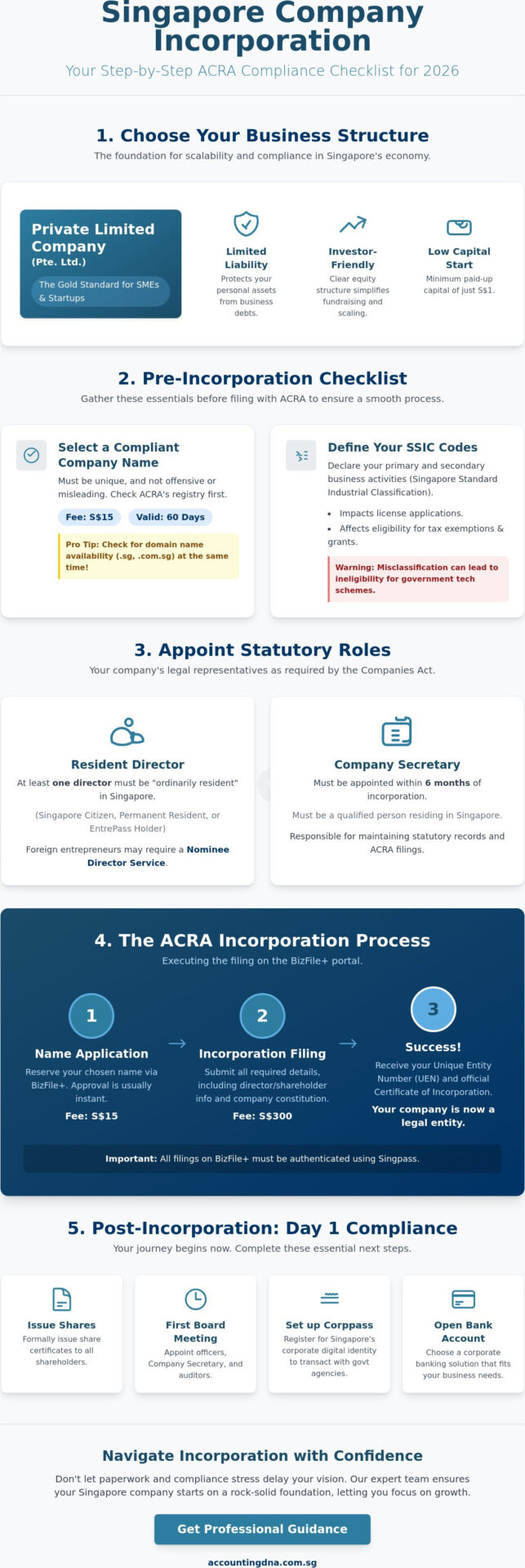
Choosing the right legal structure is the most critical item on your company incorporation checklist. For most SMEs and startups heading into 2026, the “Private Company Limited by Shares” (Pte Ltd) remains the gold standard. This structure creates a separate legal entity, meaning your personal assets aren’t at risk if the business faces financial hurdles. Investors and venture capitalists almost exclusively look for the Pte Ltd structure because it allows for clear equity distribution and shares. You can even start with a paid-up capital as low as S$1, giving you the flexibility to scale up as your cash flow grows.
The Accounting and Corporate Regulatory Authority (ACRA) serves as the national regulator for these entities. With Singapore’s economy projected to grow by up to 4% in 2026, setting up a robust structure today ensures you’re ready to capture that momentum. A well-defined structure isn’t just about following the law; it’s about building a foundation that banks and government agencies trust. If you’re planning to apply for grants or internationalize within ASEAN, getting this right from the start is non-negotiable.
Selecting a Compliant Company Name
Your business name is your first impression, but it must also pass ACRA’s strict naming conventions. Names that are “identical” to existing companies or “undesirable” (offensive or misleading) will be rejected immediately. Once you’ve identified a compliant name, the reservation costs S$15 and stays valid for 60 days. A practical tip we always share with clients: check for domain name availability simultaneously. You don’t want to register your dream company name only to find the .sg or .com.sg domain is already owned by someone else.
Decoding SSIC Codes for Your Business
Singapore Standard Industrial Classification (SSIC) codes tell the government exactly how you generate revenue. This is a common sticking point in any company incorporation checklist because the list of codes is vast. You’re required to select one primary and one secondary activity. Choosing the wrong code isn’t just a minor clerical error; it can prevent you from qualifying for specific tax exemptions or delay your applications for necessary business licenses.
For instance, if your main revenue driver is AI-driven fintech but you mistakenly select a general “management consultancy” code, you might find yourself ineligible for tech-specific government schemes. We often see founders struggle with misclassification because they’re trying to fit a modern business model into traditional categories. If you’re feeling stuck between two similar codes, it’s a good idea to reach out for a quick consultation to ensure your filing accurately reflects your operations and protects your future eligibility for incentives.
The Statutory Roles: Who You Need on Your Team
Building a company in Singapore involves more than just having a great business plan. You must appoint specific individuals to meet legal requirements. This part of your company incorporation checklist focuses on the people who will hold legal responsibility for your entity. According to the World Bank’s overview of business in Singapore, the country’s regulatory framework is designed to be efficient, but it requires strict adherence to these statutory appointments. Missing these deadlines can lead to significant penalties that disrupt your momentum.
The Critical Role of the Resident Director
Every Singapore company must have at least one director who is “ordinarily resident” in Singapore. This means they must be a Singapore Citizen, a Permanent Resident, or an EntrePass holder. If you’re a foreign entrepreneur without a local partner, you’ll likely need a nominee director. This person holds serious fiduciary duties. They’re legally responsible for ensuring the company complies with all ACRA regulations. It’s a role built on trust and reliability. For those managing this process from abroad, understanding the legal boundaries and risks involved in this arrangement is essential — our detailed guide on nominee director service Singapore compliance and risk covers everything you need to know before making this appointment. Our Corporate Secretarial Services can provide the necessary guidance to ensure your board is structured correctly and remains compliant.
Beyond the director, you’ll need to define your shareholders. Since the minimum paid-up capital is only S$1, founders often start small and increase share capital as they grow. Keeping these allocation strategies clear is a vital step in your company incorporation checklist. You also need to appoint a qualified Company Secretary within six months of incorporation. This person manages your statutory registers and ensures all ACRA filings are done on time. While many startups think they can handle this alone, a professional secretary prevents the compliance creep that leads to late filing fees.
What about an auditor? Most new companies qualify for the small company audit exemption. You won’t need to appoint an auditor if you meet at least two of these criteria: your annual revenue is under S$10 million, your total assets are under S$10 million, or you have fewer than 50 employees. This significantly reduces your administrative burden and costs in the early years, allowing you to reinvest that capital into your core business operations.
Choosing a Registered Office Address
Your business needs a physical home in Singapore. ACRA requires a registered office address Singapore where all official communications and notices can be sent. It’s important to remember that a P.O. Box is not acceptable. If you’re running a lean startup, you might consider the Home Office Scheme, which allows you to use your HDB or private residence, provided you get approval from the relevant authorities. However, many modern businesses prefer a commercial or virtual office address to maintain a professional image and keep their home life private. If you’re unsure which address type fits your 2026 growth plans, it’s worth chatting with an expert to weigh your options.
Documentation Checklist: Preparing Your KYC and Constitution
Have you ever felt the frustration of a rejected application because of a single missing document? We’ve seen it happen more often than it should. Preparing your paperwork is often the most time-consuming part of the company incorporation checklist, but getting it right ensures a smooth journey with ACRA. Think of this stage as the foundational “homework” that protects your business from future legal disputes. It’s not just about filling forms; it’s about defining the rules of your corporate life.
Service providers in Singapore are legally bound by “Know Your Customer” (KYC) protocols. These are anti-money laundering measures designed to keep the business environment transparent and secure. You’ll need to provide clear, high-resolution copies of NRICs for all local directors and shareholders. If your team includes foreign members, a passport scan and proof of residential address, such as a utility bill or bank statement from the last three months, are mandatory. If these documents aren’t in English, you must provide an official English translation to meet regulatory standards.
The Standard vs. Custom Constitution
The Company Constitution is your business’s rulebook. It replaces what was previously known as the Memorandum and Articles of Association. For speed and simplicity, most SMEs use the ACRA Model Constitution. It’s a robust document that covers standard governance, but it might not fit every scenario. If you’re managing a multi-founder setup with complex vesting schedules or unique share classes, you should consider a customized version. Key clauses regarding share transfers and director voting rights deserve a close look before you sign off.
KYC Requirements for Foreign Founders
For non-resident directors, the verification process is slightly more rigorous. If you aren’t physically in Singapore to present your documents, you’ll likely need notarized copies of your passport and address proof. This adds a layer of authenticity that ACRA expects for cross-border setups. We understand that coordinating these documents from another country can be stressful, which is why we offer specialized support through our other corporate services. Ensuring your foreign documentation is in order prevents unnecessary delays in getting your UEN. Don’t let a missing notary seal hold back your 2026 launch plans.
Executing the Incorporation: The Step-by-Step ACRA Process
You’ve gathered your documents and defined your structure; now it’s time for the most exciting part of the company incorporation checklist. This is where your vision becomes a legal reality through the BizFile+ portal. In Singapore, this process is remarkably efficient, but it requires precise data entry to avoid unnecessary delays. Most founders find that the actual submission takes less than an hour if they’ve prepared their details in advance. The gateway to this system is Singpass, which ensures that every transaction is secure and verified. If you’re a foreign founder without Singpass, you’ll typically engage a registered filing agent to handle this digital handshake on your behalf.
The first hurdle is the Name Application. As we’ve noted, this costs S$15 and is the first step in the lodgement process. Once your name is approved, you move into the registration phase. This involves a S$300 registration fee, bringing your total government cost to S$315. During this stage, you’ll input the details of your directors, shareholders, and your chosen SSIC codes. You’ll also upload your Company Constitution. Once you pay the fees via credit card or PayPal, the system processes your application. If everything is in order, the “birth” of your company happens almost instantly.
Navigating the BizFile+ Portal
The online application interface is logical, but it’s easy to trip over common errors. One frequent mistake is using words in your company name that trigger a “referral.” Words like “Bank,” “Academy,” or “Finance” often require manual review by external government agencies, which can extend your approval time from 15 minutes to several weeks. In 2026, most straightforward applications are processed within the same business day. If your application is referred, don’t panic; it simply means a human officer needs to verify your credentials or business intent before granting approval.
What is the BizProfile and Why is it Vital?
Once ACRA approves your registration, you’ll receive an email with your Unique Entity Number (UEN) and a link to download your BizProfile. This PDF is the “birth certificate” of your Singapore company. It contains your UEN, which is the 9 or 10-digit identification number you’ll use for every official transaction, from tax filings to signing contracts. You should immediately verify your company details on the public ACRA register to ensure everything is accurate. This document is what banks and vendors will ask for to prove your company’s existence. If the digital portal feels a bit overwhelming, you can reach out to our team to manage the entire filing process for you, ensuring a perfect submission on the first try.
Post-Incorporation: Your ‘Day 1’ Compliance Checklist
Receiving your UEN is a significant victory, but it’s just the start of your journey as a business owner. Many founders think the work is done once they appear on the ACRA register. In reality, the next 90 days are vital for staying on the right side of the law. This final phase of your company incorporation checklist focuses on operationalizing your business while maintaining full compliance with IRAS and ACRA requirements. Getting these steps right today prevents a mountain of administrative stress six months down the road.
Your first priority is opening a corporate bank account to manage your share capital. While traditional Singapore banks often require an in-person meeting with directors, digital-first banking solutions have become a popular, faster alternative for startups in 2026. Once your account is active, you must set up Corppass. It’s the digital identity you’ll use to access all government services. You’ll need this to manage your tax obligations, including GST registration if your taxable turnover exceeds S$1 million. If you’re nearing that threshold or want to plan for it early, our Corporate Tax & GST Filing Services can help you manage the registration process seamlessly.
Choosing your Financial Year End (FYE) is another strategic decision. It doesn’t have to be December 31st. Many companies choose a date that aligns with their specific business cycle or maximizes their eligibility for first-year tax exemptions. We often recommend a date that allows for a full 12 months of operations in your first “Year of Assessment” to get the most out of start-up tax schemes.
First 90 Days: Essential Regulatory Tasks
Within the first three months, you must issue physical or digital share certificates to your shareholders. You’re also required to establish and maintain statutory registers, specifically the Register of Registrable Controllers (RORC). This is a mandatory ACRA requirement that identifies who truly pulls the strings in your company. You also need to finalize the appointment of your company secretary if you haven’t already. These steps ensure that your internal governance is as professional as your public profile and ready for any future due diligence.
Ongoing Compliance: AGM and Annual Returns
Your first Annual General Meeting (AGM) must be held within six months of your FYE. This is a formal meeting where shareholders review the company’s financial health. Following the AGM, you have 30 days to file your Annual Return with ACRA, which costs a S$60 filing fee. Missing these dates is a common mistake that leads to automatic late lodgement fees starting at S$300. To keep your focus on growth rather than paperwork, consider exploring our Professional Accounting Services. We ensure your books are audit-ready and your filings are always on time, protecting you from unnecessary regulatory friction as you scale your 2026 venture.
Securing Your Business Future in 2026
Starting a business in Singapore is an exciting milestone, but the regulatory details can often feel like a heavy weight. We’ve walked through the essentials: from choosing a structure that attracts investors to managing the critical first 90 days of compliance. By following this company incorporation checklist, you’ve laid a foundation that protects your personal assets and sets the stage for scalable growth. Remember that the ACRA registration is just the beginning; the real success lies in maintaining those statutory registers and meeting your filing deadlines without fail.
You don’t have to manage this complex environment alone. Our team of ACRA-certified filing agents provides a boutique experience where you get direct access to senior advisors. We understand the hustle of a founder, which is why we offer flexibility with evening and weekend availability to suit your busy schedule. We’re here to be your protective partner, ensuring every document is perfect and every deadline is met with ease.
Ready to launch? Get your bespoke Singapore incorporation consultation today
Your entrepreneurial journey in Singapore is full of potential, and we can’t wait to see your business thrive in the year ahead.
Frequently Asked Questions
Can a foreigner be the sole director of a Singapore company?
No, a foreigner cannot act as the sole director. Every company must have at least one director who is ordinarily resident in Singapore. This means they must be a Singapore Citizen, a Permanent Resident, or an EntrePass holder. While you can own 100% of the shares as a foreign founder, you’ll need to appoint a local resident to the board to satisfy ACRA’s statutory requirements.
How long does the company incorporation process take in 2026?
Most straightforward applications are approved within 15 minutes to one business day. The process is highly digitized through the BizFile+ portal. However, if your business name or activity requires a referral to an external government agency for review, the timeline can extend to 14 days or more. Having your company incorporation checklist ready ensures no delays occur on your end.
What is the minimum paid-up capital required to start a business in Singapore?
You can incorporate a company with a minimum paid-up capital of just S$1. This flexibility allows founders to start lean and increase the capital amount as the business grows. It’s important to remember that while the legal minimum is low, certain business licenses or work pass applications may require a higher capital amount to be reflected in your BizProfile for approval.
Do I need to be physically present in Singapore to incorporate my company?
No, you don’t need to be in Singapore to register your business. The entire process is conducted online via the ACRA portal. Foreign founders typically engage a registered filing agent to handle the submission on their behalf. While you can incorporate from abroad, you’ll still need to fulfill the local resident director requirement and eventually open a corporate bank account for your operations.
What happens if I miss the deadline for appointing a company secretary?
Failing to appoint a secretary within six months of incorporation is a breach of the Companies Act. ACRA may impose late filing penalties or take enforcement action against the company directors. A qualified company secretary is vital for maintaining statutory records and ensuring the company meets its annual filing obligations. It’s best to appoint one early to avoid unnecessary compliance stress and potential fines.
Is a company seal mandatory for all Singapore companies?
No, a common seal is no longer mandatory for Singapore companies as of 2017. You can execute documents by having them signed by two directors, or one director and a company secretary, or one director in the presence of a witness. While some older institutions might still ask for a seal, it’s generally not required for modern business transactions and legal documents in Singapore.
Can I use my home address as the registered office for my startup?
Yes, you can use your HDB or private residence under the Home Office Scheme. You must obtain prior written approval from the Housing & Development Board (HDB) or the Urban Redevelopment Authority (URA) before registering the address with ACRA. This is an excellent way for small startups to save on commercial rent, provided the business activities don’t disturb neighbors or violate residential regulations. For a detailed comparison of your options, including the costs and privacy benefits of virtual versus physical solutions, see our guide on registered office address Singapore choices for 2026.
What are the common reasons ACRA might reject a company name?
Rejections typically happen if a name is identical to an existing entity or is deemed “undesirable” by the registrar. Names that include restricted words like “Bank,” “University,” or “Legal” often trigger a referral for manual review by other authorities. Ensuring your name is unique and doesn’t infringe on trademarks is a key step in your company incorporation checklist to prevent your application from being delayed.
Disclaimer
The information provided on this website is for general informational purposes only and is not intended to constitute professional accounting, tax, legal, or financial advice. While we strive to ensure that the content is accurate and up to date, regulations in Singapore, including those administered by ACRA, IRAS, CPF Board, and MOM, may change from time to time and may differ depending on individual circumstances.
Readers should not act or rely on any information contained on this website without seeking specific advice from a qualified professional based on their individual situation.
DNA Corporate Services and its affiliates accept no responsibility or liability for any loss or damage arising from reliance on the information provided in this website or any linked materials.
For tailored advice relating to accounting, taxation, corporate secretarial, or compliance matters in Singapore, please contact us directly for professional consultation.



