

What if a simple clerical oversight in your office cabinet could cost your company S$20,000 and lead to a potential 12 month prison sentence? As of May 6, 2026, the stakes for corporate governance in Singapore have never been higher. Maintaining an accurate Singapore company statutory register is no longer just a back-office task; it’s a critical legal shield for your business and its directors. We understand that when you’re focused on scaling your SME, worrying about the nuances between your Register of Registrable Controllers (RORC) and your Register of Nominee Directors (ROND) feels like an unnecessary distraction.
Key Takeaways
- Learn how to distinguish between your internal Singapore company statutory register and public BizFile records to ensure your legal ownership is never in question.
- Identify the mandatory registers required under the Companies Act, including specific records for directors, secretaries, and registrable controllers.
- Master the “7-Day Rule” for record updates to avoid the common maintenance pitfalls that lead to ACRA penalties and compliance risks.
- Understand the legal shift toward electronic record-keeping and how to properly store your statutory documents at your registered office address.
- See how a boutique, centralized service model for your secretarial needs can protect your business from missing critical filing deadlines.
What is a Singapore Company Statutory Register?
Think of your company’s records not just as a stack of paperwork, but as the legal DNA of your business. A Singapore company statutory register is a collection of mandatory records that every company must maintain under the Companies Act 1967. These registers serve as the official, definitive account of your company’s structure, ownership, and management. While many new founders focus on their product or service, the Accounting and Corporate Regulatory Authority (ACRA) views these registers as the primary tool for ensuring corporate transparency and accountability across the city-state.
Why does this matter for your daily operations? These documents are often the very first things investors, bankers, or auditors examine during due diligence. If your registers are incomplete or outdated, it sends a signal that your internal governance is weak, which can stall a funding round or a bank loan application. Furthermore, these registers must align perfectly with your company’s Constitution. If your Constitution dictates specific rules for share transfers or director appointments, your statutory registers are where the execution of those rules is legally proven.
The Legal Backbone of Your Singapore Business
In legal terms, statutory registers are considered “prima facie” evidence of the facts recorded within them. This means that in a court of law or during an ACRA inspection, the details in your register are accepted as the truth unless someone can prove otherwise. Many directors mistakenly believe that the information visible on BizFile+ is the only record that matters. However, your internal private registers are the actual legal source of truth. Relying on a “set and forget” mindset is a dangerous gamble. If there’s a discrepancy between your internal books and the public ACRA records, you could face significant legal hurdles when trying to prove share ownership or director authority.
Who is Responsible for Maintaining the Registers?
The law is clear: the ultimate responsibility for the accuracy of these records lies with the company directors. While you’ll typically rely on your appointed company secretary to handle the actual data entry and filing, you can’t delegate your legal liability. If the registers are found to be inaccurate or missing, directors face personal consequences. Under the Corporate and Accounting Laws (Amendment) Act 2025, which took full effect on May 6, 2026, the maximum fine for breaches of directors’ duties has increased significantly to S$20,000. It’s a sobering reminder that staying on top of your administrative record-keeping is just as vital as managing your cash flow. We see our role as your protective partner, ensuring your secretary keeps these records in “inspection-ready” condition at all times.
Mandatory Registers Required Under the Singapore Companies Act
Staying compliant in Singapore’s rigorous business environment means more than just filing your annual tax returns. Under the Singapore Companies Act 1967, your business is legally bound to maintain a specific set of records that document every major structural change. These aren’t just administrative chores; they’re the official proof of who owns, manages, and holds interests in your company. We often find that SMEs struggle most with keeping these updated in real-time, especially when share transfers or director appointments happen during busy growth phases.
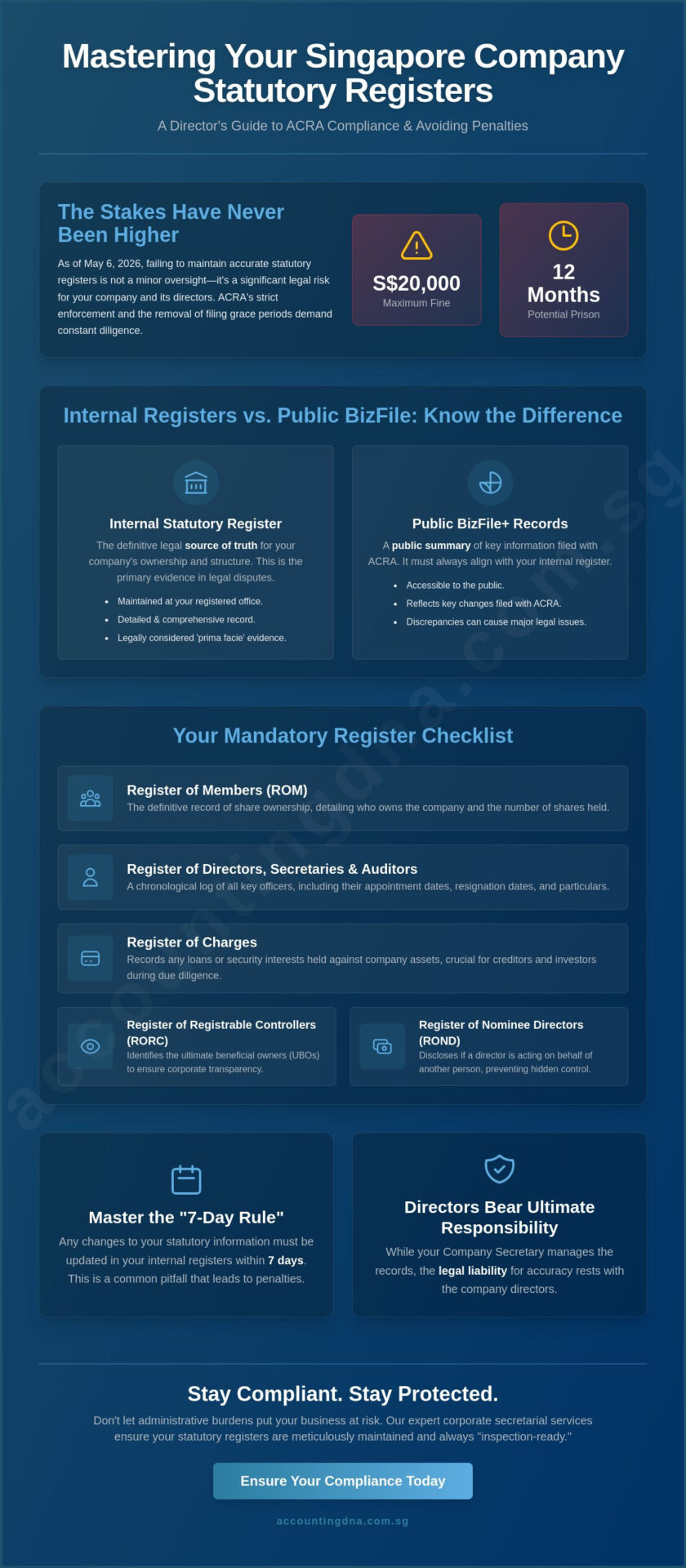
Every Singapore company statutory register must be kept at the company’s registered office or another location notified to ACRA. The core registers you’ll need to manage include:
- Register of Members (ROM): The definitive record of share ownership. For private companies, this is now largely maintained electronically by ACRA, but you must ensure internal consistency.
- Register of Directors, Secretaries, Auditors, and Managers: A chronological log of every key appointment and resignation.
- Register of Charges: This records any secured interests or loans against company assets, which is vital for transparency with creditors.
- Register of Registrable Controllers (RORC) and Nominee Directors (ROND): These focus on ultimate beneficial ownership and transparency.
The Register of Registrable Controllers (RORC) Deep Dive
ACRA’s focus on anti-money laundering has made the RORC one of the most scrutinized parts of your compliance folder. A “controller” is generally anyone who holds more than 25% of shares or has “significant control” over company decisions. You’re required to follow a strict two-step process: first, maintain an internal RORC at your office, and second, file that same information with ACRA’s central register. Don’t let the paperwork pile up. You must update your internal register within 2 business days after a controller’s information has been confirmed. Failing to mirror your internal records with the central ACRA register is a common red flag during inspections.
Understanding the Register of Nominee Directors
If you’re an overseas entrepreneur using nominee director services to meet the local residency requirement, you must maintain a Register of Nominee Directors (ROND). This register isn’t open to public inspection, but it must be available to ACRA and law enforcement agencies upon request. It must capture specific details about the “nominator” (the person who appointed the nominee). Keeping these details private yet accessible is a delicate balance that requires professional oversight. Understanding the full scope of corporate secretary duties Singapore companies must fulfil can help you ensure nothing falls through the cracks. If you’re feeling unsure about whether your current records meet these exact standards, it’s often helpful to get a professional health check to ensure everything is in order.
Common Maintenance Pitfalls and ACRA Compliance Risks
Managing a Singapore company statutory register isn’t a one-time task you complete at incorporation. It’s a living document that requires constant attention. One of the most frequent traps for SME directors is the “7-Day Rule.” Under the Companies Act, most changes to your company’s structure or officer details must be reflected in your internal registers within seven days. Many business owners mistakenly believe that updating BizFile+ is enough. In reality, failing to mirror those changes in your private internal records creates a legal mismatch that ACRA inspectors view as a serious compliance breach.
We’ve seen many founders fall behind when simple life events happen. Did a director move to a new house? If you don’t update their residential address in the register immediately, you’re technically in default. The same applies to the transfer of shares or the issuance of new equity. If these aren’t recorded the moment the instrument of transfer is executed, your company’s ownership trail becomes murky. This lack of precision often comes back to haunt businesses during bank account openings or when a potential investor asks to see the “clean” books.
Trigger Events: When Do You Need to Update Your Registers?
Compliance isn’t just about the big milestones. You need to trigger an update to your registers whenever there’s a shift in the company’s foundational data. To stay protected, refer to the recent updates to company maintenance which outline the strict expectations for modern Singaporean firms. Common trigger events include:
- Changes in shareholding, including allotments, transfers, or the transmission of shares upon a member’s death.
- Updates to the personal particulars of directors, secretaries, or auditors, such as a change in name, nationality, or passport number.
- The formal appointment or resignation of any company officer.
- The creation, modification, or satisfaction of a charge (loan) secured against company assets.
The Real Cost of Non-Compliance in 2026
The regulatory landscape shifted significantly on January 1, 2026, when ACRA officially removed the informal “end of the month” grace period for statutory filings. Today, penalties are strictly enforced from the exact due date. For late updates to registers like the RORC or director addresses, you’ll face an immediate S$50 fine if filed within three months, jumping to S$200 for longer delays. While these amounts might seem small, they’re just the tip of the iceberg.
If a failure to keep registers is deemed a persistent neglect of duty, it can escalate to court prosecution. Under the Corporate and Accounting Laws (Amendment) Act 2025, which took effect on May 6, 2026, directors can face personal fines of up to S$20,000 for breaches of duty. Beyond the financial hit, messy records are a major red flag for financial institutions. Banks are increasingly rejecting account applications or even closing existing ones if they detect discrepancies in a company’s statutory history. Keeping your records pristine isn’t just about avoiding fines; it’s about keeping your business’s vital systems running smoothly.
Storage and Accessibility: Physical vs Digital Registers
The days of dusty, leather-bound books taking up space in a locked cabinet are rapidly fading. Most SMEs in Singapore have transitioned to electronic formats for their Singapore company statutory register. This isn’t just about saving paper; it’s about accuracy, speed, and ensuring your records are “inspection-ready” at a moment’s notice. However, even if your records are purely digital, the law still requires them to be “kept” at your registered office address. This means if an ACRA officer walks into your premises, you must be able to pull up those records and display them on a screen or print them immediately.
We understand that managing digital files can feel just as daunting as physical ones. You need to ensure that your digital storage isn’t just a folder on a random laptop, but a secure, centralized system. Security protocols are vital to prevent unauthorized tampering. If a disgruntled employee or an external party could change shareholding data without an audit trail, your entire legal foundation is at risk. Digital registers must be protected by robust access controls and regular backups to maintain their status as the company’s “source of truth.”
The Legality of Electronic Registers in Singapore
Section 395 of the Companies Act 1967 specifically grants companies the right to maintain their records in electronic form. To stay on the right side of the law, these digital files must be “readily accessible” and “reproducible in hard copy” format. If your data is trapped in a software that can’t generate a clear, readable PDF, you’re technically in breach of the Act. Digital registers are now the preferred standard for ACRA compliance because they significantly reduce the risk of manual data entry errors and allow for much faster synchronization with central filings during annual return season.
Right of Inspection and Copying
Who actually has the legal right to see your internal books? While registers like the RORC and ROND are strictly private and only accessible to authorities, your Register of Members (ROM) is a different story. Any member of the public can request to inspect your ROM, provided they give the required notice. For companies still using physical books, you’re legally required to make them available for inspection for at least two hours each business day during standard office hours.
If a person requests a copy of your register, you’re entitled to charge a small administrative fee for the service, but you cannot refuse the request. This is why digital registers are so much more efficient. Instead of manually photocopying pages of a ledger, you can securely share the relevant data points. If you’re still managing physical books and want to modernize your compliance, reach out to our team for a seamless transition to a digital-first secretarial model.
Professional Support: How DNA Accounting Manages Your Compliance
Compliance shouldn’t feel like a weight dragging down your business growth. At DNA Accounting, we believe that a well-maintained Singapore company statutory register is the foundation of a healthy enterprise. By choosing a centralized model for your accounting and secretarial needs, you eliminate the communication gaps that often lead to filing errors. When your bookkeepers and secretaries sit at the same table, a change in share capital or a new director appointment is caught and recorded instantly. This proactive approach is exactly what sets our boutique firm apart from larger, less attentive providers who might treat your compliance as just another ticket in a queue.
We recently partnered with a local fintech startup that discovered three years of missing statutory records during an investment round. Their previous DIY software hadn’t accounted for complex share allotments made back in 2024. Our team stepped in to reconstruct their entire record trail, cross-referencing historical bank statements with ACRA filings to restore their legal standing. We don’t just fix problems; we provide the peace of mind that comes with knowing your advisor is reachable during those high-stress moments. Our commitment to extreme accessibility means we’re often available during evenings or non-working days to answer your urgent compliance questions when you need us most.
Bespoke Corporate Secretarial Care
Why settle for a bot when you can have a dedicated expert? While automated software is popular, it lacks the human judgment needed to spot subtle compliance gaps. Our process begins with a thorough audit of your current registers. We look for the “silent” errors, like outdated passport numbers or missing nominee director declarations that software often overlooks. This meticulous care is then seamlessly integrated with your annual filing with ACRA, ensuring that every box is ticked long before the deadline looms. We act as your protective partner, catching mistakes before they turn into costly penalties.
Ready to Secure Your Company’s Compliance?
The regulatory environment in 2026 leaves no room for “wait and see” tactics. With ACRA’s stricter enforcement and the total removal of informal grace periods, acting today is the only way to shield your directors from personal liability. Transitioning your records to our professional management is a straightforward process where we handle the heavy lifting of data migration and verification. Don’t wait for an audit notice to arrive in your inbox. It’s time to give your business the foundational care it deserves. Contact DNA Accounting for a compliance health check today and let us take the stress out of your statutory obligations.
Secure Your Company’s Future with Pristine Statutory Records
Ensuring your business stays on the right side of ACRA doesn’t have to be a source of constant stress. We’ve explored how a meticulous Singapore company statutory register acts as your legal shield; protecting directors from the increased S$20,000 fines and ensuring your business remains “bankable” for future growth. The shift toward digital-first records and the strict removal of filing grace periods in 2026 means that administrative precision is now mandatory, not optional. By mastering the “7-Day Rule” for updates and maintaining clear records of your registrable controllers, you’re building a foundation that investors and regulators will respect.
You don’t have to manage these complex requirements alone. With over 10 years of experience supporting Singapore SMEs, our team provides the bespoke care and ACRA-certified Qualified Individual (QI) support that larger, impersonal firms simply can’t match. We’re here to handle the administrative heavy lifting so you can focus on what you do best: scaling your business. Get a Professional Compliance Health Check for Your Registers today to ensure your records are flawless. Let’s work together to keep your company’s compliance status perfectly intact.
Frequently Asked Questions
Is a company statutory register the same as BizFile+?
No, they’re distinct records. BizFile+ is the public database managed by ACRA, while your statutory register is the private, internal record kept at your registered office. While BizFile+ provides public transparency, your internal books are the “prima facie” evidence of your company’s ownership and management. If there’s ever a legal dispute, the internal register usually carries more weight than the public filing.
Can I maintain my statutory registers in an Excel spreadsheet?
You can technically use electronic formats under Section 395 of the Companies Act, but an Excel sheet is rarely the best choice. For a Singapore company statutory register to be compliant, it must be secure and easily reproducible. Excel lacks the robust audit trails and version controls that ACRA looks for. Most SMEs now prefer specialized secretarial software that ensures every change is timestamped and legally valid.
Where must the statutory registers be kept if I have a virtual office?
Your registers must be kept at the registered office address you’ve notified to ACRA. If you use a corporate service provider as your virtual office, they’ll typically maintain these records on your behalf at their premises. If you decide to move them elsewhere, you must notify ACRA of the new location within 14 days to remain compliant with the Companies Act.
How often do I need to update the Register of Registrable Controllers (RORC)?
You must update your internal RORC within two business days after you’ve confirmed the controller’s information. This is one of the strictest deadlines in Singapore corporate law. Once the internal update is done, you’ll also need to mirror those changes on ACRA’s central register. Delaying this update can lead to immediate composition fines, as ACRA has removed informal grace periods as of 2026.
What happens if I lose my company’s physical statutory registers?
You must reconstruct them immediately to avoid serious legal consequences. This process involves reviewing past board resolutions, share certificates, and BizFile history to rebuild an accurate timeline. It’s a stressful and complex task that usually requires professional help. Transitioning to a digital Singapore company statutory register is the best way to prevent this risk, as cloud-based backups ensure your data is never truly lost.
Do dormant companies still need to maintain statutory registers?
Yes, dormant status doesn’t exempt you from statutory record-keeping. While your company might not have active accounting transactions, it still has directors, shareholders, and a legal structure that must be documented. Failing to maintain registers for a dormant company is a common mistake that leads to surprise penalties when you eventually try to strike off the company or reactivate it for new business.
Who is allowed to sign off on changes to the statutory registers?
Typically, your appointed company secretary or a director signs off on these changes. While the secretary handles the administrative work of updating the entries, the directors hold the ultimate legal liability for the accuracy of the information. It’s vital that your secretary is a Qualified Individual who understands the nuances of the Companies Act to ensure every signature and entry meets ACRA’s standards.
How long must a company keep its registers after it has been struck off?
You’re required to keep your company registers for at least five years after the date of striking off. This requirement ensures that a clear paper trail exists if the company is ever restored or if authorities need to investigate past transactions. We recommend storing these records in a secure digital archive, as it’s much easier to maintain than physical boxes over a five year period.
Disclaimer
The information provided on this website is for general informational purposes only and is not intended to constitute professional accounting, tax, legal, or financial advice. While we strive to ensure that the content is accurate and up to date, regulations in Singapore, including those administered by ACRA, IRAS, CPF Board, and MOM, may change from time to time and may differ depending on individual circumstances.
Readers should not act or rely on any information contained on this website without seeking specific advice from a qualified professional based on their individual situation.
DNA Corporate Services and its affiliates accept no responsibility or liability for any loss or damage arising from reliance on the information provided in this website or any linked materials.
For tailored advice relating to accounting, taxation, corporate secretarial, or compliance matters in Singapore, please contact us directly for professional consultation.



