

Did you know that ACRA has officially removed the informal “end-of-month” grace period for submissions? Even a single day’s delay now triggers an automatic S$300 penalty, making your annual filing ACRA process more time-sensitive than ever. It’s completely natural to feel a sense of dread as your Financial Year End approaches. Between the technicalities of XBRL v4.0 and the pressure of meeting AGM deadlines, the administrative burden often feels like it’s pulling you away from actually running your company.
We understand that keeping up with these shifting regulations feels like a high-stakes hurdle every year. You’re looking for a way to stay compliant without the constant fear of enforcement actions or personal liability for directors. This guide provides the clear roadmap you need. You’ll master the latest 2026 deadlines, learn to navigate the BizFinx preparation tool with confidence, and discover how to streamline your reporting process. Let’s make sure your Singapore business remains in good standing while you focus on what you do best.
Key Takeaways
- Understand why the Annual Return is a legal requirement under the Companies Act and how it serves as a vital health check for your business.
- Learn how to calculate your specific deadline based on your Financial Year End to ensure your annual filing ACRA is submitted within the 7-month window.
- Identify if your company qualifies for audit exemption under the “Small Entity” framework and how to prepare your financials in the mandatory XBRL format.
- Get a step-by-step walkthrough of the BizFile+ portal to avoid common submission errors that lead to enforcement actions.
- Discover how a professional corporate secretary acts as your compliance partner, managing statutory timelines so you can focus on growth.
What is Annual Filing with ACRA and Why Is It Mandatory?
Think of your annual return as a mandatory “health check” for your Singapore company. It’s a formal declaration that provides a snapshot of your company’s vitals, including its current directors, shareholders, and financial position. Under Section 197 of the Singapore Companies Act, every company incorporated in Singapore must lodge this return with the Accounting and Corporate Regulatory Authority (ACRA). This isn’t just a bureaucratic exercise. It ensures that the public register remains accurate, allowing stakeholders, creditors, and the government to verify your business’s legitimacy.
Maintaining a status of “Good Standing” on your ACRA profile is a silent power move for your business. When you apply for corporate bank loans or seek government grants from Enterprise Singapore, the first thing these institutions check is your compliance record. A history of timely annual filing ACRA signals that your company is well-managed and reliable. Conversely, a “Default” status can immediately disqualify you from funding opportunities and damage your reputation with potential partners who perform due diligence via BizFile+.
The Components of a Complete Annual Filing
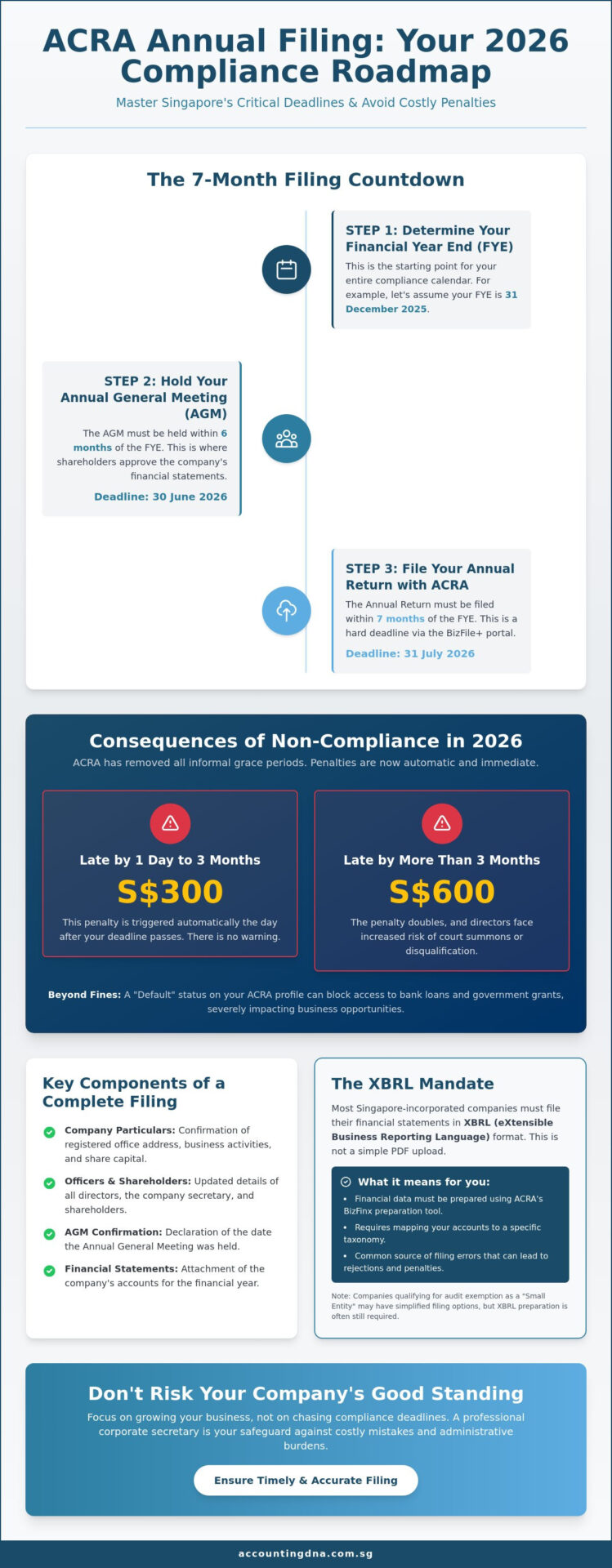
A successful filing requires more than just clicking a button. You’ll need to confirm and update several critical data points. This includes your company’s registered office address, details of your officers and shareholders, and your total share capital. Beyond these basics, you must attach your financial statements. Depending on your company’s size, these may be audited or unaudited. Additionally, you must confirm that an Annual General Meeting (AGM) was held, where shareholders reviewed the company’s accounts. The minutes of this meeting serve as the foundational proof that your directors have fulfilled their fiduciary duties for the year.
Consequences of Non-Compliance in 2026
ACRA has significantly tightened its grip on late submissions. As of 2026, the informal grace periods of the past are gone. If you miss your deadline by even one day, you’ll face an immediate S$300 penalty. If the delay exceeds three months, that penalty doubles to S$600. These costs add up quickly, especially if you’re managing multiple entities. However, the financial sting is only the beginning. Directors who consistently fail to meet these obligations risk receiving court summons or, in severe cases, disqualification from acting as a director for any company. This is why many SMEs choose to engage professional corporate secretarial services to manage these timelines proactively. Protecting your company’s public profile and creditworthiness starts with staying ahead of the calendar.
The Critical Timeline: ACRA Filing Deadlines and FYE Strategy
Missing a deadline isn’t just about the S$300 fine; it’s about the administrative chaos that follows. For private non-listed companies in Singapore, your compliance calendar is governed by the 7-month rule. This means your annual filing ACRA must be completed within seven months after your Financial Year End (FYE). If your FYE is 31 December 2025, your filing deadline is 31 July 2026. It’s a tight window, especially when you factor in the prerequisite Annual General Meeting (AGM), which must be held within six months of your FYE. Essentially, the AGM is where your shareholders approve the accounts, and the filing is where you report that approval to the regulator.
Sometimes, life happens and you might miss the window. If you realize you can’t meet the deadline, you can apply for an Extension of Time (EOT) via the BizFile+ portal. This costs S$200 and provides a one-time 60-day extension. However, you must apply for this before your original deadline expires. Waiting until you’re already late won’t stop the S$300 penalty from triggering on day one, so proactivity is your best defense against unnecessary costs.
Choosing the Right Financial Year End (FYE)
Many entrepreneurs choose 31 December by default, but this isn’t always the most strategic move. Aligning your FYE with your business’s natural low season ensures you have the mental bandwidth and cash flow to manage the closing of accounts. Additionally, your first FYE determines your first tax filing window with IRAS, which can impact your eligibility for start-up tax exemptions. If you find your current FYE is causing administrative stress, you can notify ACRA to change it. You’ll need to provide a valid reason and ensure the change doesn’t result in a financial year exceeding 18 months, unless specifically approved.
AGM Requirements and Exemptions
While the law requires an AGM within six months of your FYE, many private companies can simplify this through Section 175A of the Companies Act. If your shareholders pass a resolution to dispense with the AGM, you don’t need to hold a physical meeting. Instead, you can circulate the financial statements and pass written resolutions. This is a massive time-saver for small teams. However, don’t confuse “dispensing with the AGM” with “skipping the paperwork.” You still need to prepare the accounts and ensure they are sent to all members. If you’re feeling overwhelmed by these dates, reaching out for a professional timeline review can help you stay ahead of the curve.
Preparing Your Financials: Unaudited vs. XBRL Filing
Before you can hit “submit” on your annual filing ACRA, you must have your financial statements finalized and approved. A common misconception among new directors is that every company requires a formal audit. In reality, most Singapore SMEs qualify as a “Small Entity” and are exempt from statutory audits. To qualify for this exemption, your company must meet at least two of the following three criteria for the past two consecutive financial years:
- Total annual revenue not exceeding S$10 million;
- Total assets not exceeding S$10 million;
- A total workforce of 50 or fewer employees.
Even if you’re audit-exempt, you aren’t off the hook for financial reporting. You’re still legally required to prepare Unaudited Financial Statements that comply strictly with the Singapore Financial Reporting Standards (SFRS). These documents are the bedrock of your compliance. They ensure your GST filing services Singapore are backed by accurate data and provide the necessary figures for your corporate tax returns. Cutting corners during the preparation stage often leads to discrepancies that trigger ACRA or IRAS inquiries later down the road.
What is XBRL Filing and Does It Apply to You?
ACRA uses a digital format called eXtensible Business Reporting Language (XBRL) to standardize financial data. Since February 2026, all companies required to file financial statements must use the BizFinx Preparation Tool v4.0. Depending on your shareholding structure, you might file a Full XBRL set, a Simplified version, or just the Financial Statements Highlights (FSH). Mapping your accounts to the ACRA taxonomy is a technical task. A single misclassification in your balance sheet can lead to formal queries, which is why many firms rely on professional accounting and bookkeeping support to handle the digital conversion.
Solvency Declarations for Dormant Companies
If your company had no accounting transactions during the financial year, it’s classified as dormant. While dormant companies enjoy a simpler process and are often exempt from preparing full financial statements, you must still lodge an annual return. You’ll need to submit a solvency declaration signed by the directors to confirm the company can pay its debts. Don’t forget that even if your business is inactive, you’re still legally required to maintain your internal Singapore company statutory register, including the Register of Registrable Controllers (RORC). Keeping these foundational records updated ensures you stay compliant even while your business is in a “hibernation” phase.
Step-by-Step Guide to Filing Your Annual Return via BizFile+
Once your financial statements are ready and your AGM is concluded, the final step happens within the BizFile+ portal. This is where your preparations meet the regulator’s digital gateway. To begin, you’ll need to authenticate your identity using Singpass or CorpPass. Only registered company officers, such as a director or a qualified company secretary, have the authorization to lodge these documents. Once logged in, navigate to the “Local Company” tab and select “Annual Return.”
Before you proceed to the payment page, the system will present a summary of your company’s current particulars. This is a critical moment. You must verify that your list of officers, shareholders, and share capital is entirely accurate. If you’ve had a change in directors or a transfer of shares that wasn’t previously updated, you shouldn’t proceed with the annual filing ACRA until those records are corrected. After verification, you’ll upload your financial statements. For most SMEs, this means attaching the XBRL file generated from the BizFinx tool or a PDF of your unaudited accounts. Finally, you’ll pay the S$60 filing fee. Always download the acknowledgement page; it serves as your official proof of compliance.
Essential Pre-Filing Checklist
Don’t let a small oversight lead to a formal query. Before you even log into BizFile+, ensure these three pillars of your corporate record are solid:
- Share Registry: Confirm all recent share transfers are finalized and reflected in the system.
- RORC Compliance: Ensure your Register of Registrable Controllers is updated on ACRA’s central portal.
Common BizFile+ Errors and How to Resolve Them
Technical glitches can be incredibly frustrating when you’re working against a deadline. System timeouts are common during peak filing seasons, so it’s best to avoid the last-minute rush. If you encounter document size limitations, ensure your PDFs are optimized and under 5MB. One of the most frequent “hard stops” in the portal occurs when there’s a discrepancy between your AGM date and the financial period covered. If the system prevents you from filing because your “Position” isn’t recognized, check that your appointment as a director or secretary was correctly lodged. If these technical hurdles are slowing you down, contact our team for a guided compliance session to get your filing over the finish line.
Why Professional Corporate Secretarial Services are the Best Safeguard
The emotional weight of running a company often peaks during the compliance season. Many directors describe a persistent sense of anxiety as deadlines loom, fearing that a small administrative oversight might lead to a formal enforcement action or a permanent stain on their professional record. This is where the value of a professional corporate secretary becomes clear. They aren’t just a name on your ACRA profile; they are your primary defense against regulatory risk. By acting as a protective partner, a qualified secretary tracks every statutory milestone, ensuring that your annual filing ACRA never falls through the cracks while you focus on scaling your business.
At DNA Accounting, we believe in a bespoke approach to compliance. We understand that a startup’s needs differ vastly from those of an established SME. Our team provides personalized support that moves beyond simple data entry. By integrating our accounting and bookkeeping services with our secretarial functions, we create a centralized flow of information. This means your financial data is already verified and ready for filing long before the deadline hits. You won’t have to deal with the stress of coordinating between different service providers who don’t talk to each other.
Moving from DIY to Managed Compliance
The decision to manage compliance in-house often stems from a desire to save costs, but the “hidden costs” of DIY filing can be staggering. Beyond the immediate S$300 or S$600 late penalties, there is the cost of your own time spent navigating the technicalities of XBRL v4.0 mapping or resolving BizFile+ errors. A professional secretary ensures technical accuracy from the start, preventing the need for expensive corrective filings or legal fees associated with court summons. To fully understand what these responsibilities entail and how they protect your business, reviewing the complete corporate secretary duties Singapore SMEs must comply with in 2026 can help you make an informed decision. When you perform a cost-benefit analysis, the peace of mind and the guarantee of “Good Standing” status far outweigh the annual service fee.
Your Partner in Growth
Compliance is a continuous journey, not a once-a-year event. Whether you’re navigating a change in shareholding, updating your registered office address, or planning a strategic shift in your financial year end, having an expert guide is invaluable. We pride ourselves on our accessibility, often making our team available during non-traditional hours to suit the hectic schedules of founders and finance managers. We’re invested in your business lifecycle, providing the foundational stability you need to pursue new opportunities with confidence. Contact our team today for a stress-free compliance health check and let us handle the complexities of your next annual filing.
Secure Your Company’s Future with Proactive Compliance
Are you ready to move past the yearly stress of statutory deadlines? Staying on top of your annual filing ACRA obligations is more than just avoiding a S$600 penalty. It’s about protecting your directors from personal liability and keeping your business in good standing for future growth. By mastering the 7-month deadline rule and ensuring your financials meet the latest XBRL v4.0 standards, you build a foundation of trust with banks, partners, and regulators alike.
Compliance doesn’t have to be a lonely or overwhelming journey. With over 10 years of Singapore SME experience, our team of ACRA-certified filing agents provides the bespoke corporate secretarial support your business deserves. We take the administrative burden off your shoulders so you can focus on your core mission. Get a stress-free ACRA compliance quote today. We look forward to helping your company thrive in Singapore’s vibrant business landscape.
Frequently Asked Questions
What happens if I miss the ACRA annual filing deadline?
Missing the deadline results in an immediate S$300 penalty. If the delay extends beyond three months, this fine increases to S$600 per late section. Beyond financial costs, directors may face court summons or enforcement actions that lead to disqualification. It’s vital to resolve these issues quickly to prevent a “Default” status from appearing on your public business profile, which can impact your ability to secure bank loans.
Can a dormant company be exempted from filing annual returns?
No, dormant companies are not exempt from filing. While you might be exempt from preparing full financial statements if you meet specific criteria, you must still lodge an annual return via BizFile+. You will typically submit a declaration of dormancy and solvency. This ensures ACRA knows the company is still active in the register despite having no accounting transactions during the financial period.
Do I need to hire an auditor for my SME’s annual filing?
You only need an auditor if your company fails to meet the “Small Company” audit exemption criteria. If your company meets at least two of the following, annual revenue under S$10 million, total assets under S$10 million, or 50 or fewer employees, you can submit unaudited statements. Most Singapore SMEs utilize this exemption to reduce administrative costs while remaining compliant with the Companies Act.
What is the difference between an AGM and an Annual Return?
The AGM is the internal meeting where shareholders approve the financial statements, while the Annual Return is the external report filed with the regulator. Think of the AGM as the approval phase and the annual filing ACRA as the notification phase. You cannot complete the filing until the AGM has been held or formally dispensed with by passing a written resolution among shareholders.
How much are the ACRA late filing penalties in 2026?
In 2026, ACRA enforces a tiered penalty system for late submissions. A penalty of S$300 is imposed if the filing is late by up to three months. For delays exceeding three months, the penalty doubles to S$600. These fines are strictly applied from the first day after the deadline, as ACRA no longer offers informal grace periods for corporate compliance.
Can I file my annual return myself without a company secretary?
While a director can technically perform the filing on BizFile+, every Singapore company is legally required to appoint a qualified company secretary within six months of incorporation. The secretary’s role is to ensure the technical accuracy of the annual filing ACRA and maintain statutory registers. Relying on a professional ensures that complex requirements, like XBRL mapping, are handled correctly to avoid regulatory queries.
How long does the ACRA annual filing process take?
The actual submission on the BizFile+ portal usually takes about 15 to 30 minutes if you have all your documents ready. However, the preparation phase, including bookkeeping, financial statement drafting, and holding the AGM, should begin at least two months before your deadline. Starting early prevents technical glitches or last-minute data discrepancies from causing an accidental late filing.
What is the Extension of Time (EOT) and how do I apply for it?
An Extension of Time (EOT) is a formal request to delay your filing deadline by up to 60 days. You must apply for this through BizFile+ before your original deadline expires, and the application fee is S$200. This is a helpful safety net if your accounts are complex or your directors are unavailable, but it’s a one-time extension that requires a valid reason for approval.
Disclaimer
The information provided on this website is for general informational purposes only and is not intended to constitute professional accounting, tax, legal, or financial advice. While we strive to ensure that the content is accurate and up to date, regulations in Singapore, including those administered by ACRA, IRAS, CPF Board, and MOM, may change from time to time and may differ depending on individual circumstances.
Readers should not act or rely on any information contained on this website without seeking specific advice from a qualified professional based on their individual situation.
DNA Corporate Services and its affiliates accept no responsibility or liability for any loss or damage arising from reliance on the information provided in this website or any linked materials.
For tailored advice relating to accounting, taxation, corporate secretarial, or compliance matters in Singapore, please contact us directly for professional consultation.



