

What if your tax deadline wasn’t a drain on your bank account, but a way to keep your cash flow steady for nearly a year? Many Singapore SME owners view ECI filing Singapore as just another administrative headache or a looming risk for IRAS penalties. It’s completely understandable to feel uneasy about estimating your income before your final accounts are even ready. You’re likely concerned about how a large tax bill might impact your daily operations, but filing early can actually be your best financial move.
We’re here to help you move past that stress and master your compliance obligations. This guide will show you how to turn a mandatory filing into a strategic advantage for your business. You’ll discover if you qualify for the filing waiver, how to maximize the enhanced 50% CIT rebate for the 2026 Year of Assessment, and the exact steps to secure up to 10 interest-free installments. We’ll clarify the critical differences between ECI and Form C-S so you can stay compliant without the guesswork and keep your focus on growing your company.
Key Takeaways
- Identify if your business meets the dual criteria to qualify for the ECI filing waiver, potentially saving your team valuable administrative time.
- Discover how to unlock up to 10 interest-free tax installments by completing your ECI filing Singapore within one month of your financial year-end.
- Learn how the enhanced 50% Corporate Income Tax rebate for YA 2026 can be leveraged to protect your company’s cash reserves and manage energy costs.
- Master the timeline for reconciling your initial estimates with the final Form C-S filing to ensure total IRAS compliance and avoid unnecessary penalties.
- Gain peace of mind by understanding exactly how IRAS handles automatic refunds if your actual profits turn out lower than your original ECI estimate.
What is ECI Filing in Singapore and Does Your Company Qualify for a Waiver?
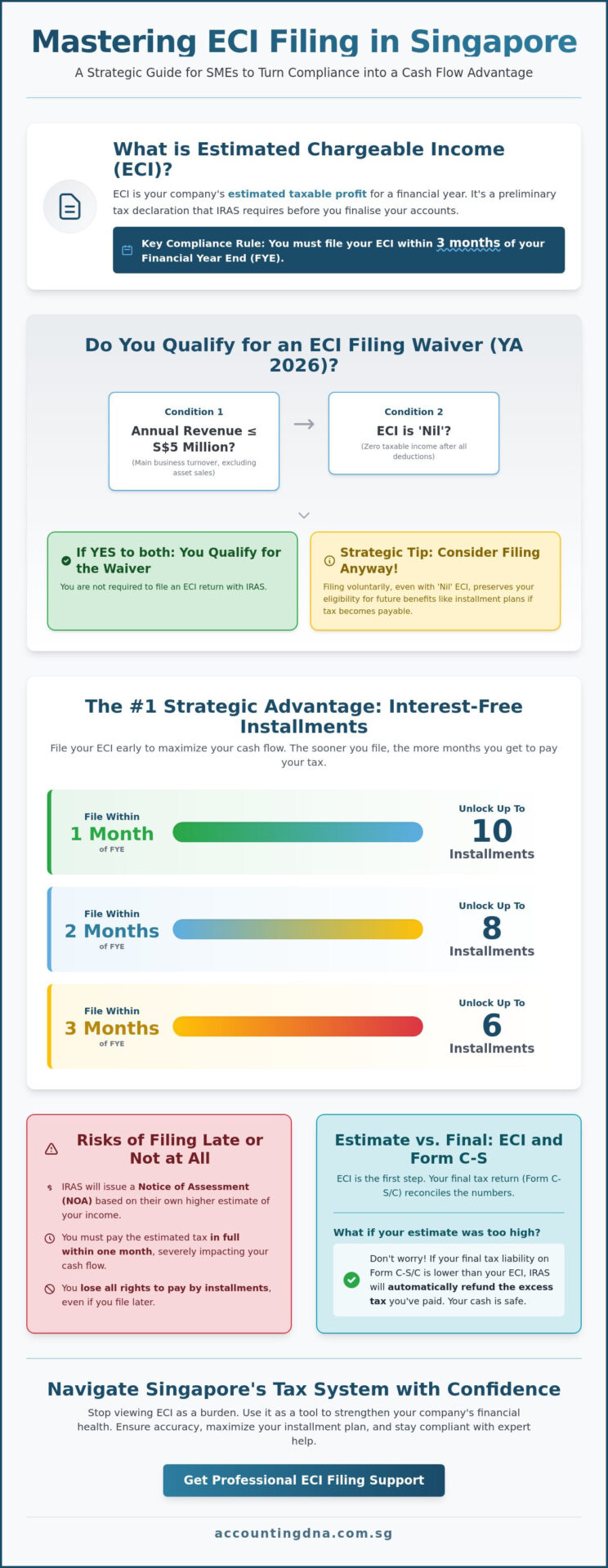
Have you ever wondered why IRAS asks for your profit figures before your financial year is even fully audited? This process is known as ECI filing Singapore. Effectively, Estimated Chargeable Income (ECI) is the preliminary tax declaration required by IRAS to facilitate early tax assessment. It represents your company’s best guess of taxable profit before you finalize your year-end tax computation. Under the “3-Month Rule”, every company must submit this estimate within three months of their Financial Year End (FYE), playing a vital role in Singapore’s tax system.
Even if you suspect your company qualifies for a waiver, many savvy directors choose to file early anyway. Filing an ECI statement, even for a small amount, secures your eligibility for installment plans that help manage cash flow later in the year. If you wait until the final Form C-S filing, you lose that flexibility. It’s a proactive way to protect your business’s liquidity while staying on the right side of the law.
The 2026 Waiver Criteria: S$5 Million and Nil ECI
To ease the administrative burden on smaller enterprises, IRAS allows certain companies to skip this step. You aren’t required to file if you meet two specific conditions for the Year of Assessment 2026. First, your annual revenue for the financial year must be S$5 million or below. Second, your ECI must be “Nil”. In plain English, “Nil ECI” means your company has zero taxable income after accounting for all tax-deductible expenses and capital allowances. If you’re unsure about your calculations, our IRAS Corporate Tax Filing Services can provide the clarity you need to confirm your waiver eligibility.
What Counts as Revenue for ECI Purposes?
A common mistake we see is directors over-reporting their revenue by including every cent that enters the bank account. For ECI purposes, revenue refers specifically to your main business turnover. You should exclude gains from the sale of fixed assets, such as selling a company vehicle or office property. Similarly, most investment income and non-taxable receipts should be left out to avoid an inflated tax estimate. Getting this definition right ensures you don’t overpay tax upfront based on an incorrect revenue figure. As your turnover grows, it’s also worth monitoring whether you’re approaching the S$1 million threshold that triggers mandatory GST registration Singapore obligations, since revenue tracking for ECI and GST purposes often go hand in hand.
The Strategic Advantage of Early ECI Filing: Installments and Cash Flow
The number of installments decreases for every month you delay filing after your financial year-end. If you’re looking for the maximum flexibility, you’ll want to aim for the “Early Bird” window. A common pitfall we see is directors assuming installments are automatic. You cannot pay by installments if you don’t have an active GIRO arrangement with IRAS. It’s best to set this up through your corporate bank account well before your filing deadline to avoid any last-minute stress.
Maximizing Your 2026 Tax Installment Plan
For the 2026 Year of Assessment, the installment schedule is designed to favor those who act fast. The breakdown is simple:
- File within 1 month of FYE: Up to 10 installments.
- File within 2 months of FYE: Up to 8 installments.
- File within 3 months of FYE: Up to 6 installments.
Setting up your corporate GIRO ensures seamless deductions, so you don’t have to worry about missing a payment date. If you’re unsure how to sync your accounting software with the myTax Portal, reaching out for professional guidance can ensure your payment plan is secured without a hitch.
Avoiding ECI Filing Mistakes and Penalties
What happens if you ignore the deadline? If you fail to file, IRAS may issue an “Estimated Assessment” based on their own figures. This estimate is usually higher than your actual profit, and you’ll be required to pay the full amount within one month without the option for installments. Understanding your corporate tax obligations in Singapore is essential for maintaining a clean compliance rating. Late filings don’t just lead to immediate penalties; they can also complicate your future dealings with ACRA and IRAS. Similarly, growing SMEs should be aware that missing the deadline for GST registration Singapore requirements can trigger its own set of IRAS penalties as your revenue scales.
Reconciling ECI with Form C-S: What Happens if Your Estimate is Wrong?
What happens when your “best guess” doesn’t match your year-end reality? It’s a common concern for directors, but the process is actually quite straightforward. Think of your ECI filing Singapore as the opening act and the Form C-S (or Form C) as the final word. Once your finalized accounts are ready and you submit your actual tax return by the 30 November deadline, IRAS performs a reconciliation to ensure everything balances out.
If your actual profit turns out to be lower than your initial estimate, there’s no need to chase the authorities. IRAS will automatically refund the excess tax you’ve paid after they process your Form C-S. On the flip side, if your business performed better than expected and your actual profit is higher, you’ll receive an additional Notice of Assessment (NOA). This document will outline the difference you owe, which must typically be settled within one month from the date of the NOA. Keeping your records tidy through stress-free accounting and bookkeeping makes this transition seamless.
When to Revise Your ECI Filing
Partnering with a Boutique Firm for Compliance
At DNA Accounting, we provide the bespoke care that larger firms often overlook. We don’t just file forms; we act as a dedicated partner who monitors your FYE deadlines so you never face late penalties. Our team ensures your ECI is grounded in real-time data, giving you a clearer picture of your 2026 liabilities. For a deeper look at the final step of the journey, explore our corporate tax filing Singapore guide. We’re here to manage the technicalities so you can focus on the growth and success of your business.
Secure Your 2026 Cash Flow and Compliance Today
Managing your corporate tax doesn’t have to be a source of constant worry. By mastering your ECI filing Singapore obligations, you aren’t just following the law; you’re actively protecting your company’s liquidity. Whether you’re qualifying for a waiver or securing up to 10 interest-free installments, these early decisions set the tone for a successful financial year. Remember that even if your initial estimates aren’t perfect, the reconciliation process with your final Form C-S ensures that you only pay what you truly owe.
Why tackle these complex regulations alone when you can have a dedicated partner by your side? At DNA Accounting, our Singapore-registered tax agents specialize in SME and startup compliance, offering the bespoke care your business deserves. If you’re in your first few years of operation, it’s also worth exploring the tax exemption scheme for new startups, which can shield your first S$200,000 in profit and dramatically reduce your overall tax burden. We understand that your schedule doesn’t always fit into a nine-to-five window, so we make ourselves available during evenings and non-working days to suit your needs. Our boutique approach means you get a centralized service model that scales with you.
Ready to streamline your tax season? Get a Professional ECI Filing Consultation from DNA Accounting and let us handle the technicalities while you focus on scaling your vision. You’ve built something great; let’s make sure it stays protected and compliant.
Frequently Asked Questions
Is ECI filing mandatory for dormant companies in Singapore?
ECI filing isn’t mandatory for dormant companies that have no income and zero revenue for the financial year. Since a dormant business naturally meets the dual waiver criteria of having Nil ECI and revenue below S$5 million, it’s exempt from this requirement. You don’t need to submit a formal waiver application; the exemption is automatic as long as your company stays truly inactive during the period.
Can I pay my ECI tax via credit card instead of GIRO installments?
You can pay your tax bill via credit card through platforms like AXS or SAM, but you’ll have to settle the full amount in a single payment. The beneficial installment plans are strictly reserved for companies with an active GIRO arrangement. If you opt for a credit card payment over GIRO, you lose the strategic advantage of spreading your ECI filing Singapore liabilities over several months.
What happens if my company’s actual revenue exceeds the S$5 million waiver threshold later?
If your finalized accounts show revenue exceeding S$5 million, your initial waiver eligibility is technically invalidated. In this case, you should file your ECI as soon as you discover the discrepancy to avoid an “Estimated Assessment” by IRAS. While you might miss the earlier installment windows, acting quickly helps maintain your compliance rating and prevents the risk of late filing penalties or IRAS queries.
How do I check my company’s ECI filing status on the IRAS myTax Portal?
You can verify your status by logging into the IRAS myTax Portal using your Corppass credentials. Navigate to the “Corporate Tax” menu and select “View Filing Status” to confirm if your ECI filing Singapore has been successfully received. This digital dashboard provides a clear record of your submission date and assessment status, ensuring you stay informed about your company’s 2026 tax obligations.
Disclaimer
The information provided on this website is for general informational purposes only and is not intended to constitute professional accounting, tax, legal, or financial advice. While we strive to ensure that the content is accurate and up to date, regulations in Singapore, including those administered by ACRA, IRAS, CPF Board, and MOM, may change from time to time and may differ depending on individual circumstances.
Readers should not act or rely on any information contained on this website without seeking specific advice from a qualified professional based on their individual situation.
DNA Corporate Services and its affiliates accept no responsibility or liability for any loss or damage arising from reliance on the information provided in this website or any linked materials.
For tailored advice relating to accounting, taxation, corporate secretarial, or compliance matters in Singapore, please contact us directly for professional consultation.



