

Could a simple calculation error at the end of the quarter really lead to a heavy IRAS penalty for your growing business? It’s a question that keeps many Singapore directors up at night, especially as the $1 million revenue mark approaches. Managing GST registration Singapore is about more than just tracking turnover; it’s about protecting the entity you’ve built from avoidable compliance risks and ensuring your transition is seamless.
We understand that the shift from a non-GST to a GST-registered business often feels like a daunting leap into complex paperwork and quarterly filing deadlines. You’re likely balancing the fear of late notification penalties with the worry that administrative costs will eat into your margins. It’s a common concern for SMEs, but with the right guidance, these regulatory hurdles become manageable steps in your growth journey.
This guide provides a definitive roadmap to master the registration process and understand the $1 million threshold with precision. You’ll learn how to navigate retrospective and prospective assessments, evaluate the new InvoiceNow requirements for 2026, and decide if voluntary registration is the right strategic move for your long-term cash flow.
Key Takeaways
- Identify when your business hits the S$1 million taxable turnover threshold to avoid costly IRAS late notification penalties.
- Learn the exact documentation needed for GST registration Singapore, including how to correctly calculate your effective date based on retrospective or prospective views.
- Determine if voluntary registration is a smart financial move by weighing the benefits of input tax claims against the administrative cost of quarterly filings.
- Assess how your customer base, whether B2B or B2C, influences the strategic decision to register for GST before you’re legally required to do so.
- Get ahead of the 2026 InvoiceNow mandate to ensure your accounting system remains compliant with the latest digital reporting standards.
Compulsory vs. Voluntary GST Registration: Determining Your Liability
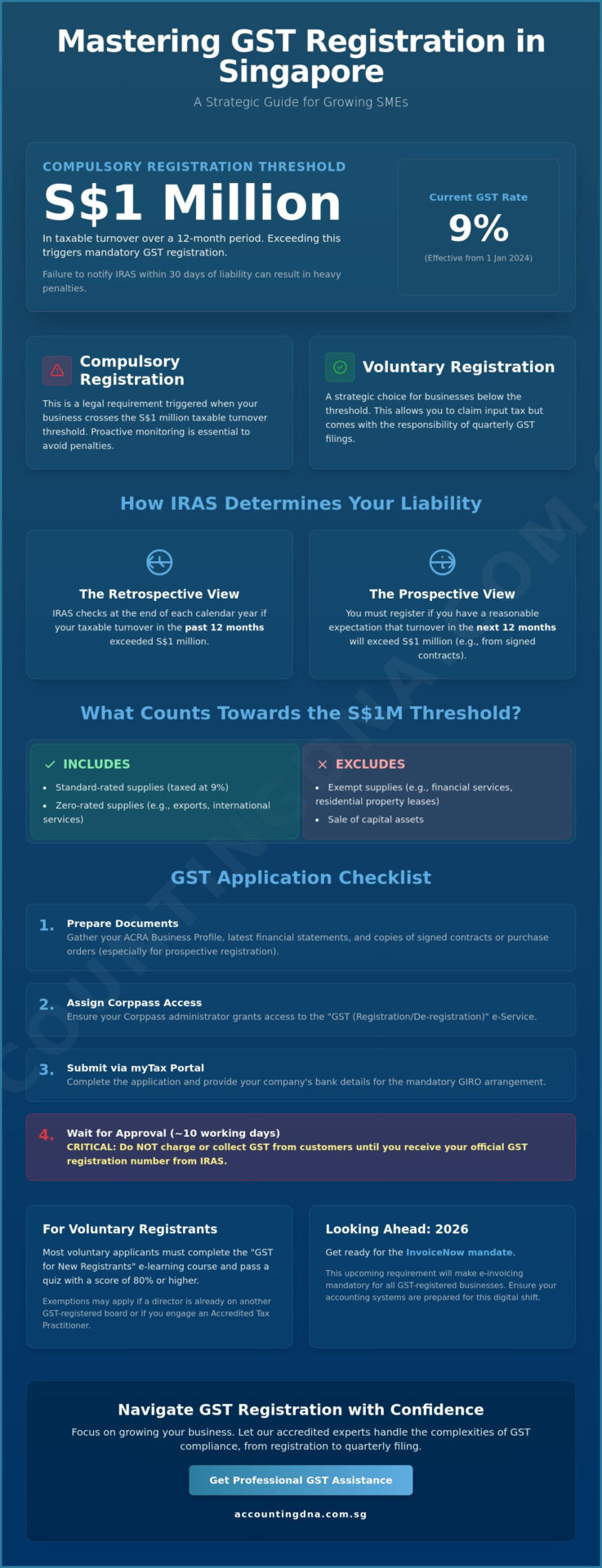
How do you know when your business has officially crossed the line into mandatory tax compliance? In the local business context, GST is a broad-based consumption tax charged on the supply of goods and services. Since January 1, 2024, the prevailing rate has been 9%. While it’s a sign of healthy growth when your revenue climbs, it also triggers specific legal obligations under Singapore’s Goods and Services Tax system. You must apply for GST registration Singapore if your taxable turnover exceeds the S$1 million threshold, and failing to notify IRAS within 30 days of becoming liable can lead to significant penalties.
It’s vital to distinguish between the types of supplies you provide. Standard-rated supplies are those taxed at 9%, while zero-rated supplies, such as the export of goods or international services, are taxed at 0%. Both count toward your S$1 million limit. On the other hand, exempt supplies, like residential property leases or certain financial services, don’t contribute to this threshold. Understanding these categories is the first step in ensuring you don’t register too late or, conversely, too early.
The Retrospective and Prospective Views Explained
IRAS uses two distinct lenses to determine your liability. Under the retrospective view, you must check at the end of each calendar year if your taxable turnover has exceeded S$1 million. If it has, you’re liable. The prospective view is more immediate. If you have a reasonable expectation that your turnover will exceed S$1 million in the next 12 months, perhaps due to a major signed contract or a sudden surge in demand, you must register. Startups often trigger the prospective view when they secure large-scale projects early in their journey, making proactive monitoring essential. New companies should also explore the tax exemption scheme for new startups to maximise their tax savings during these critical early years of growth.
What Counts Toward Your Taxable Turnover?
Your taxable turnover includes all local sales of goods and services along with your exports. However, you should exclude the sale of capital assets, such as office equipment or company vehicles, and any exempt financial services. Keeping a precise, month-to-month record is the only way to stay ahead of these requirements. If you’re finding the math complex, our GST registration Singapore services can help you track these figures with total accuracy, ensuring you never miss a compliance deadline.
Step-by-Step Guide to Applying for GST Registration in Singapore
Ready to move forward with your application? Once you’ve determined your liability, the actual process for GST registration Singapore is handled digitally through the myTax Portal. Preparation is the key to a smooth experience. You’ll need your latest ACRA Business Profile, your most recent financial statements, and copies of signed business contracts or purchase orders. These contracts are particularly important if you’re registering under the prospective view, as they serve as concrete evidence of your upcoming revenue.
Before logging in, ensure your Corppass administrator has granted you the “GST (Registration/De-registration)” e-Service access. You’ll also need your company’s bank account details on hand. IRAS typically requires a GIRO arrangement for GST payments and refunds, so having your bank information accurate from the start prevents unnecessary delays in the approval process.
The e-Learning Course for Voluntary Registrants
If you’re choosing to register before hitting the S$1 million mark, IRAS wants to be certain you’re prepared for the administrative responsibilities. The “GST for New Registrants” e-learning course is mandatory for most voluntary applicants. Usually, the company director or the key person handling the accounts must complete this module and pass a quiz with a score of 80% or higher. You might be exempt from this requirement if you’re already a director of other GST-registered entities or if you’ve engaged GST filing services from an Accredited Tax Practitioner.
Submitting via myTax Portal and Post-Registration Steps
Navigate to the “Apply for GST Registration” e-Service within the portal to begin your submission. You’ll need to select your effective date of registration carefully; for compulsory cases, this is generally the first day of the second month after your liability arises. While waiting for your GST registration number, which often takes about 10 working days to process, you must not charge GST to your customers. If the technicalities feel like a distraction from your core business, speaking with a specialist can help ensure your first submission is error-free. Once your number is issued, you must immediately update your invoicing software to reflect the 9% charge and start maintaining GST-compliant records.
Strategic Considerations: Should Your SME Register Voluntarily?
Is your business ready for the operational shift that comes with GST? While reaching the S$1 million threshold makes registration mandatory, many SMEs choose to register voluntarily much earlier. The primary incentive is the ability to claim input tax on business expenses and imports, which can significantly lower your overheads. However, you must weigh this against your customer base. If you primarily serve other GST-registered businesses (B2B), they can claim back the 9% you charge, making the move neutral for them. If your clients are individuals (B2C), you’ll suddenly appear 9% more expensive unless you absorb the cost yourself. Remember that voluntary GST registration Singapore requires a minimum commitment of two years, so you’ll need to be certain about your long-term revenue projections before committing. Younger companies in particular should consider pairing this decision with a review of the tax exemption scheme for new startups, which can offset corporate tax liabilities during the same period.
Avoiding Late Notification Penalties and Compliance Risks
Missing the 30-day notification window is a costly mistake that many directors overlook. If you register late, IRAS may backdate your registration to the date you were first liable. This means you’ll owe GST on all past sales from that date, even if you didn’t collect it from your customers. It’s a massive hit to cash flow that can be avoided with proactive monitoring. Beyond the numbers, you must ensure your price displays are updated to be GST-inclusive and that your first filing deadline is marked clearly in your calendar. Managing these moving parts is a core component of maintaining statutory compliance in Singapore and protecting your company from avoidable audits.
Managing the Administrative Burden of Quarterly Filings
The hidden cost of being GST-registered lies in the administrative hours required for quarterly F5 submissions. You’ll need to set up your accounting system to track GST-inclusive and exclusive figures with total precision. From April 1, 2026, voluntary registrants must also use InvoiceNow-ready systems to transmit data directly to IRAS. Engaging professional GST filing services in Singapore ensures that your records are kept for the mandatory five-year period and that every claim is technically accurate. This professional support allows you to focus on scaling your business while we handle the meticulous details of tax reporting and compliance for you.
Secure Your Business Growth with Strategic Tax Compliance
You don’t have to face these complex regulations alone. DNA Accounting offers a boutique service model where you get direct access to senior advisors who understand the nuances of both ACRA and IRAS requirements. We value your time as a director; that’s why we offer evening and weekend availability to suit your schedule, ensuring your compliance is handled without disrupting your daily operations. Our expertise ensures your step-by-step roadmap is followed correctly from the very first submission.
Get a stress-free GST registration consultation with DNA Accounting today. Let’s turn your compliance requirements into a solid foundation for your business’s long-term success.
Frequently Asked Questions
How long does the GST registration process take in Singapore?
Most applications for GST registration Singapore are processed within 10 working days. This timeline assumes your documentation, such as your ACRA business profile and signed contracts, is complete and accurate. If IRAS requires additional clarifications or if your business involves complex cross-border transactions, the approval process may take slightly longer.
Can I register for GST if my turnover is below $1 million?
Yes, you can apply for voluntary registration even if your taxable turnover hasn’t hit the S$1 million threshold. This is a strategic move often made by businesses that want to claim back the 9% GST paid on imports or capital expenses. You must remain registered for a minimum of two years and maintain diligent quarterly records once your application is approved.
What is the penalty for late GST registration in Singapore?
Failing to notify IRAS within 30 days of becoming liable can result in a fine of up to S$10,000 and a 10% penalty on the tax due. The most significant risk is that IRAS will backdate your registration to the day you first became liable. You’ll be required to pay GST on all past sales from that date, which can severely impact your company’s cash reserves.
Do I need to charge GST the moment I apply or only after approval?
You must only start charging GST once you’ve received your GST registration number and reached your official effective date of registration. It’s actually an offense to charge GST before this date. While waiting for approval, continue to issue invoices without the tax charge and ensure your accounting system is ready to flip the switch the moment your status is confirmed.
Disclaimer
The information provided on this website is for general informational purposes only and is not intended to constitute professional accounting, tax, legal, or financial advice. While we strive to ensure that the content is accurate and up to date, regulations in Singapore, including those administered by ACRA, IRAS, CPF Board, and MOM, may change from time to time and may differ depending on individual circumstances.
Readers should not act or rely on any information contained on this website without seeking specific advice from a qualified professional based on their individual situation.
DNA Corporate Services and its affiliates accept no responsibility or liability for any loss or damage arising from reliance on the information provided in this website or any linked materials.
For tailored advice relating to accounting, taxation, corporate secretarial, or compliance matters in Singapore, please contact us directly for professional consultation.



