

Did you know that a simple oversight in your filing calendar could expose you to personal penalties of up to S$20,000 as a company director? It’s a heavy burden to carry while you’re trying to scale a new business in Singapore’s competitive market. Most founders find the overlap between ACRA and IRAS deadlines confusing, especially when you’re juggling statutory registers alongside daily operations. With ACRA removing filing grace periods as of 2026, the margin for error has never been thinner for local entrepreneurs.
This guide provides a comprehensive ACRA compliance checklist for startups to ensure you remain in “Good Standing” without the stress of last-minute scrambles. We’ll map out your filing dates chronologically, explain how to qualify for audit exemptions, and show you how a dedicated partner can handle the paperwork while you focus on your company’s growth.
Key Takeaways
- Identify the critical six-month window for appointing your Corporate Secretary and setting a Financial Year End that optimizes your future tax cycles.
- Master the chronological sequence of holding your AGM and filing Annual Returns to maintain a flawless regulatory record on BizFile+.
- Utilize our comprehensive ACRA compliance checklist for startups to stay ahead of 2026 deadlines and avoid escalating late-filing fees.
- Protect your personal standing as a director by understanding the tiered enforcement system and the long-term risks of statutory non-compliance.
Immediate Post-Incorporation ACRA Duties for New Startups
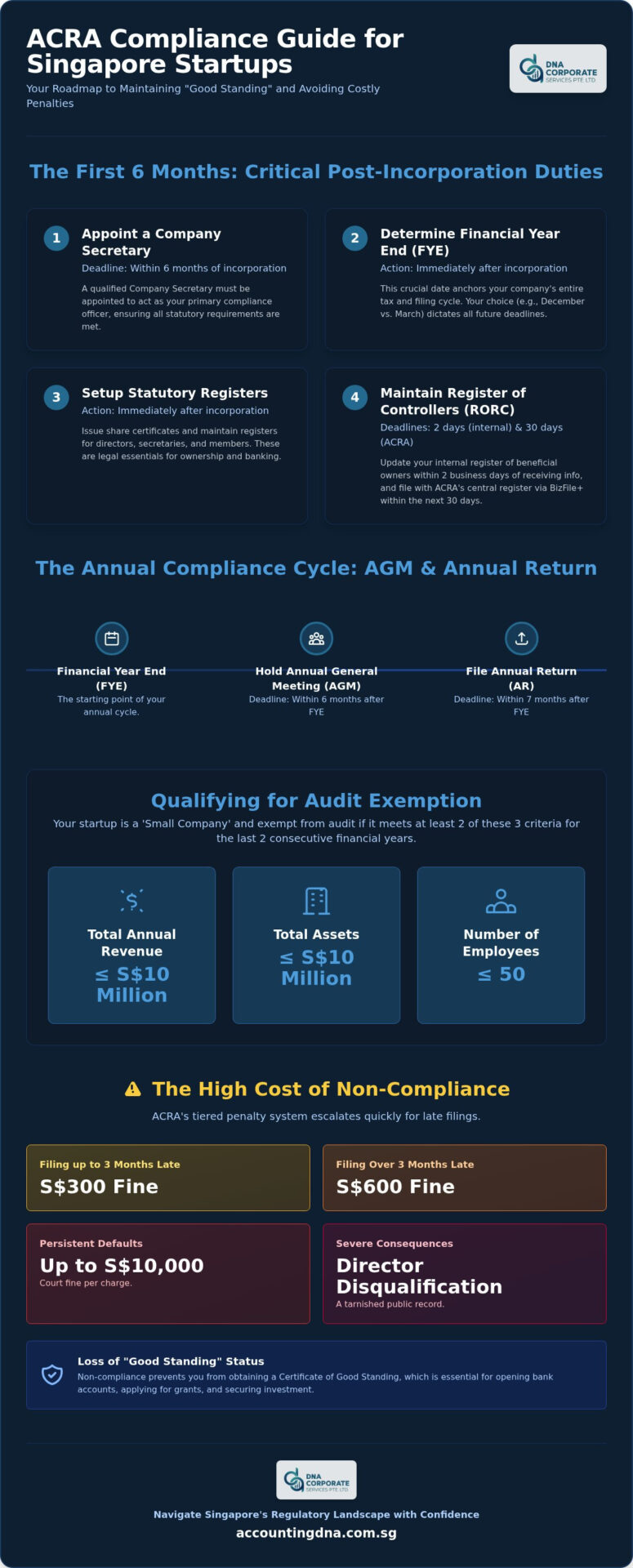
Congratulations on your new company. Once the excitement of incorporation fades, the “compliance clock” begins. Your first priority on any ACRA compliance checklist for startups is appointing a qualified Company Secretary within six months of your incorporation date. The Company Secretary serves as the primary compliance officer responsible for ensuring your private limited company adheres to all statutory requirements set by the Accounting and Corporate Regulatory Authority (ACRA).
You must also determine your Financial Year End (FYE) immediately. This date is the anchor for every future tax cycle and filing deadline. If you choose a December FYE, your reporting calendar looks very different from a March FYE. Don’t forget to issue share certificates and set up your initial statutory registers for directors, secretaries, and members. These documents aren’t just paperwork; they’re the legal foundation of your ownership structure and are essential for opening corporate bank accounts.
Mandatory Filing of the Register of Registrable Controllers (RORC)
ACRA requires all startups to maintain a RORC to track “beneficial owners” who exert significant control over the business. You must update your internal register within two business days of receiving controller information. Following this, you have a 30-day window to update the central RORC via BizFile+. Missing these windows can trigger enforcement actions that disrupt your operations. At DNA Accounting, we manage these complex timelines through our corporate secretarial services, keeping your records accurate while you focus on scaling. We ensure your ACRA compliance checklist for startups stays green from day one.
The Annual Compliance Cycle: AGM and Annual Return Deadlines
Once you’ve anchored your FYE, the annual cycle begins in earnest. A critical item on your ACRA compliance checklist for startups is the six-month AGM rule. Private companies must hold their Annual General Meeting within six months after the financial year ends. This meeting allows shareholders to review and approve financial statements while addressing any governance concerns. Following this, you have a one-month window to file your Annual Return (AR) via BizFile+. Effectively, your final deadline to update ACRA on your company’s status and officers is seven months post-FYE.
Some startups must also prepare their financial statements in XBRL format. This extensible business reporting language is a digital standard that helps regulators analyze corporate data. While ACRA focuses on your statutory standing, you must also manage your tax filings with IRAS. For a deeper dive into tax cycles and corporate tax requirements, refer to The Master Guide to Statutory Compliance in Singapore.
Qualifying for the ‘Small Company’ Audit Exemption
Most Singapore startups qualify for the “Small Company” exemption, which removes the need for a costly statutory audit. To qualify, your business must meet at least two of the following three criteria for the previous two consecutive financial years: total annual revenue of S$10 million or less, total assets of S$10 million or less, or 50 or fewer employees. Identifying this status early saves significant administrative costs. However, “audit exempt” does not mean “accounting exempt.” You are still legally required to prepare financial statements that comply with Singapore Financial Reporting Standards (SFRS). Maintaining these records diligently is the most effective way of avoiding penalties and enforcement actions. If you find these regulations daunting, you can contact our advisors to ensure your ACRA compliance checklist for startups remains accurate and stress-free.
Protecting Your Startup from ACRA Penalties and Enforcement
Ignoring your ACRA compliance checklist for startups carries high stakes. ACRA’s tiered penalty system is designed to discourage delays; you’ll face a S$300 fine for filings up to three months late. This fee doubles to S$600 if the delay exceeds three months. For repeat offenders, the consequences aren’t just financial. Persistent defaults can lead to court fines of up to S$10,000 per charge or even director disqualification. A tarnished public record makes it significantly harder to secure future investment or venture capital funding.
Maintaining “Good Standing” is essential for your company’s operational health. You’ll need a Certificate of Good Standing to open corporate bank accounts or apply for government grants. Without this proof of compliance, your startup’s growth could stall at the most critical moment. Engaging a professional for corporate secretarial services ensures your standing remains impeccable as you scale, providing a foundation for long term success.
Real-Time Reporting: When to Update BizFile+ Within 14 Days
Securing Your Startup’s Future Through Flawless Compliance
Mastering the ACRA compliance checklist for startups is about more than just avoiding S$600 late fees. It’s about protecting your personal reputation as a director and ensuring your business remains eligible for the grants and banking facilities it needs to scale. By staying ahead of the 14-day update windows and the annual AGM cycle, you build the “trust equity” that investors look for in a successful venture. Your focus should remain on innovation; let the statutory fine print be our priority.
Frequently Asked Questions
Can a startup director also be the Company Secretary in Singapore?
A sole director cannot serve as the company secretary. Singapore law requires a separate individual for the secretarial role if the company only has one director. If your startup has multiple directors, one can be appointed as secretary as long as they are a Singapore resident. Most founders outsource this to professionals to ensure their ACRA compliance checklist for startups is managed accurately.
What are the ACRA late filing penalties for 2026?
For 2026, ACRA enforces a tiered penalty system for late Annual Returns. You’ll be charged S$300 for filings up to three months late and S$600 for any delay beyond that. It’s vital to remember that ACRA removed all filing grace periods in August 2026. This means penalties accrue the very first day after your deadline passes, potentially leading to court prosecution for persistent defaults.
Does a dormant startup still need to file an Annual Return with ACRA?
Yes, dormant companies must continue to file Annual Returns with ACRA. While a dormant company may be exempt from preparing financial statements or holding an AGM, the statutory requirement to update the company’s records on BizFile+ remains mandatory. Neglecting this duty is a frequent oversight that results in avoidable fines and can negatively impact a director’s public record of compliance.
How do I change my company’s Financial Year End (FYE)?
You can change your FYE by filing a notice through BizFile+ before your current statutory deadlines expire. You cannot change the FYE for a year where the filing period has already passed. Additionally, ACRA’s approval is required if the change results in a financial year longer than 18 months. This adjustment is often a strategic part of an ACRA compliance checklist for startups seeking tax optimization.
Disclaimer
The information provided on this website is for general informational purposes only and is not intended to constitute professional accounting, tax, legal, or financial advice. While we strive to ensure that the content is accurate and up to date, regulations in Singapore, including those administered by ACRA, IRAS, CPF Board, and MOM, may change from time to time and may differ depending on individual circumstances.
Readers should not act or rely on any information contained on this website without seeking specific advice from a qualified professional based on their individual situation.
DNA Corporate Services and its affiliates accept no responsibility or liability for any loss or damage arising from reliance on the information provided in this website or any linked materials.
For tailored advice relating to accounting, taxation, corporate secretarial, or compliance matters in Singapore, please contact us directly for professional consultation.



