

Could a single missing line on a payslip really cost your company SGD 5,000 and months of unnecessary administrative stress? For many Singapore SME owners, payroll feels like a monthly tightrope walk between keeping employees happy and staying on the right side of the Ministry of Manpower. It’s natural to feel a bit of dread when thinking about an MOM audit, particularly when the itemised payslip requirements Singapore enforces are so specific. We understand that you’d rather focus on your customers than spend your evenings calculating overtime rates or double-checking CPF contribution rows.
This 2026 guide is designed to strip away that complexity and give you total confidence in your payroll compliance. You’ll learn exactly which 12 items must appear on every slip, the strict timelines for issuance, and the record-keeping rules you need to follow. Let’s turn this daunting regulatory hurdle into a smooth, efficient part of your business operations.
Key Takeaways
- Learn how to align your business with the Employment Act to protect your company from MOM audits and potential administrative penalties.
- Identify the 12 mandatory itemised payslip requirements Singapore employers must include, covering everything from basic pay to specific statutory deductions.
- Establish a robust record-keeping framework that meets the two-year retention rule for current employees and ensures you stay compliant even after staff leave.
- Simplify your monthly workflow by recognizing the risks of manual payroll and how professional management can eliminate calculation errors.
Navigating the Legal Landscape of Itemised Payslips in Singapore
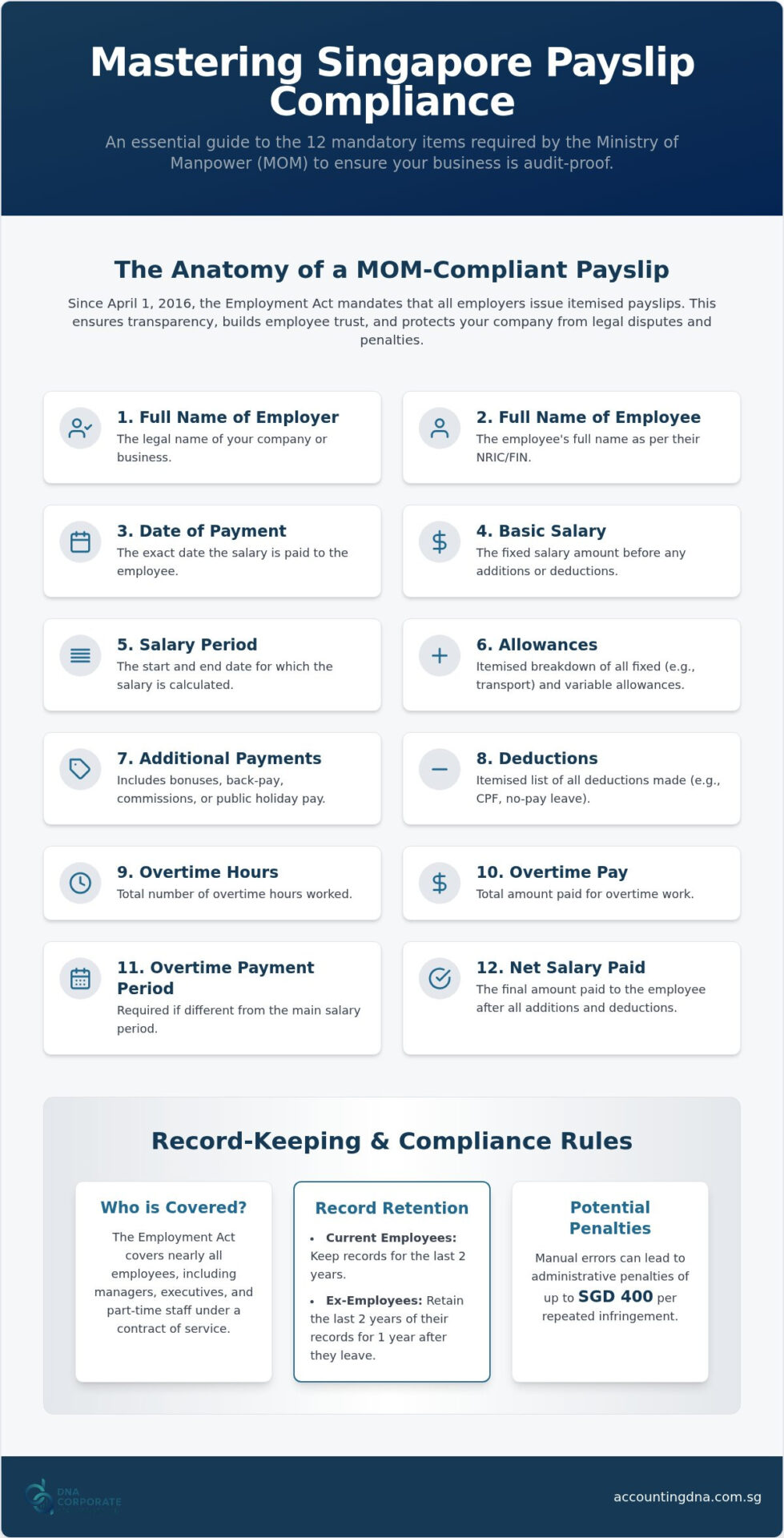
Since April 1, 2016, the Employment Act has made it clear that every worker deserves a detailed breakdown of their earnings. These itemised payslip requirements Singapore SMEs must follow serve two vital roles. First, they protect your team by providing clarity on their hard-earned pay. Second, they act as your legal shield, documenting that you’ve fulfilled your statutory duties. By ensuring every deduction and allowance is clearly stated, you eliminate the ambiguity that often leads to employee disputes. In the current 2026 compliance climate, the Ministry of Manpower (MOM) has intensified its focus on payroll transparency to reduce workplace friction. This documentation goes hand-in-hand with Key Employment Terms (KETs), which must be provided in writing within 14 days of an employee’s start date. Understanding the legal framework of Employment in Singapore is the first step toward a worry-free payroll cycle. At DNA Accounting, we view these regulations as a foundation for building trust. This proactive approach ensures your business remains resilient against regulatory shifts.
Who is Covered Under the Employment Act?
The mandate covers almost everyone under your roof, including managers and executives. Whether you hire part-time students or long-term contract staff, the requirement remains the same.
- Managers and Executives: Fully covered under the mandate.
- Part-time Staff: Required if under a contract of service.
- Exceptions: Doesn’t apply to domestic workers, seafarers, and most government employees.
If you’re unsure about staff classifications, our team can provide personalized guidance to keep your business safe.
The 12 Mandatory Items for a MOM-Compliant Payslip
Meeting the itemised payslip requirements Singapore mandates isn’t just about ticking boxes; it’s about ensuring your records align perfectly with your annual IRAS tax filings and monthly CPF submissions. According to MOM’s official guidelines, you must include 12 specific items. These include employer and employee names, the payment date, basic salary, and the salary period. You also need to itemise all allowances, additional payments like bonuses or public holiday pay, and every deduction made. For hourly, daily, or piece-rated staff, the basic rate and total units of work are mandatory. Finally, overtime hours, overtime pay, and the net salary paid must be clearly visible.
Accuracy here is paramount for IRAS reconciliation. You need to distinguish between fixed allowances, such as monthly transport stipends, and ad-hoc payments like one-off bonuses. Misclassifying these can lead to errors in your Auto-Inclusion Scheme (AIS) submissions, potentially triggering unwanted queries from tax authorities. If managing these nuances feels overwhelming, our team can help you streamline your payroll process to ensure every line item remains audit-proof.
Calculating Overtime and Statutory Deductions
Operational Excellence: Record-Keeping and Professional Payroll Solutions
Staying compliant doesn’t end when the payslip is issued. MOM requires a standardized record-keeping approach that many founders find difficult to manage alongside daily operations. For current staff, you’re obligated to keep records for the last two years. For those who have moved on, you must retain the last two years of their employment records for one year after their departure date. This is a non-negotiable aspect of itemised payslip requirements Singapore law. Relying on manual spreadsheets often results in late issuance or calculation errors, which carry administrative penalties of up to SGD 400 per repeated infringement. Beyond fines, manual systems are prone to data security breaches that can damage employee trust and your company’s reputation.
By integrating DNA Accounting’s payroll services, you shift the burden of compliance to a dedicated partner. Our centralized boutique model ensures that every statutory contribution, from CPF to SDL, is handled with extreme precision. We don’t just process numbers; we provide a protective layer for your business, ensuring that your records are always audit-ready and your employees are paid accurately and on time.
Transitioning to Outsourced Payroll for SME Growth
Many SMEs hesitate to outsource, fearing they’ll lose control or receive impersonal service. However, choosing a boutique firm offers the best of both worlds: high-level expertise and bespoke care. We ensure your payroll data is perfectly prepared for year-end tax reporting and IRAS Auto-Inclusion Scheme (AIS) submissions. This proactive management eliminates the stress of the tax season and ensures your filings are flawless. If you’re ready to reclaim your time and reduce your regulatory risk, we invite you to start with a bespoke payroll consultation to see how we can support your growth.
Securing Your Company’s Future Through Payroll Compliance
Mastering the itemised payslip requirements Singapore enforces is about more than just avoiding fines; it’s about building a foundation of trust with your team and ensuring your business remains audit-ready. By documenting the 12 mandatory items and maintaining strict record-keeping for at least two years, you protect your company from unnecessary disputes and administrative penalties. We know that managing these statutory complexities while growing a startup or SME can feel like a full-time job. You don’t have to navigate the nuances of MOM, CPF, and IRAS regulations alone. Our boutique firm offers direct expert access and a centralized model that ensures full compliance with every standard. Streamline your payroll compliance with DNA Accounting today and let us handle the administrative weight. You’ve built something great; let’s keep it protected and flourishing together.
Frequently Asked Questions
When exactly must I issue payslips to my employees?
You must issue payslips to your employees either at the time of salary payment or within three working days of that payment. If an employee is terminated or dismissed, the payslip must be given alongside their final salary payment. Staying on top of these timelines is a core part of itemised payslip requirements Singapore employers must follow to avoid administrative friction with the Ministry of Manpower.
Can I provide soft copy payslips, or must they be printed?
Yes, you can provide payslips in either soft or hard copy formats. While many modern Singapore SMEs prefer digital PDFs for efficiency and data security, MOM also accepts handwritten or printed versions. The key is ensuring the document is legible and contains all twelve mandatory items. Choosing a digital approach often simplifies record-keeping, as you’re required to retain these documents for at least two years.
What are the penalties for not issuing itemised payslips in Singapore?
Failure to comply can lead to significant financial and legal consequences. Repeated infringements typically result in administrative penalties of up to SGD 400 per offense. For more severe or persistent violations, fines can escalate to SGD 5,000, and company directors could even face up to six months of imprisonment. These penalties highlight why maintaining a robust, MOM-compliant payroll system is vital for your business’s long-term health.
Do I need to issue a consolidated payslip if I pay my staff twice a month?
You aren’t required to issue two separate slips if you pay your staff twice a month. You can issue a single consolidated payslip, provided it covers all payments made during that month and is given to the employee by the time of the final payment. This consolidated document must still clearly itemise every allowance, deduction, and overtime hour worked within those specific payment periods to remain compliant.
Disclaimer
The information provided on this website is for general informational purposes only and is not intended to constitute professional accounting, tax, legal, or financial advice. While we strive to ensure that the content is accurate and up to date, regulations in Singapore, including those administered by ACRA, IRAS, CPF Board, and MOM, may change from time to time and may differ depending on individual circumstances.
Readers should not act or rely on any information contained on this website without seeking specific advice from a qualified professional based on their individual situation.
DNA Corporate Services and its affiliates accept no responsibility or liability for any loss or damage arising from reliance on the information provided in this website or any linked materials.
For tailored advice relating to accounting, taxation, corporate secretarial, or compliance matters in Singapore, please contact us directly for professional consultation.



