

Did you know that even if your headcount drops below five next year, your company remains legally bound to the Auto-Inclusion Scheme once you’ve joined? For many Singapore SME owners, the shift to electronic reporting feels like an administrative hurdle, especially when you’re trying to navigate the mandatory five-employee threshold or the technical quirks of the myTax Portal. It’s natural to worry about IRAS penalties or the impact of an inaccurate IR8A on your employees’ personal tax filings.
We believe compliance shouldn’t be a source of stress for growing businesses. This guide will help you master your AIS 2027 requirements for the upcoming Year of Assessment, ensuring your employment income reporting is both timely and accurate. We’ll break down the participation rules, highlight the critical March 1, 2027 deadline, and provide a clear path to simplifying the tax season for your entire team. You’ll move from confusion to total confidence in your payroll reporting obligations, allowing you to focus on what matters most: growing your business.
Key Takeaways
- Understand how the Auto-Inclusion Scheme simplifies your year-end reporting by electronically transmitting income data directly to IRAS.
- Determine if your company must register for AIS 2027 based on the compulsory five-employee threshold, which includes part-time staff and directors.
- Learn why maintaining precise monthly payroll records throughout 2026 is the most effective way to ensure a seamless and error-free submission process.
- Identify the specific employee details, such as NRIC/FIN and residential addresses, that must be verified to avoid common filing mistakes and IRAS queries.
- Gain peace of mind by mastering the March 1 deadline and protecting your business from the stress of late-filing penalties.
Understanding the Auto-Inclusion Scheme (AIS) for YA 2027
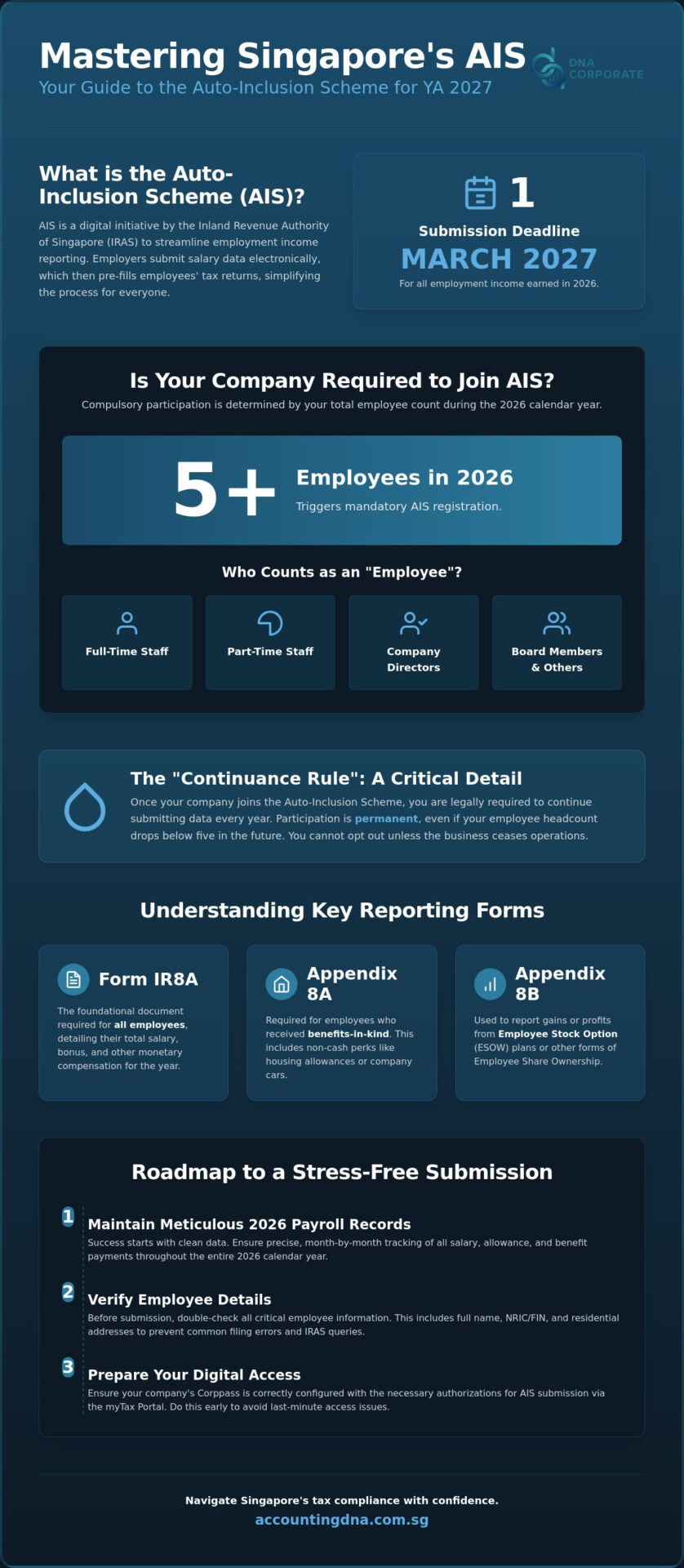
The Auto-Inclusion Scheme (AIS) is a digital initiative by the Inland Revenue Authority of Singapore (IRAS) designed to streamline how businesses report employment income. Instead of issuing physical forms to every staff member, employers submit salary data electronically. For AIS 2027, the reporting cycle covers all employment income earned between 1 January and 31 December 2026. This shift toward a paperless environment is becoming the standard for almost all Singapore-registered entities, moving away from manual, error-prone processes.
Your employees benefit significantly from this arrangement. When you participate, their income details are pre-filled in their individual tax returns on the myTax Portal. This minimizes filing errors and simplifies the broader framework of Income tax in Singapore for the average professional. It’s a proactive way to support your team, ensuring they don’t have to manually calculate their earnings or worry about missing documents during the peak tax season.
Key Components: IR8A, Appendix 8A, and 8B
Reporting involves more than just a single number. The IR8A is the foundational document for all employees, but extra details are often required. You must use Appendix 8A if you provide benefits-in-kind, such as housing allowances or company cars. If your company offers Employee Share Option (ESOW) plans, Appendix 8B is necessary to report gains from those stock options. Managing these different forms accurately is a core part of our taxation services, helping you avoid the common pitfalls of under-reporting.
The “Continuance Rule” for AIS Participation
One detail that often catches SME owners off guard is the continuity rule. Once your company is registered for the scheme, you must continue to submit data every year. Even if your headcount drops below the compulsory threshold in the future, you cannot simply opt-out. Participation is permanent unless your business ceases operations. This makes it vital to establish a robust payroll routine early on, as the requirement remains a fixture of your annual compliance calendar.
Is Your Company Required to Join AIS by 2027?
Determining your eligibility for the IRAS Auto-Inclusion Scheme isn’t always as simple as checking your current headcount. For AIS 2027, the compulsory participation threshold remains at five or more employees. This calculation includes everyone who received income from your company during the 2026 calendar year. If you hit that number at any point, even if some staff have since left, electronic registration is mandatory.
Many directors ask us exactly who qualifies as an “employee” in the eyes of IRAS. The definition is broad. It encompasses full-time and part-time resident staff, non-resident employees, company directors, and even board members. If you’ve paid out salaries, fees, or bonuses to five or more distinct individuals throughout 2026, your business must be registered and ready for the March 1, 2027 deadline.
Compulsory vs. Voluntary Participation
IRAS typically sends out a “Notice to File” to companies that meet the criteria, but you shouldn’t wait for a letter to act. Proactive registration is a hallmark of good corporate governance. Even if you only employ one or two people, joining voluntarily can save you from the manual headache of issuing IR8A hardcopies every year. If you’re looking to understand how this fits into your wider obligations, you can refer to The Master Guide to Statutory Compliance in Singapore for a deeper dive into local requirements.
AIS Registration Process on myTax Portal
Registering is a straightforward digital process, provided your Corppass access is correctly configured. You’ll need to log in to the myTax Portal and navigate to the “Employer” section to sign up for AIS 2027. A common error we see is businesses failing to authorize the correct digital services within Corppass first, which leads to login loops and unnecessary frustration. Getting these administrative details in order early ensures you don’t face a last-minute scramble. If you’d like us to review your setup or handle the registration for you, feel free to contact us for a quick consultation.
How to Ensure Stress-Free AIS Submission for Your Employees
Success for AIS 2027 begins long before the filing window opens. It starts with meticulous payroll hygiene throughout 2026. You should verify every NRIC or FIN number and residential address against current records. Small typos often lead to rejected files or incorrect tax assessments for your staff. This is a critical step when following a guide to reporting employee earnings, as the data link between your records and IRAS must be seamless.
Common AIS Submission Mistakes to Avoid
Many directors forget that “income” includes more than just a base salary. You must report benefits-in-kind and ensure director fees are declared in the correct Year of Assessment. Missing the hard deadline of 1 March is another common pitfall that leads to composition fines. Inaccurate reporting of CPF contributions, particularly the different rates for Singapore Citizens versus Permanent Residents, remains a frequent point of failure for many SMEs.
Partnering with a Professional Service Provider
At DNA Accounting, we manage the end-to-end submission process to protect your business from compliance risks. Our boutique approach means we provide bespoke care, catching errors in benefits or CPF calculations before they reach the authorities. We act as your reliable guide, ensuring your AIS 2027 filing is error-free and submitted well ahead of the deadline. We invite you to contact us for a payroll consultation to see how we can simplify your tax season.
Secure Your Compliance for Year of Assessment 2027
Managing the transition to AIS 2027 doesn’t have to be a source of year-end anxiety. By now, you understand that meeting the five-employee threshold triggers a permanent commitment to electronic reporting. You also know that verifying employee details early in the 2026 calendar year is the best defense against rejected submissions and IRAS penalties. Accurate payroll isn’t just about numbers; it’s about maintaining trust with your team and ensuring their tax returns are pre-filled correctly.
Get a Stress-Free Quote for AIS and Payroll Management and take the first step toward a seamless tax season. We’re here to make your regulatory journey as smooth as possible.
Frequently Asked Questions
What is the deadline for AIS 2027 submission?
The hard deadline for submitting your employees’ income information for AIS 2027 is March 1, 2027. IRAS is strict about this date and doesn’t typically grant extensions for late filings. We recommend completing your submission by mid-February to avoid the heavy traffic on the myTax Portal as the deadline approaches. Missing this window can lead to composition fines or even legal summons for the company’s directors.
Must I join AIS if I only have 2 employees in 2026?
No, participation isn’t compulsory if you have fewer than five employees throughout the 2026 calendar year. The mandatory requirement only kicks in once you hit the five-employee threshold, which includes part-time staff and directors. However, you can still choose to join the scheme voluntarily. Many small startups do this to eliminate the need for manual IR8A hardcopies and to provide a more professional, digital experience for their team.
What happens if I submit wrong information in my AIS filing?
You’ll need to file an amendment through the myTax Portal immediately to correct any errors in your original submission. If you catch the mistake before the March 1 deadline, the process is relatively straightforward. However, leaving inaccuracies unaddressed can lead to incorrect tax assessments for your employees. This often results in administrative friction and could potentially trigger an IRAS audit if the discrepancies are significant or recurring.
Do I need to provide hard copies of IR8A to employees if I am in AIS?
No, you’re not required to issue physical IR8A forms to your employees once you’ve joined the scheme. Their employment income details will be automatically pre-filled in their individual income tax returns on the myTax Portal. While hard copies aren’t legally necessary, it’s still good practice to provide your staff with a summary of their reported earnings. This allows them to verify the figures before they finalize their own tax filings.
Can I submit AIS records manually without payroll software?
Yes, you can manually enter your data directly into the myTax Portal or use the Provident And Tax (PAT) system. While this works for micro-SMEs with very few employees, it becomes increasingly risky as your headcount grows. Manual entry is prone to typos and calculation errors that can complicate your compliance profile. For most growing businesses, using IRAS-compatible software or outsourcing to a specialist is a much safer way to ensure accuracy.
Disclaimer
The information provided on this website is for general informational purposes only and is not intended to constitute professional accounting, tax, legal, or financial advice. While we strive to ensure that the content is accurate and up to date, regulations in Singapore, including those administered by ACRA, IRAS, CPF Board, and MOM, may change from time to time and may differ depending on individual circumstances.
Readers should not act or rely on any information contained on this website without seeking specific advice from a qualified professional based on their individual situation.
DNA Corporate Services and its affiliates accept no responsibility or liability for any loss or damage arising from reliance on the information provided in this website or any linked materials.
For tailored advice relating to accounting, taxation, corporate secretarial, or compliance matters in Singapore, please contact us directly for professional consultation.



