

Could a simple 0.25% calculation be the difference between a stress-free month-end and a frustrating compliance notice from the authorities? For many entrepreneurs, the Skills Development Levy Singapore often feels like a confusing secondary task that’s easily buried under more pressing CPF obligations. We know how draining it is to manually track levies for a diverse team of local and foreign staff while worrying about potential MOM or ACRA penalties.
You deserve to feel confident that your business is fully regulated without losing sleep over payroll math. This guide simplifies everything you need to know about SDL for 2026, from the $2 minimum contribution to the $11.25 cap for higher earners. We’ll show you how to streamline your monthly payments and avoid the sting of late payment interest. By the end of this article, you’ll have a clear, actionable roadmap to handle your statutory duties with total precision.
Key Takeaways
- Master the 0.25% calculation rule, which ranges from a $2 minimum to an $11.25 cap per employee. Accurate math ensures your monthly payroll stays compliant and audit-ready.
- Realize that the Skills Development Levy Singapore applies to all staff, including foreign employees and part-timers. Don’t fall for the common myth that only local employees require this contribution.
- Streamline your workflow by paying SDL alongside your monthly CPF contributions. A centralized approach helps you avoid missed deadlines and keeps your statutory records organized.
- Protect your company from the 10% per annum late payment penalty. Maintaining a proactive payment schedule is the most effective way to safeguard your business’s reputation and cash flow.
- Learn how these mandatory contributions support workforce upgrading through training grants. It’s a foundational step in building a more skilled and competitive team for your Singapore SME.
Understanding the Skills Development Levy (SDL) in Singapore
The Skills Development Levy Singapore is a mandatory monthly contribution that every employer must pay for their staff. While the CPF Board collects these funds, they are actually managed by the Skills & Workforce Development Agency (SWDA). This requirement is legally anchored in the Skills Development Levy Act, making compliance a top priority for every registered business. We often see directors mistake this for a simple tax, but it’s actually a strategic investment in your team’s future.
These contributions flow directly into the Skills Development Fund (SDF). This fund supports the SkillsFuture national movement, offering training grants that help SMEs like yours offset the cost of staff upgrading. When you look at it this way, SDL isn’t just a regulatory hurdle; it’s a foundational tool for growing your company’s internal expertise. If you’re ever unsure about your specific headcount obligations, it’s best to speak with a professional advisor to avoid any friction with the authorities.
Who is exempt from SDL?
Exemptions are quite specific in Singapore. You don’t need to pay the levy for domestic servants, gardeners, or chauffeurs who are employed strictly for private, domestic use. If you’re running a business as a sole proprietor or a partner, remember that you don’t contribute SDL for yourself. You only handle the levy for the employees currently on your payroll.
Does SDL apply to foreign employees?
Unlike CPF contributions which only apply to locals, SDL has a broader reach that includes your entire international workforce. All foreign employee wages must be included in your monthly Skills Development Levy Singapore calculation to ensure your business remains fully compliant.
How to Calculate and Pay SDL for Your Employees
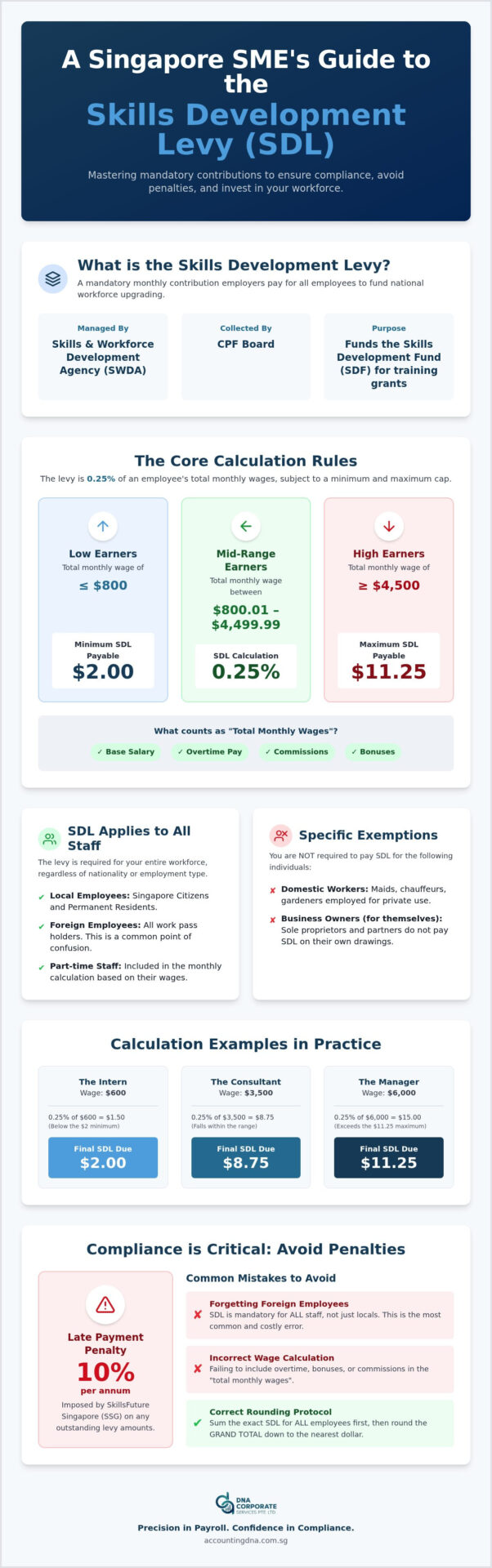
Calculating the Skills Development Levy Singapore is straightforward once you understand the floor and ceiling. The levy is set at 0.25% of an employee’s total monthly wages. However, you aren’t calculating into infinity. There’s a minimum payable amount of $2 for employees earning $800 or less, and a maximum cap of $11.25 for those earning more than $4,500. If your staff earns exactly $4,500, the 0.25% math works out perfectly to $11.25.
What exactly counts as “total monthly wages”? It isn’t just the base salary. You must include overtime pay, commissions, and bonuses in your math. According to SkillsFuture Singapore’s official SDL FAQ, even certain allowances are typically included if they’re part of the gross wage. We often see clients get tripped up by the rounding protocol. Don’t round individual employee figures. Instead, sum up the exact SDL amounts for every staff member first. Once you have that grand total, round the final figure down to the nearest dollar. This prevents small discrepancies that could trigger a compliance flag.
Step-by-step SDL calculation examples
- Example 1: An intern earning $600/month. The math ($600 x 0.0025) is $1.50, but since this is below the floor, you pay the minimum of $2.
- Example 2: A manager earning $6,000/month. The math ($6,000 x 0.0025) is $15, but since this exceeds the ceiling, you pay the maximum of $11.25.
- Example 3: A consultant earning $3,500/month. The calculation ($3,500 x 0.0025) results in an exact payment of $8.75.
Standard payment methods for Singapore employers
Most Singapore employers use CPF EZPay. It’s the most seamless way to handle your monthly statutory contributions in one go. If you only hire foreign staff and don’t have a CPF account, you’ll need to use the GoBusiness Dashboard instead. If these calculations feel like an extra burden on your month-end, reaching out for a quick payroll review can save you hours of manual work and ensure your records are always audit-ready.
Ensuring Payroll Compliance and Avoiding Common SDL Mistakes
Missing a deadline might seem like a minor oversight, but the financial impact is real. SkillsFuture Singapore (SSG) can impose a 10% per annum penalty on any outstanding levy amounts. This interest accrues quickly, turning a small administrative error into a significant cost. Beyond the money, frequent underpayment flags your company for closer scrutiny during ACRA or SSG reviews. It’s much easier to get the math right the first time than to manage the stress of a late payment notice.
One of the most dangerous myths we hear is that foreign staff are exempt from these requirements. Many directors think that because they aren’t paying CPF for an Employment Pass holder, they don’t need to worry about the Skills Development Levy Singapore. This is a high-risk error. Whether your team consists of local citizens or foreign work pass holders, their total remuneration must be included in your calculations. Integrating SDL into your statutory compliance Singapore framework ensures you’re protected from these easily avoidable pitfalls.
Why outsourced payroll simplifies SDL management
Manual spreadsheets are where errors hide. Automated calculations prevent human error, especially when applying the wage caps for a mix of local and foreign staff. A centralized system ensures your SDL is paid alongside your monthly CPF submissions, so you never miss a deadline. You can explore our payroll services Singapore to see how we streamline this entire process, allowing you to focus on growth instead of paperwork.
Maximising the value of your SDL contributions
Think of SDL as a resource rather than just a cost. You can reclaim this value by applying for training grants through the Skills Development Fund. To do this, you must maintain an active employer profile on the SkillsFuture portal. This allows you to offset training costs and build a more capable team without straining your budget. If you’re feeling overwhelmed by these portals or the monthly math, reach out to our team for a consultation. We’re here to help you stay compliant while you focus on scaling your business.
Securing Your Business Growth Through Seamless Compliance
If you’d rather spend your time scaling your operations than wrestling with wage caps and rounding rules, we’re here to help. DNA Accounting has specialized in Singapore SME compliance since 2016, offering a boutique level of personalized care that larger firms often overlook. We understand that a director’s schedule doesn’t always end at five, so we make ourselves available for consultations during evenings and non-working days to suit your needs.
Ready to simplify your month-end? Contact DNA Accounting for Stress-Free Payroll Support today. Let’s ensure your business remains fully regulated while you focus on what you do best. You’ve built a great company; we’ll help you keep it running smoothly.
Frequently Asked Questions
Is SDL mandatory even if I have only one employee?
Yes, the Skills Development Levy Singapore is compulsory as soon as you hire your first employee. There’s no minimum headcount required to trigger this obligation. Whether you’re a small startup with a single staff member or a growing SME, you must contribute the monthly levy for every individual on your payroll to remain compliant with the Skills Development Levy Act.
How do I pay SDL if I hire only foreign employees and do not have a CPF account?
You should use the GoBusiness Dashboard to make your payments directly if you don’t have a CPF submission number. While most employers find it convenient to bundle SDL with their monthly CPF contributions via EZPay, companies that exclusively hire foreign work pass holders must use this alternative e-service. It’s a straightforward process that ensures your international team is covered without needing a CPF account.
What happens if I underpaid SDL for previous months?
You must calculate the shortfall and make a voluntary back-payment as soon as you discover the error. It’s always better to be proactive, as SkillsFuture Singapore (SSG) can charge a 10% per annum penalty on any outstanding arrears. Rectifying these discrepancies early shows the authorities that you’re committed to proper corporate governance and helps you avoid more stressful audit scenarios later on.
Are bonuses and allowances included in the SDL calculation?
Yes, your calculation must be based on the “total monthly wages,” which includes basic salary, bonuses, allowances, commissions, and overtime pay. When a staff member receives a performance bonus, you’ll need to add that to their base pay before applying the 0.25% rate. Just remember that even during high-payout months, you don’t need to pay more than the $11.25 maximum cap for any single employee.
Disclaimer
The information provided on this website is for general informational purposes only and is not intended to constitute professional accounting, tax, legal, or financial advice. While we strive to ensure that the content is accurate and up to date, regulations in Singapore, including those administered by ACRA, IRAS, CPF Board, and MOM, may change from time to time and may differ depending on individual circumstances.
Readers should not act or rely on any information contained on this website without seeking specific advice from a qualified professional based on their individual situation.
DNA Corporate Services and its affiliates accept no responsibility or liability for any loss or damage arising from reliance on the information provided in this website or any linked materials.
For tailored advice relating to accounting, taxation, corporate secretarial, or compliance matters in Singapore, please contact us directly for professional consultation.



