
What if the biggest threat to your SME’s growth isn’t a competitor, but a missed ACRA deadline or a messy ledger you’ve been meaning to tidy up since last quarter? We understand that running a business in Singapore is exhilarating, yet the constant pressure of statutory compliance often feels like a heavy anchor. You didn’t start your company to spend your evenings wrestling with receipts or fearing IRAS penalties for late filings. It’s frustrating when manual data entry steals time you should be using to scale.
This 2026 guide will help you master the essentials of basic bookkeeping services to ensure your business remains fully compliant while gaining total clarity over your finances. We’ll explore the specific requirements for ACRA and IRAS, clarify the difference between bookkeeping and full accounting, and provide a roadmap for audit-ready records that drive real business growth.
Key Takeaways
- Learn how aligning your financial records with Singapore Financial Reporting Standards (SFRS) protects your SME from ACRA penalties and ensures you’re always audit-ready.
- Discover how implementing cloud-based systems can eliminate the stress of manual data entry while providing real-time clarity over your company’s cash flow.
- Understand how professional basic bookkeeping services move your business beyond simple record-keeping to provide the accurate data needed for seamless IRAS tax filings.
- Find out why a centralized boutique model offers a more personalized and reliable experience than faceless automated platforms for busy Singapore company directors.
Understanding Basic Bookkeeping Services within the Singapore Regulatory Framework
Think of your business’s financial health as a building. If the foundation is weak, the structure eventually crumbles. In our local context, basic bookkeeping services act as that essential foundation. It’s the systematic recording and organizing of every single transaction to align with Singapore Financial Reporting Standards (SFRS). While some see it as mere admin work, it’s actually the rigorous maintenance of your General Ledger, bank reconciliations, and transaction categorization. These records ensure that every dollar flowing through your company is verified and assigned to its correct account.
It’s vital to distinguish this from full accounting. Bookkeeping focuses on the daily “what” and “when” of records, whereas accounting involves the strategic analysis and tax filing needed for long term success. To see how these pieces fit into your larger strategy, you can explore our guide on Professional Accounting Services in Singapore: The 2026 SME Growth Guide. Professionals often use standard methods of bookkeeping to ensure every cent is accounted for before the analysts take over. Without these daily habits, your year-end reporting becomes a chaotic, expensive scramble.
The Critical Link Between Daily Records and ACRA/IRAS Compliance
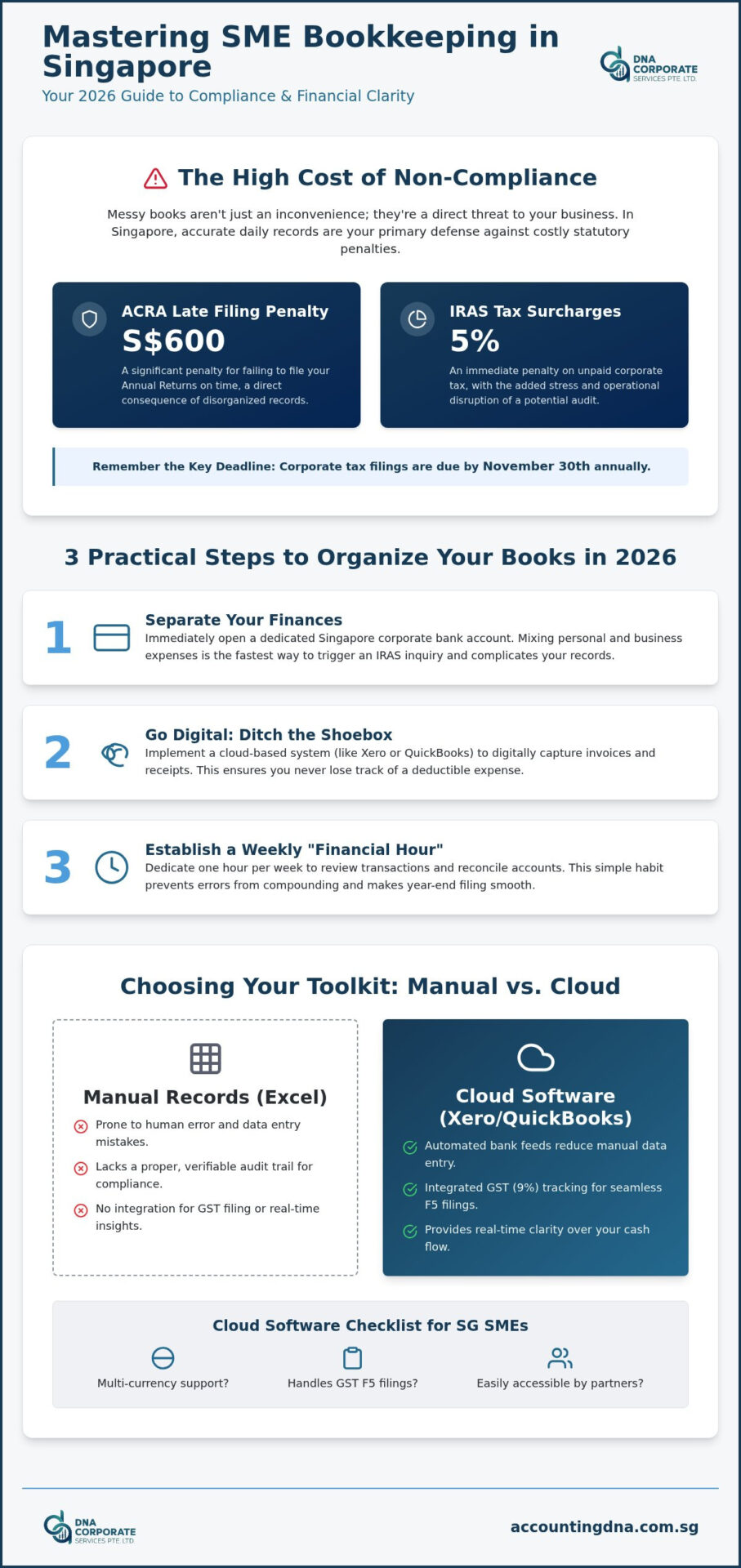
Accurate records aren’t just for your own clarity; they’re a legal necessity. Your daily entries feed directly into your Annual Return filings with ACRA and your Corporate Tax submissions (Form C-S/C) with IRAS. If your books are messy, you risk more than just confusion. IRAS can impose an immediate 5% penalty on unpaid tax, and the stress of a sudden audit can derail your operations. In Singapore, your daily bookkeeping is the primary defense against the S$600 ACRA late filing penalty and more severe IRAS surcharges. Maintaining clean, audit-ready records ensures you’re always prepared for the November 30 tax deadline without the last minute panic of missing receipts or unrecorded expenses.
Practical Steps to Organise Your Small Business Bookkeeping in 2026
Establishing a weekly “financial hour” is your best defense against errors. Use this time to review transactions and reconcile accounts before the month ends. This habit ensures nothing falls through the cracks, making your year-end filings significantly smoother. For a broader view of your obligations, check out The Master Guide to Statutory Compliance in Singapore (2026 Edition). If you feel overwhelmed by a backlog of transactions, our team is always ready to help you get your records back on track.
Choosing Between Cloud Accounting Software and Manual Records
Is Excel really enough for a growing Pte Ltd? While a spreadsheet feels familiar, it lacks a proper audit trail and invites human error. For Singapore SMEs, cloud platforms like Xero or QuickBooks Online are superior because they offer automated bank feeds and integrated GST tracking. As the GST rate remains at 9%, having a system that automates your F5 filings is invaluable. Before committing, run through this checklist:
- Does your system support multi-currency for regional trades?
- Can it handle automated GST F5 filing requirements?
- Is it easily accessible for your bookkeeping and accounting services partner?
Transitioning to Professional Bookkeeping: Why Boutique Expertise Matters for SMEs
While automated platforms promise speed, they often lack the nuance required for a growing business. This is where the “Boutique Advantage” shines. At DNA Accounting, we don’t treat your company like a ticket number in a queue. Instead, we offer a centralized service model where your bookkeeper, corporate secretary, and tax advisor work in sync. This integration ensures that a change in shareholding or a new business contract is immediately reflected in your financial records and statutory filings. We know that as an entrepreneur, your work doesn’t stop at 6 PM. That’s why we pride ourselves on being accessible during evenings and non-working days to provide the support you actually need. Choosing professional basic bookkeeping services isn’t just about avoiding fines; it’s about gaining a dedicated partner who cares about your bottom line.
The DNA Accounting Approach: Personalized Support Beyond Data Entry
If your records are currently in disarray, don’t panic. Our “bookkeeping takeover” process is designed to clean up messy historical data and bring everything up to date with zero stress for you. We understand the anxiety that comes with a looming deadline and incomplete ledgers. Unlike a silent data entry clerk, a dedicated expert from our team proactively identifies potential corporate tax filing deductions early. For instance, we ensure your business maximizes the 50% Corporate Income Tax rebate for YA 2026, capped at S$40,000. This human-led approach transforms your finances from a compliance burden into a strategic asset. Is your current provider a proactive partner in your company’s DNA, or just someone who records numbers? Professional help is an investment that provides the clarity you need to drive real business growth and long term stability.
Securing Your SME’s Financial Future in 2026
Mastered correctly, your financial records transform from a compliance headache into a powerful strategic tool. We’ve explored how aligning with SFRS standards and adopting cloud technology protects your business from ACRA penalties and IRAS surcharges. Whether you’re separating personal accounts or cleaning up messy historical data, these steps are vital for long term stability. Professional basic bookkeeping services provide the audit-ready foundation you need to focus on what you do best: growing your company.
At DNA Accounting, we offer more than just data entry. We provide bespoke care from dedicated Singapore experts who understand your unique challenges. We’re even available for evening and weekend consultations to fit your busy schedule. Ready for stress-free books? Contact DNA Accounting for a bespoke consultation today and let’s build a stronger foundation for your business together.
Frequently Asked Questions
What is the difference between bookkeeping and accounting in Singapore?
Bookkeeping is the foundational task of recording daily financial transactions, while accounting involves interpreting that data for strategic decisions and tax prep. In Singapore, bookkeeping ensures your General Ledger remains accurate for SFRS compliance. Accounting takes those records to prepare the Corporate Income Tax Return (Form C-S) and handle complex IRAS inquiries. One focuses on data entry; the other provides financial insight.
Do I need to hire a full-time bookkeeper for my Singapore startup?
Most Singapore startups don’t need a full-time hire. Outsourcing basic bookkeeping services to a boutique firm is more cost-effective and provides access to expert advice without the overhead of a salary and CPF contributions. Since private companies must file annual returns within 7 months of their financial year end, a professional partner ensures you meet every ACRA deadline without the risk of internal turnover.
How long must I keep my financial records and receipts under Singapore law?
Under Singapore law, you must keep your financial records and supporting documents for at least five years. This includes all invoices, receipts, and bank statements related to your business transactions. If your company is GST registered, keeping these records is vital for potential IRAS audits. Failure to maintain proper records can result in penalties or even prosecution, so digital archiving is highly recommended for safety.
Can I do my own bookkeeping using Excel for a Private Limited company?
You can technically use Excel, but it’s not recommended for a Private Limited company. Spreadsheets lack the audit trails required for robust compliance and increase the risk of manual errors. As your business grows, using cloud-based software like Xero ensures your records are audit-ready for ACRA and IRAS. It also allows your professional bookkeeper to provide real-time financial insights rather than fixing broken formulas.
What are the common bookkeeping mistakes that lead to IRAS penalties?
Common errors include mixing personal and business expenses, failing to reconcile bank statements, and missing the November 30 tax filing deadline. Another frequent mistake is claiming GST on non-deductible items, which can trigger an immediate 5% penalty on unpaid tax. Accurate basic bookkeeping services prevent these issues by ensuring every transaction is categorized correctly and all statutory deadlines are tracked proactively by your advisor.
How much should a small business expect to pay for monthly bookkeeping services in Singapore?
Monthly fees for bookkeeping in Singapore typically depend on your transaction volume and the complexity of your business operations. Instead of a one size fits all price, most firms offer tiered packages based on the number of bank accounts or monthly invoices. It’s best to request a bespoke consultation to ensure you only pay for the specific level of support your SME actually requires.
Disclaimer
The information provided on this website is for general informational purposes only and is not intended to constitute professional accounting, tax, legal, or financial advice. While we strive to ensure that the content is accurate and up to date, regulations in Singapore, including those administered by ACRA, IRAS, CPF Board, and MOM, may change from time to time and may differ depending on individual circumstances.
Readers should not act or rely on any information contained on this website without seeking specific advice from a qualified professional based on their individual situation.
DNA Corporate Services and its affiliates accept no responsibility or liability for any loss or damage arising from reliance on the information provided in this website or any linked materials.
For tailored advice relating to accounting, taxation, corporate secretarial, or compliance matters in Singapore, please contact us directly for professional consultation.



