
If 95.1% of Singapore SMEs have already gone digital, why are so many founders still losing sleep over messy spreadsheets and impending IRAS deadlines? You’ve likely spent hours wrestling with manual data entry, worrying if your GST filing is accurate or if you’ve missed a critical ACRA filing date. It’s a heavy burden when you’re trying to grow a business, especially with the 2026 InvoiceNow mandate approaching. We understand that compliance isn’t just about software; it’s about peace of mind.
This guide will show you how to master the shift to digital finance, ensuring your software works in harmony with local regulations. We’ll break down the Xero vs QuickBooks Singapore debate, explore seamless GST filing, and show you how automated bank feeds provide real-time cash flow clarity. You’ll discover how to transition your SME into a streamlined, compliant powerhouse with expert support that remains available even during your busiest evenings.
Key Takeaways
- Understand why cloud accounting is now a regulatory necessity in Singapore, especially with the 2026 InvoiceNow mandate for GST-registered businesses.
- Identify the best platform for your needs by comparing Xero vs QuickBooks Singapore based on local bank integrations with DBS, OCBC, and UOB.
- Learn how to replace messy manual spreadsheets with automated ecosystems that simplify your GST filing and provide real-time cash flow visibility.
- Discover the advantage of a boutique migration partner who provides industry-specific setup and expert support during your non-traditional working hours.
Why Cloud Accounting is Non-Negotiable for Singapore SMEs in 2026
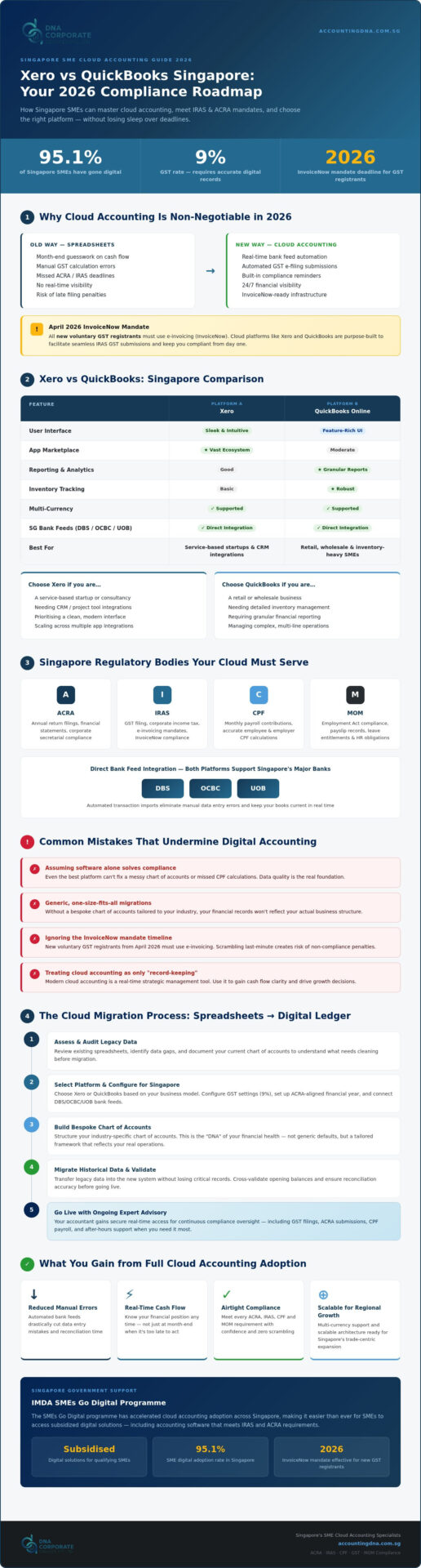
Cloud accounting has evolved far beyond basic record-keeping. In 2026, it represents a real-time, bank-grade secure financial ecosystem built specifically to handle the rigors of the Singapore regulatory landscape. Modern cloud accounting software integrates directly with local banks like DBS, OCBC, and UOB, pulling data automatically to ensure your books are always current. This shift represents a move away from traditional desktop systems that often leave you guessing about your cash flow until month-end.
For local business owners, the choice often boils down to Xero vs QuickBooks Singapore, but the software is just the tool. The real value lies in moving from “doing the books” to strategic financial management. When comparing Xero vs QuickBooks Singapore, you’ll find that both platforms offer the real-time visibility needed to thrive in a competitive market. Staying ahead requires a solid grasp of statutory compliance Singapore, ensuring your digital architecture supports every government requirement from day one.
Meeting 2026 ACRA and IRAS Digital Mandates
The regulatory environment is tightening. As of April 2026, the InvoiceNow mandate requires all new voluntary GST registrants to use e-invoicing. Cloud platforms facilitate these seamless GST submissions, reducing the risk of manual errors and ensuring you stay on the right side of the 9% GST regulations. By maintaining digital records, you simplify the preparation of financial statements and significantly lower the chance of facing an ACRA late filing penalty. It’s about being proactive rather than scrambling at the 11th hour when deadlines loom.
Evaluating Xero vs. QuickBooks: A Singaporean Comparison
Scalability is vital for Singaporean SMEs aiming for regional growth. Both platforms handle multi-currency transactions effectively, which is essential for our trade-centric economy. Crucially, they offer direct bank feed integrations with DBS, OCBC, and UOB. This automation pulls your transactions directly into the system, drastically reducing manual errors. If you’re struggling to choose between Xero vs QuickBooks Singapore for your specific workflow, we can help you evaluate your requirements.
Choosing the Right Fit for Your Business Model
Your choice should align with your operational complexity. Xero’s extensive app marketplace is a dream for service-based startups needing integration with CRM or project management tools. On the other hand, QuickBooks often provides more robust inventory tracking for retail or wholesale businesses. The SMEs Go Digital programme has accelerated this adoption, making it easier than ever to find subsidized solutions. Ultimately, you need a platform that your accounting services Singapore partner can access securely to provide real-time advice. Selecting a system that allows for bespoke oversight ensures your compliance remains airtight as you scale.
The DNA Accounting Advantage: Bespoke Cloud Migration and Advisory
Many directors worry about finding the time to manage this shift while running daily operations. That’s why we offer extreme accessibility, remaining available during evenings and non-working days to suit your busy schedule. Whether you’re navigating the Productivity Solutions Grant (PSG) to offset your software costs or need an urgent answer on a Saturday, we’re here. We act as your reliable guide, bridging the gap between sophisticated software and strict local compliance.
Continuous Compliance and Real-Time Advisory
Software provides the data, but we provide the strategic insight. We monitor your digital financial health to offer proactive tax planning and corporate tax filing Singapore support. This ensures you maximize the 50% CIT rebate for YA 2026 while staying perfectly aligned with 9% GST deadlines. Having a seasoned advisor watching your bank feeds gives you the peace of mind to focus on growth. Ready to see if your business is prepared for the leap? Contact DNA Accounting today for a personalized cloud readiness assessment.
Future-Proofing Your SME with Digital Clarity
Since 2016, we’ve specialized in helping local founders navigate these complex shifts with boutique, centralized care. We understand that your business doesn’t stop at 6 PM, which is why we remain available during evenings and non-working days to provide the support you need. Ready to modernize your business? Get a Bespoke Cloud Accounting Quote. You’ve worked hard to build your company; let us provide the digital foundation to help it thrive in a competitive landscape.
Frequently Asked Questions
Is cloud accounting safe for a Singapore-registered company?
Yes, cloud accounting is exceptionally secure for Singaporean firms. Platforms use bank-grade 256-bit SSL encryption and mandatory multi-factor authentication to protect your financial data. These global providers invest heavily in cybersecurity, often surpassing the protection levels of local desktop servers. This ensures your sensitive company records remain accessible only to authorized personnel while complying with local data protection expectations.
Can I switch from my current accounting software to a cloud platform mid-year?
You can absolutely switch to a cloud platform at any point during the financial year. While many businesses prefer transitioning at the start of a new fiscal period, a mid-year migration is very common. We assist by importing your year-to-date opening balances and transaction history. This ensures a seamless transition without losing historical data or disrupting your ongoing compliance obligations.
Do I still need a professional accountant if I use cloud software like Xero?
Yes, because software is simply a tool that requires professional oversight to ensure technical accuracy. While the Xero vs QuickBooks Singapore choice automates many tasks, an accountant provides the strategic advisory and compliance expertise needed for complex IRAS filings. We monitor your bank feeds to prevent errors, ensuring your chart of accounts is structured correctly for your industry.
How does cloud accounting help with my quarterly GST filing in Singapore?
Cloud accounting simplifies GST compliance by automatically tracking your input and output tax at the prevailing 9% rate. The software generates real-time GST F5 reports, which reduces the manual effort involved in quarterly submissions. When comparing Xero vs QuickBooks Singapore, both platforms offer features that connect directly to IRAS, ensuring your digital records meet the 2026 InvoiceNow requirements.
Disclaimer
The information provided on this website is for general informational purposes only and is not intended to constitute professional accounting, tax, legal, or financial advice. While we strive to ensure that the content is accurate and up to date, regulations in Singapore, including those administered by ACRA, IRAS, CPF Board, and MOM, may change from time to time and may differ depending on individual circumstances.
Readers should not act or rely on any information contained on this website without seeking specific advice from a qualified professional based on their individual situation.
DNA Corporate Services and its affiliates accept no responsibility or liability for any loss or damage arising from reliance on the information provided in this website or any linked materials.
For tailored advice relating to accounting, taxation, corporate secretarial, or compliance matters in Singapore, please contact us directly for professional consultation.



