

What if your company’s biggest regulatory risk isn’t a massive tax audit, but a simple missed deadline that triggers a S$600 ACRA penalty before your first anniversary? It’s a common fear for founders who feel overwhelmed when selecting business formation services to handle Singapore’s statutory landscape. You’ve likely felt the stress of wondering if your Nominee Director arrangements are robust enough or if your payroll reflects the 2026 CPF wage ceiling of S$6,800. We understand that these requirements can feel like a daunting distraction from your core mission of building a great business.
This guide provides a strategic roadmap for 2026, showing you how expert-led guidance can transform these regulatory hurdles into a solid foundation for your success. We’ll walk through the essentials of ACRA compliance, explain the latest GST InvoiceNow requirements, and show you how a centralized partner keeps your company’s DNA healthy from day one.
Key Takeaways
- Understand why the Private Limited (Pte Ltd) structure remains the most strategic choice for Singapore startups in 2026, offering essential liability protection and tax benefits.
- Learn how professional business formation services help you navigate ACRA’s mandatory requirements, from appointing a resident director to securing a qualified company secretary.
- Discover the specific steps foreign founders must take to manage Nominee Director roles and Employment Pass (EP) applications without compromising compliance.
- Identify critical post-incorporation milestones, including opening corporate bank accounts and meeting the latest InvoiceNow requirements for GST-registered businesses.
What Are Business Formation Services in Singapore?
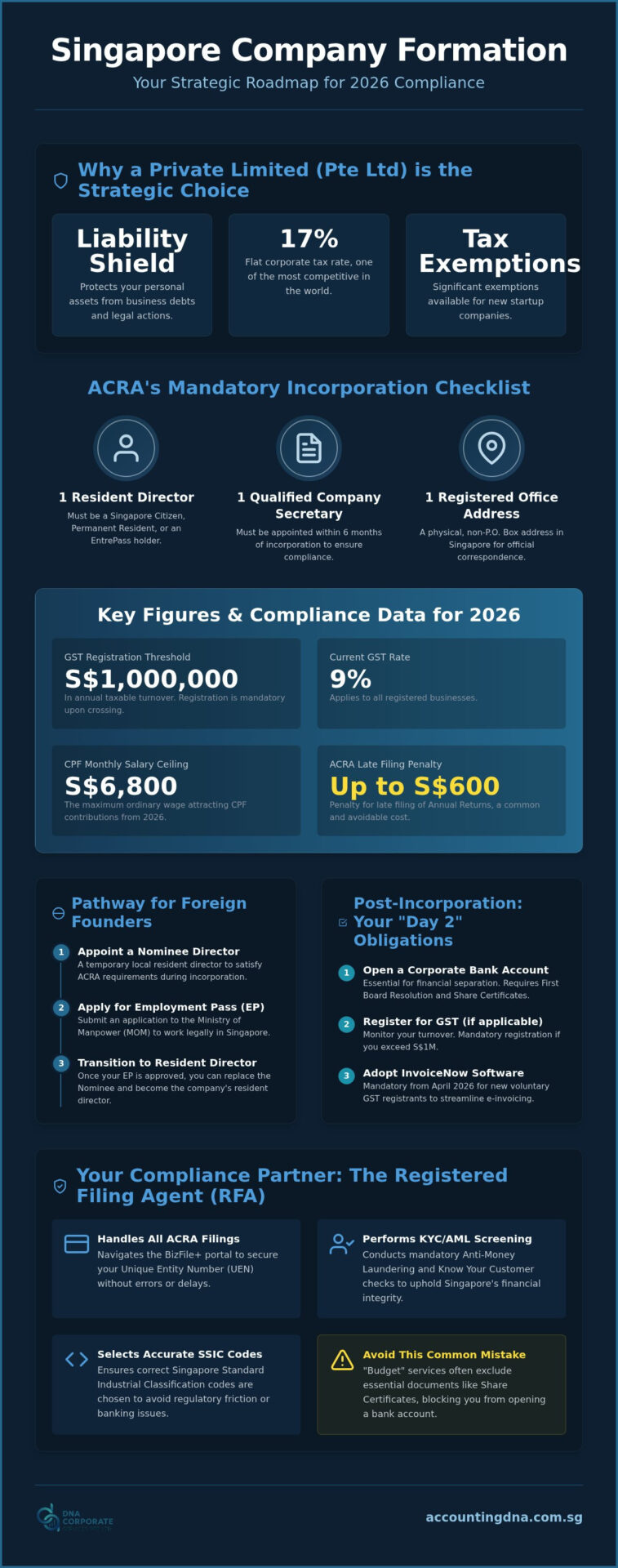
Setting up a company in Singapore is often praised for its speed, yet the underlying requirements of the Singapore Companies Act demand absolute precision. Business formation services include the entire lifecycle of creating your legal entity, ensuring every statutory box is ticked from the start. In 2026, the Private Limited (Pte Ltd) model remains the preferred choice for startups and SMEs. It provides a robust shield for personal assets and opens doors to corporate tax rates capped at a flat 17%, with further exemptions available for new firms. All these filings are centralized through the Accounting and Corporate Regulatory Authority (ACRA). Because the BizFile+ portal requires specific professional credentials, partnering with a Registered Filing Agent is the most efficient way to secure your Unique Entity Number (UEN) without administrative delays. This initial setup determines your company’s compliance trajectory for years to come.
The Role of a Registered Filing Agent (RFA)
Your Registered Filing Agent (RFA) serves as a protective partner, handling mandatory Anti-Money Laundering (AML) and Know Your Customer (KYC) screenings. These are non-negotiable under Singapore law to maintain the jurisdiction’s financial integrity. A critical area where founders often stumble is the selection of Singapore Standard Industrial Classification (SSIC) codes. These codes tell the government exactly what your business does. Selecting an inaccurate code can trigger regulatory scrutiny, banking friction, or even disqualify you from specific industry tax grants. Professional business formation services ensure these foundational details are accurate before you begin bookkeeping and accounting tasks, giving you peace of mind that your structural DNA is sound.
Choosing the Right Components for Your Business Formation
What exactly goes into a successful incorporation? To meet ACRA standards, you must appoint a local resident director, a qualified company secretary, and maintain a registered office address in Singapore. For foreign founders, the resident director requirement is often the steepest hurdle. You might initially require a Nominee Director until your Employment Pass (EP) is approved by the Ministry of Manpower. While some providers offer “budget” business formation services, be cautious. These entry-level prices often exclude critical post-incorporation documents like the First Board Resolution or Share Certificates. Without these, you’ll struggle to open a bank account or issue equity. For a high-level view of these moving parts, the EDB’s guide to setting up in Singapore provides an excellent official overview.
Corporate Secretarial and Registered Address Essentials
Under Section 171 of the Companies Act, your company secretary isn’t just an administrator; they are an officer of the company responsible for statutory compliance and board governance. This role must be filled within six months of incorporation. Similarly, your registered office address must be a physical location in Singapore where official communications are received. While a virtual office is a cost-effective start, ensure your provider offers reliable mail handling. You can explore flexible registered office address Singapore options to suit your specific scale. If you’re looking for a deeper dive into these initial steps, check out our Company Incorporation Singapore: The 2026 Founder’s Guide. If you find these requirements confusing, feel free to reach out to our team for a chat about your specific needs.
Transitioning from Setup to Sustainable Compliance
Once your UEN is issued, the focus shifts to operational milestones. Many founders mistake incorporation for the finish line, but it’s actually the start of your “Day 2” obligations. After you Register your business, your first priority is opening a corporate bank account. This requires the formal documents provided by your business formation services. You’ll also need to monitor your revenue closely. If your taxable turnover crosses the S$1 million threshold, GST registration at the current 9% rate becomes mandatory. Since April 2026, new voluntary GST registrants must also adopt InvoiceNow-ready software, making early digital adoption essential.
Managing these moving parts is easier when your business formation services are linked to your ongoing accounting and taxation services. Juggling multiple vendors often leads to communication breakdowns. A centralized partner ensures your “business DNA” is consistent across your secretarial filings, tax returns, and payroll. This holistic view helps you avoid common pitfalls, like failing to file an Estimated Chargeable Income (ECI) within three months of your financial year-end.
The DNA Accounting Approach: Bespoke Care for 2026
We don’t believe in a one-size-fits-all model. As a boutique firm, we provide a single point of contact who understands your specific goals from the moment of formation. We also know that founders don’t work a standard 9-to-5. That’s why we’re available during evenings and non-working days to offer the reassurance you need when a compliance question keeps you up at night. We act as a protective partner, guiding you through The Master Guide to Statutory Compliance to ensure your venture remains secure. If you’re ready for a seamless setup, consult with our advisors to start your formation journey now.
Build Your Singapore Venture on a Solid Compliance Foundation
Choosing the right structure is just the first step. A Private Limited company offers the best balance of liability protection and tax efficiency for 2026 startups. However, maintaining that advantage requires meticulous attention to ACRA and IRAS regulations from day one. Professional business formation services do more than just register a name; they ensure your statutory DNA is healthy and scalable. From managing Nominee Director requirements to navigating InvoiceNow mandates, your choice of partner defines your success.
At DNA Accounting, we provide personalized support as a boutique firm specialized in local compliance. We’re even available during evenings and non-working days to ensure you’re never left guessing about your obligations. Ready to build your business on a solid foundation? Contact DNA Accounting today. We look forward to helping your vision take root in Singapore.
Frequently Asked Questions
Can a foreigner own 100% of a Singapore company?
Yes, foreigners can own 100% of the shares in a Singapore company. There’s no requirement for a local partner or shareholder, which provides you with full control over your equity. While ownership is unrestricted, you must still appoint at least one resident director. This individual can be a Singapore citizen, a permanent resident, or an EntrePass holder who lives in Singapore.
What is the minimum paid-up capital required for business formation in Singapore?
The minimum paid-up capital required for business formation in Singapore is just S$1. This flexibility allows startups to incorporate without a large initial cash outlay. You can increase this capital at any time after the company is registered. Our business formation services help you structure your share capital correctly to ensure your setup meets all statutory guidelines from the start.
How long does the company incorporation process usually take in 2026?
The incorporation process is remarkably fast, typically taking between one to three business days in 2026. Because the system is fully digital, your company can often be registered within hours of submitting the application to ACRA. The timeline only extends if your chosen company name requires a manual review or if your business activities need approval from other government agencies. If you are also evaluating other global business hubs, you can discover Ventureprise Acquisitions to learn about the potential pitfalls and regulatory challenges of setting up in the UAE.
Do I need to be physically present in Singapore to engage business formation services?
No, you don’t need to be physically present to engage business formation services or start your company. We can manage the entire registration process remotely through digital documentation and online verification. While the setup is remote, please be aware that most local banks will require directors to be physically present in Singapore when you eventually open your corporate bank account to complete their internal verification.
Disclaimer
The information provided on this website is for general informational purposes only and is not intended to constitute professional accounting, tax, legal, or financial advice. While we strive to ensure that the content is accurate and up to date, regulations in Singapore, including those administered by ACRA, IRAS, CPF Board, and MOM, may change from time to time and may differ depending on individual circumstances.
Readers should not act or rely on any information contained on this website without seeking specific advice from a qualified professional based on their individual situation.
DNA Corporate Services and its affiliates accept no responsibility or liability for any loss or damage arising from reliance on the information provided in this website or any linked materials.
For tailored advice relating to accounting, taxation, corporate secretarial, or compliance matters in Singapore, please contact us directly for professional consultation.



