

What if the biggest threat to your Singapore SME isn’t a drop in revenue, but a simple misunderstanding of the word “audit”? Many directors find themselves paralyzed by the fear of ACRA late filing penalties or the technical complexity of Singapore Financial Reporting Standards (SFRS). We know it’s stressful to balance daily growth with the rigid demands of statutory compliance. You aren’t alone in feeling that the line between mandatory audit requirements and a compilation of financial statements Singapore regulations demand is often frustratingly thin.
This guide will help you master these requirements to ensure seamless ACRA and IRAS compliance for your business. We’ll clarify the 2026 audit exemption criteria and show you how professional compilation prepares your company for tax optimization. From avoiding the S$600 late filing trap to navigating new SFRS(I) 9 amendments, you’re about to gain total clarity on your year-end obligations.
Key Takeaways
- Identify whether your business meets the 2026 “Small Company” criteria to legally bypass expensive statutory audits in favor of a simpler reporting model.
- Discover how a professional compilation of financial statements Singapore ensures your reports align perfectly with the latest Singapore Financial Reporting Standards (SFRS).
- Master the step-by-step process of transitioning from basic bookkeeping to technical year-end adjustments like depreciation and accruals for ACRA filing.
- Protect your company from the S$600 late filing penalty trap by understanding the critical deadlines for both ACRA Annual Returns and IRAS tax submissions.
What is a Compilation of Financial Statements in Singapore?
Are you confused about whether your business needs a full audit or just a professional report? For most SMEs, a compilation of financial statements Singapore requires is the answer. It’s the essential bridge between your raw monthly bookkeeping and the formal statutory filing needed for audit-exempt companies. While an audit involves rigorous transaction testing, a compilation focuses on presenting your financial data in a clear, compliant format that satisfies regulatory bodies.
A compilation engagement involves an expert accountant organizing your management data into a structured format without providing the high-level assurance of an audit. Even though it lacks an audit opinion, these reports must strictly follow the Singapore Financial Reporting Standards (SFRS) and the Singapore Standard on Related Services (SSRS) 4410. A complete set includes the Profit & Loss statement, Balance Sheet, and Cash Flow statement, all accompanied by a formal Directors’ Statement. Understanding What is a Compilation of Financial Statements helps clarify that this isn’t just a summary; it’s a technical document that ensures your numbers are presented fairly to ACRA and IRAS.
Who Needs a Compilation Report in Singapore?
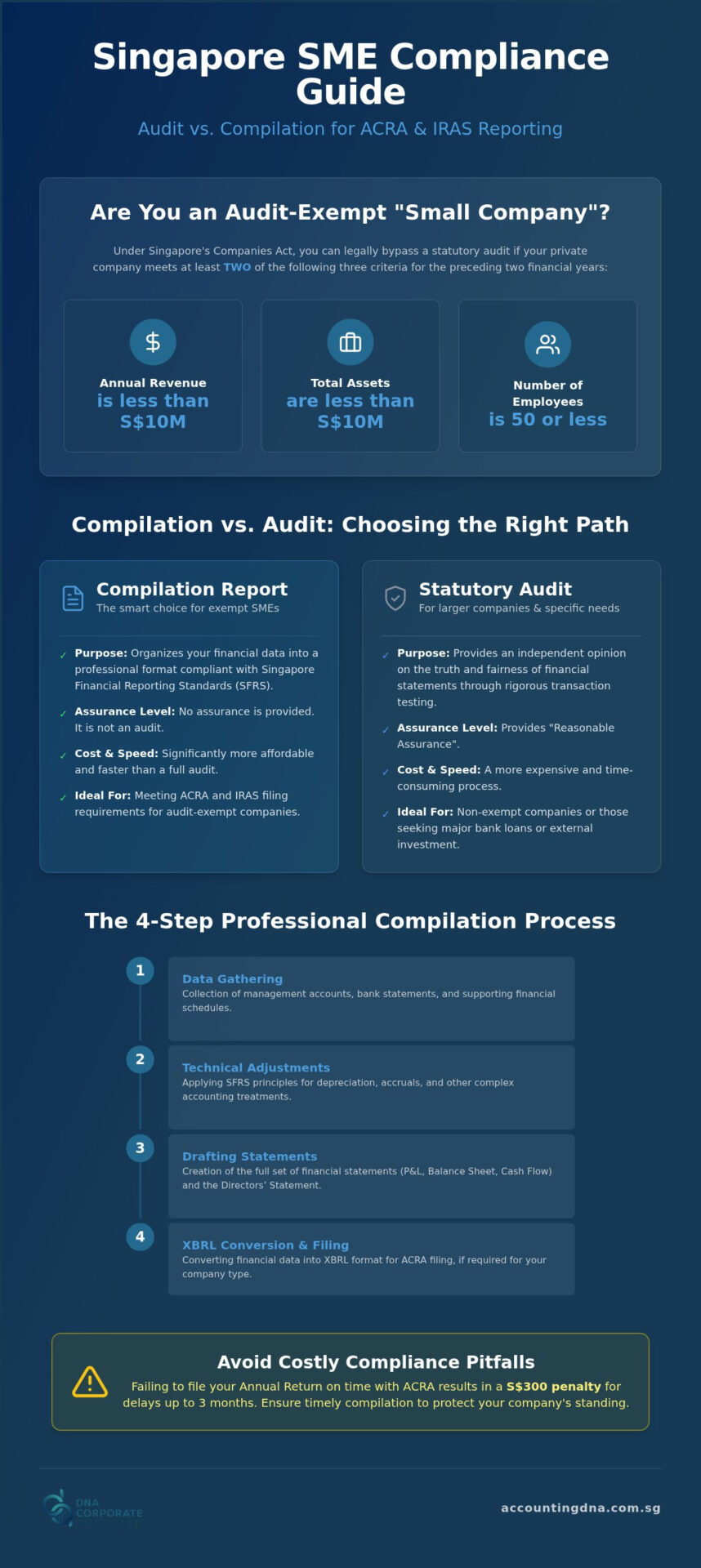
Most private companies qualify for audit exemption under the “Small Company” concept. You don’t need an audit if you meet at least two of these three criteria: annual revenue under S$10 million, total assets under S$10 million, or fewer than 50 employees. However, being audit-exempt doesn’t mean you’re exempt from filing. If your company has corporate shareholders or doesn’t meet the “solvent exempt private company” status, you must file these statements in XBRL format. We can help you manage these transitions through our bookkeeping and accounting services to ensure you remain fully compliant with ACRA rules and avoid unnecessary penalties.
Compilation vs. Audit: Which Path for Your Business?
Many business owners assume a full audit is the only way to prove financial health. That’s a common misconception that can lead to unnecessary expenses. For the vast majority of audit-exempt SMEs, a professional compilation of financial statements Singapore regulations specify is the most efficient path forward. While an audit provides “reasonable assurance” through rigorous transaction testing, a compilation focuses on organizing your management data into a structured, SFRS-compliant format.
Choosing compilation isn’t just about following the law; it’s a strategic cost-saving move. It’s significantly more affordable than an audit while still satisfying the requirements of ACRA and IRAS. By having a professional prepare these reports, you also reduce the risk of IRAS queries. Your accounts are effectively “tax-ready,” which minimizes the chance of errors that trigger regulatory scrutiny. You might only choose a voluntary audit if you’re applying for substantial bank loans or if external investors require that extra level of verified assurance.
The Strategic Benefits of Choosing Compilation
Speed is one of the most immediate advantages. Compiling your statements is much faster than a full audit, which helps you meet tight AGM and Annual Return deadlines without stress. Additionally, a compiled report from a qualified boutique firm carries significantly more weight with banks than self-prepared management accounts. It demonstrates that your financial foundation is solid and technically accurate. To ensure your year-end data is ready for this process, it helps to maintain high-quality bookkeeping and accounting services throughout the year. If you’re unsure which path fits your current growth stage, feel free to reach out for a quick chat about your compliance needs.
The Compilation Process and ACRA Filing Requirements
The process of moving from raw bookkeeping to a finished report is often where directors feel the most pressure. A professional compilation of financial statements Singapore follows a clear, four-step path to ensure nothing is missed. It’s not just about data entry; it’s about technical accuracy that stands up to regulatory review.
Failing to meet these deadlines carries heavy consequences that can impact your company’s standing. If you file your annual return late, ACRA imposes a S$300 penalty for delays up to three months, which jumps to S$600 if you exceed that window. Beyond the financial hit, persistent failure can lead to court summons or even director disqualification. It’s also vital that your compiled figures align perfectly with your Corporate Tax GST Filing to avoid triggering IRAS queries. We understand that business doesn’t always happen between nine and five. That’s why DNA Accounting offers bespoke care, including availability during evenings and non-working days to handle urgent compliance needs when they matter most.
Master Your Statutory Obligations with Confidence
Navigating the transition from simple bookkeeping to a formal compilation of financial statements Singapore requires doesn’t have to be a source of stress. By understanding your audit exemption status and following a structured filing process, you protect your business from costly penalties and regulatory queries. You’ve worked hard to build your company. Ensuring your year-end reports are technically accurate is the final step in securing that success.
We’re here to act as your protective partner, offering the deep local expertise of ACRA and IRAS compliance experts. Whether you need help with technical SFRS adjustments or urgent support during evenings and weekends, our team is ready to guide you. Ready to simplify your year-end compliance? Contact DNA Accounting for a professional compilation consultation today. Let’s ensure your business remains fully compliant while you focus on what you do best: growing your enterprise.
Frequently Asked Questions
Is a compilation report mandatory for all Singapore companies?
A compilation report isn’t mandatory for every single entity, but preparing financial statements is a statutory requirement for all Singapore companies. If your business qualifies as a “Small Company” by meeting two of the three audit exemption criteria, you can choose a compilation of financial statements Singapore rules allow instead of a full audit. It’s a reliable way to stay compliant without high audit costs.
Can I prepare my own compilation report for ACRA?
While directors are ultimately responsible for the accuracy of financial records, preparing a compilation report requires deep knowledge of Singapore Financial Reporting Standards (SFRS). It isn’t just about listing income and expenses; you’ve got to handle technical adjustments like depreciation and accruals. Most SMEs outsource this to experts like DNA Accounting to ensure the report is error-free and ready for ACRA filing or XBRL conversion.
What is the deadline for filing compiled financial statements in Singapore?
For non-listed companies, you’ve got to file your Annual Return within seven months of your Financial Year End (FYE). You also need to prepare these statements within six months of your FYE to present them at your Annual General Meeting (AGM). Missing these windows can trigger automatic ACRA penalties starting at S$300, so early preparation is your best defense against late fees and court summons.
What is the difference between a compilation and XBRL filing?
Compilation is the professional process of organizing your financial data into a formal report that follows SFRS. By contrast, XBRL is the specific digital format required by ACRA for the actual filing process. Think of compilation as writing the story and XBRL as the digital language used to upload that story to the government’s BizFile+ portal. It’s a technical requirement for companies with corporate shareholders.
Disclaimer
The information provided on this website is for general informational purposes only and is not intended to constitute professional accounting, tax, legal, or financial advice. While we strive to ensure that the content is accurate and up to date, regulations in Singapore, including those administered by ACRA, IRAS, CPF Board, and MOM, may change from time to time and may differ depending on individual circumstances.
Readers should not act or rely on any information contained on this website without seeking specific advice from a qualified professional based on their individual situation.
DNA Corporate Services and its affiliates accept no responsibility or liability for any loss or damage arising from reliance on the information provided in this website or any linked materials.
For tailored advice relating to accounting, taxation, corporate secretarial, or compliance matters in Singapore, please contact us directly for professional consultation.



