

What if a single decimal point error in your CPF contributions could trigger a Ministry of Manpower (MOM) audit that stalls your business growth for months? As a director in Singapore, you’ve likely felt the weight of compliance deadlines pressing down on you. Whether it’s the confusion of calculating the Skills Development Levy (SDL) or the anxiety of filing an IR21 for a departing foreign employee, managing a growing team often feels like navigating a regulatory minefield. You aren’t alone in feeling that the administrative burden of employee payroll services is distracting you from your core mission of scaling your company.
We understand that your priority is your people, not just their paperwork. This 2026 guide is designed to help you master Singapore’s latest payroll regulations, from the S$8,000 CPF Ordinary Wage ceiling to the mandatory Auto-Inclusion Scheme (AIS) requirements. You’ll learn how a centralized, boutique approach to payroll management doesn’t just ensure timely salary payments; it provides the protective expertise needed to shield your business from IRAS penalties. We’ll walk you through the essential compliance deadlines and show you how to transform payroll from a monthly stressor into a seamless, automated pillar of your operations.
Key Takeaways
- Understand the personal liability directors face under the Employment Act and how to protect your business from MOM penalties through rigorous compliance.
- Master the 14th-of-the-month rule by leveraging professional employee payroll services to ensure timely CPF contributions and accurate SDL calculations.
- Identify the critical differences between generic automated software and a boutique, bespoke service model that adapts to your specific business requirements.
- Streamline your financial workflow by integrating payroll data with your bookkeeping and secretarial records for total operational oversight.
- Prepare for the 2026 regulatory landscape with actionable insights on tax clearances and statutory reporting for a diverse workforce.
Navigating Singapore’s Payroll Compliance: Beyond Basic Salary Calculations
While the global definition of What is Payroll? covers the basic distribution of wages, the Singapore landscape requires a much more integrated approach. Here, employee payroll services aren’t just about cutting checks. They represent a complex intersection of Ministry of Manpower (MOM) standards, Central Provident Fund (CPF) contributions, and Inland Revenue Authority of Singapore (IRAS) tax reporting. For a startup or SME, missing a single update in the 2026 Skills Development Levy (SDL) rates or failing to account for the S$8,000 CPF Ordinary Wage ceiling can lead to immediate friction with regulators. DIY payroll might seem like a cost-saving measure, but it often results in expensive ACRA or IRAS penalties that far outweigh any initial savings.
The Legal Framework: MOM and the Employment Act
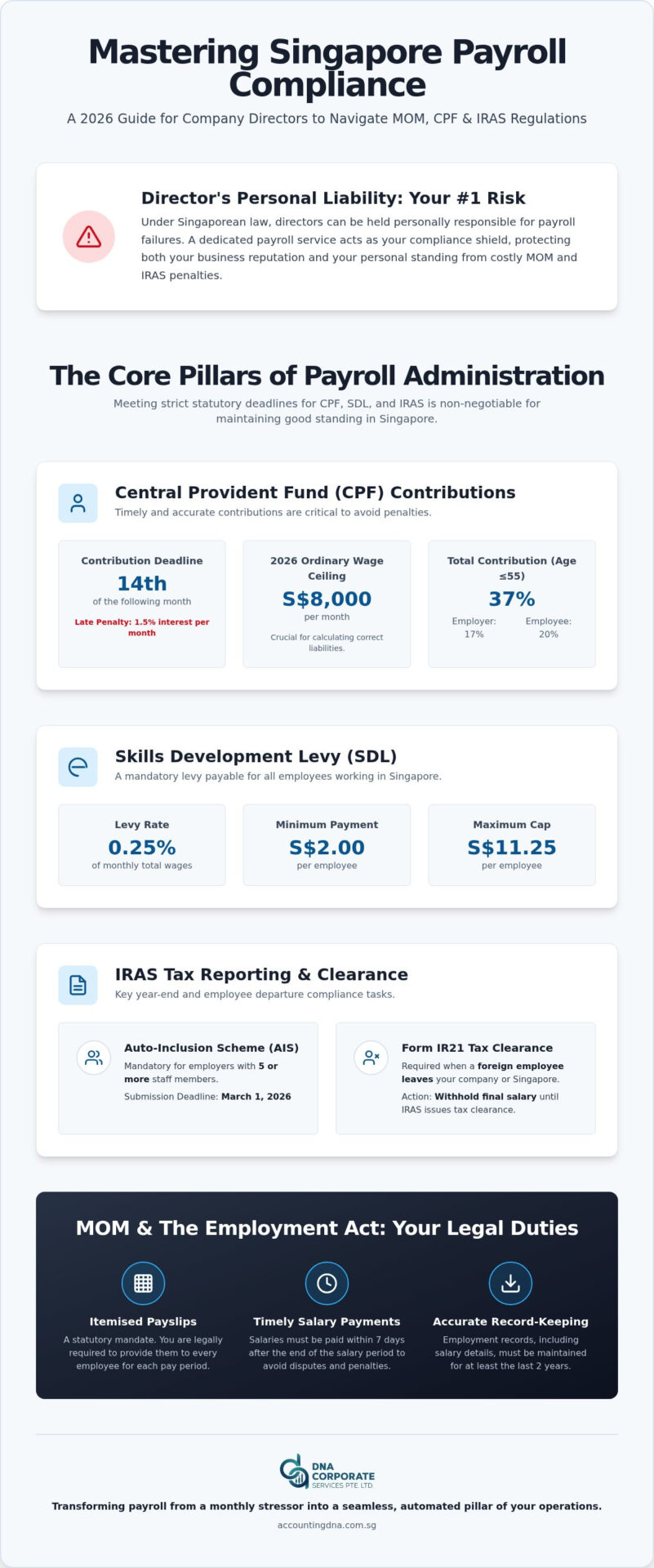
Under the Employment Act, you’re legally required to provide itemised payslips to every employee. This isn’t a suggestion; it’s a statutory mandate. You also need to ensure salary payments are made within seven days after the end of the salary period. Many business owners struggle with the nuances of calculating overtime pay or public holiday rates, which are frequent triggers for MOM disputes. If you’re feeling overwhelmed by these moving parts, aligning your payroll with your bookkeeping and accounting services provides the comprehensive oversight needed to avoid compliance gaps and ensure your financial records remain perfectly synchronized.
Director Liability: Why Compliance is Your #1 Priority
Did you know that as a company director, you can be held personally liable for failures in payroll compliance? If the company fails to pay salaries or CPF contributions on time, the authorities don’t just look at the business entity; they look at the officers in charge. This is where professional employee payroll services become your most vital shield. Beyond just processing numbers, a dedicated partner ensures you maintain accurate employment records for at least two years, as required by law. We act as your compliance buffer, catching errors before they become legal liabilities. This proactive care allows you to sleep better at night, knowing your personal standing and your company’s reputation are protected.
Core Pillars of Payroll Administration: CPF, SDL, and IRAS Reporting
Managing payroll isn’t just about ensuring employees are happy on payday. It’s about meeting strict statutory deadlines that keep your business in good standing. The “14th of the Month Rule” is your most critical milestone. If you don’t submit your CPF contributions and pay by the 14th of the following month, you’ll face a late payment interest of 1.5% per month. For a busy director, these small administrative oversights can quickly snowball into significant financial penalties. This is why many SMEs transition to professional employee payroll services to ensure these recurring dates never slip through the cracks.
CPF Contributions and Statutory Deductions
As of 2026, the CPF Ordinary Wage ceiling has reached S$8,000 per month. It’s vital to distinguish between Ordinary Wages and Additional Wages, such as bonuses, when calculating your liabilities. For employees aged 55 and below, the total contribution rate is 37%, which includes 17% from the employer and 20% from the employee. You can verify the specific CPF contribution rates for various age groups to ensure your calculations are precise. Alongside CPF, you must account for the Skills Development Levy (SDL). This is mandatory for all employees at a rate of 0.25% of monthly wages, with a minimum of S$2 and a maximum cap of S$11.25 per individual.
Year-End and Departure Compliance: IR8A and IR21
When tax season arrives, the Auto-Inclusion Scheme (AIS) is mandatory for any employer with five or more staff members. You must submit your employees’ income information via the AIS by March 1, 2026, to ensure their tax portals are pre-filled correctly. Managing foreign staff adds another layer of complexity, particularly the IR21 tax clearance process. When a foreign employee leaves your company or Singapore, you’re required to file Form IR21 and withhold their final salary until tax clearance is issued. If these technical filings feel like a distraction from your growth, you can always speak with our team to see how our employee payroll services can take the weight off your shoulders.
Strategic Payroll Outsourcing: Why a Centralized Model Wins for Singapore SMEs
Efficiency Through Integration
Coordination between multiple vendors often leads to data silos and communication breakdowns. By integrating your payroll with Accounting and Bookkeeping, you create a singular, reliable stream of financial data. This synchronization is particularly vital for the Auto-Inclusion Scheme (AIS), where accuracy is non-negotiable. When your payroll records and general ledgers are in harmony, your year-end Corporate Tax Filing becomes a streamlined process rather than a seasonal headache. You’ll spend less time chasing paperwork and more time focused on your strategic objectives.
The DNA Accounting Advantage
We recognize that as a founder, your most important work often happens outside of traditional office hours. This is why we offer extreme accessibility during evenings and weekends, providing a level of support that fits your actual schedule. Our boutique size is our strength. It allows us to provide a level of personalized care that larger, more distant firms simply can’t offer. Investing in employee payroll services is a strategic move that protects your bottom line. When you weigh the cost of professional management against the S$5,000 fines per offense for late salary payments, the choice for your business becomes clear. Contact DNA Accounting today for a bespoke payroll consultation that fits your business DNA.
Securing Your Company’s Future with Compliant Payroll
At DNA Accounting, we believe your growth shouldn’t be stalled by administrative complexity. Our team provides the boutique care and specialist support you need to navigate ACRA and IRAS requirements with confidence. Because we know your schedule doesn’t always end at 6 PM, we make ourselves available during evenings and non-working days to support your journey. Transitioning to professional employee payroll services allows you to reclaim your time and focus on leading your company toward success.
Ready to experience a more personalized approach to compliance? Request a Bespoke Payroll Quote from DNA Accounting today and let us handle the details while you focus on the big picture. We’re here to help your business thrive in Singapore’s dynamic regulatory environment.
Frequently Asked Questions
Is it mandatory to outsource payroll for a small company in Singapore?
No, there’s no legal requirement to outsource your payroll, but doing it yourself carries significant compliance risks. As a director, you’re personally liable under the Employment Act for ensuring salaries and CPF are paid correctly. Many small business owners find that professional employee payroll services provide a necessary safety net. This prevents the human errors that often lead to MOM audits or IRAS penalties, allowing you to focus on your core operations.
What are the penalties for late CPF contributions in 2026?
Late CPF contributions trigger an immediate interest charge of 1.5% per month, starting from the day after the due date. The statutory deadline is the 14th of the following month. If you miss this window, the minimum interest charged is S$5. Repeated late payments can lead to composition fines or even prosecution by the CPF Board. Maintaining a disciplined submission schedule is essential for protecting your company’s reputation and financial standing.
How do I handle tax clearance (IR21) for a foreign employee who is resigning?
You must file Form IR21 at least one month before a non-citizen employee ceases employment or leaves Singapore for more than three months. It’s your responsibility to withhold all monies due to the employee from the day they give notice. You can only release these funds once you receive the Tax Clearance Directive from IRAS. This process ensures all outstanding taxes are settled before the individual departs, shielding your company from potential recovery actions.
Does my company need to register for the Auto-Inclusion Scheme (AIS) for IR8A?
Registration for the Auto-Inclusion Scheme (AIS) is mandatory if your company employed five or more employees during the entire year. Under this scheme, you submit employment income information to IRAS electronically by March 1 each year. While companies with fewer than five staff aren’t legally required to join, many choose to do so for better administrative flow. Using integrated employee payroll services makes this transition seamless and ensures your team’s tax portals are pre-filled accurately.
Disclaimer
The information provided on this website is for general informational purposes only and is not intended to constitute professional accounting, tax, legal, or financial advice. While we strive to ensure that the content is accurate and up to date, regulations in Singapore, including those administered by ACRA, IRAS, CPF Board, and MOM, may change from time to time and may differ depending on individual circumstances.
Readers should not act or rely on any information contained on this website without seeking specific advice from a qualified professional based on their individual situation.
DNA Corporate Services and its affiliates accept no responsibility or liability for any loss or damage arising from reliance on the information provided in this website or any linked materials.
For tailored advice relating to accounting, taxation, corporate secretarial, or compliance matters in Singapore, please contact us directly for professional consultation.



