

Is your business accidentally accumulating a tax debt every time you pay an overseas vendor? It’s a common worry for SME owners who find the distinction between a resident and a non-resident confusing. This withholding tax Singapore guide simplifies the 2026 compliance requirements so you can stop fearing IRAS late payment penalties. Whether you’re paying interest, royalties, or service fees, the responsibility to withhold and remit the correct amount falls squarely on your shoulders.
Key Takeaways
- Identify your legal obligations as a Withholding Agent to avoid accidental tax debt when paying non-resident entities.
- Use this withholding tax Singapore guide to master the 2026 rates for professional services and royalties, ensuring every payment is IRAS-compliant.
- Uncover how Double Taxation Agreements (DTAs) can lower your tax rates and the specific steps required to claim these benefits.
- Learn how to secure a Certificate of Residence from your payees to protect your business from hefty late payment penalties.
- Streamline your S45 filing process with practical tips that integrate compliance into your existing bookkeeping workflow.
What is Singapore Withholding Tax and When Does it Apply?
Singapore operates on a territorial basis of taxation. This means that income earned in or derived from Singapore is subject to tax. When your company makes specific types of payments to a non-resident, the law requires you to “withhold” a percentage of that payment and remit it directly to the Inland Revenue Authority of Singapore (IRAS). Think of your business as a Withholding Agent. You aren’t just paying a vendor’s bill; you’re acting as a temporary custodian of tax revenue. This system ensures that the government collects Income tax in Singapore from overseas entities that don’t have a physical presence here but still profit from our local economy.
The responsibility for this tax lies entirely with the Singapore payer. If you fail to deduct the correct amount, IRAS holds your company liable for the tax debt, plus potential penalties. This is why a clear withholding tax Singapore guide is vital for SME directors who manage international contracts. It’s not just about the numbers; it’s about protecting your company’s cash flow from unexpected recovery actions. Our team often helps clients integrate these checks into their taxation services to ensure no payment slips through the cracks.
Determining Non-Resident Status for Tax Purposes
Consider these real-world scenarios:
- The Remote Freelancer: You hire a designer in Europe to create a logo. Since the work is performed entirely outside Singapore, withholding tax usually doesn’t apply.
- The Local Agency: You hire a Singapore-registered firm. You pay their invoice in full because they’re a tax resident responsible for their own corporate filings.
Common Payment Types and Withholding Tax Rates (2026)
Unlike dividends, which are generally tax-exempt under Singapore’s one-tier system, these specific payments require proactive deduction. It’s often stressful for finance managers to keep track of these distinctions, especially when vendor contracts are complex. Our team focuses on simplifying this through dedicated taxation services, ensuring you never overpay or miss a required deduction.
Standard IRAS Withholding Tax Rates
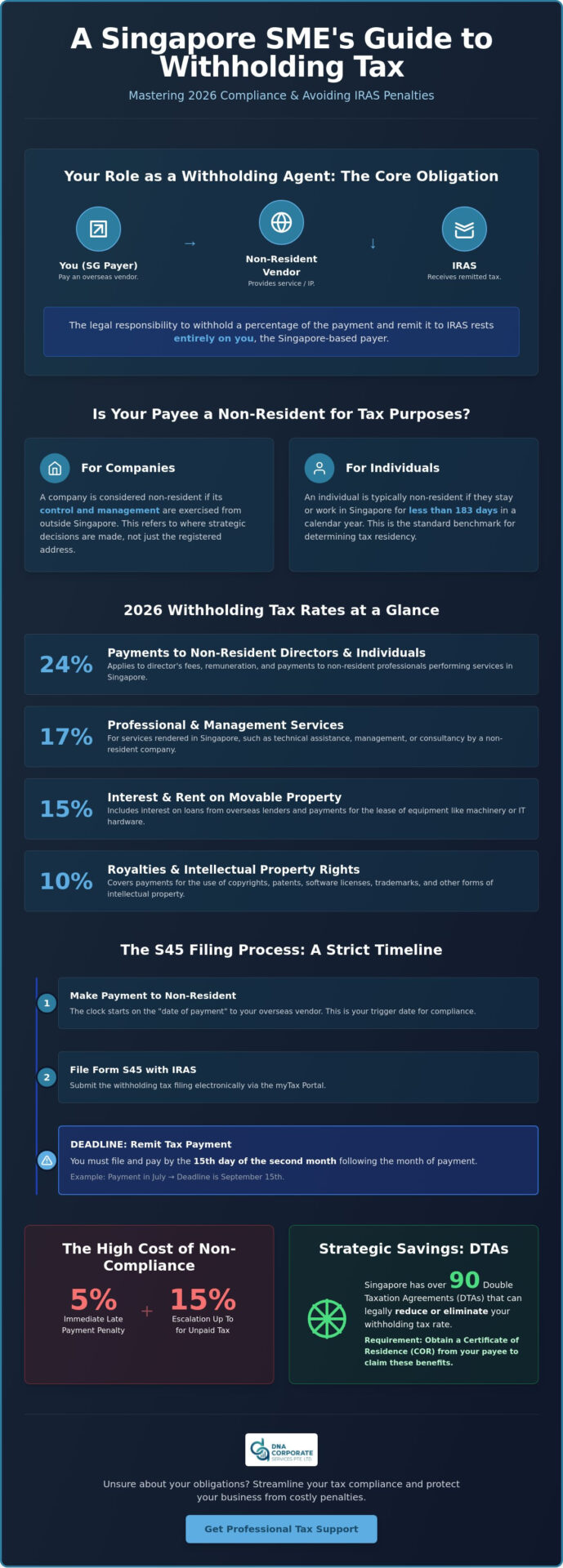
For professional services performed in Singapore, such as technical assistance or management consultancy, you’ll need to apply the prevailing corporate income tax rate of 17%. It’s a common misconception that all services carry a flat rate. In fact, payments to non-resident individuals and directors are taxed at a higher rate of 24% as of June 2026. You can find more details in this Singapore withholding tax overview provided by IRAS. Always check your contracts for “gross-up” clauses. If your agreement states the vendor must receive a “net” amount, you’ll need to calculate the tax on a grossed-up basis, which effectively increases your actual cost.
Filing Deadlines and the S45 Process
The timeline for compliance is strict. You must file and pay the tax by the 15th day of the second month following the date of payment. If you pay an overseas consultant in July, your deadline is September 15th. Filing is done electronically via the myTax Portal using the S45 form. Missing this window triggers an immediate 5% penalty. If the tax remains unpaid, IRAS adds an additional 1% penalty for every month it’s overdue. If you’re feeling overwhelmed by these timelines, it’s a good idea to reach out to our team to set up a seamless filing schedule.
Strategic Compliance: DTAs and Professional Tax Support
One of the most effective ways to manage your tax liability is by leveraging Singapore’s extensive network of over 90 Double Taxation Agreements (DTAs). These treaties often reduce or even eliminate withholding tax on payments like interest and royalties. However, claiming these benefits isn’t automatic. You must obtain a valid Certificate of Residence (COR) from your non-resident vendor’s tax authority to prove they are entitled to treaty relief. Without this document, IRAS expects you to apply the standard domestic rates discussed earlier in this withholding tax Singapore guide.
A common pitfall for SMEs is the temptation to mischaracterise payments. You might be tempted to label a payment as a “management fee” to avoid the 10% royalty rate, but IRAS looks at the underlying substance of the transaction. If the payment is actually for the use of intellectual property, reclassifying it can lead to audits and heavy back-tax assessments. Ensuring your contracts are structured correctly is a core part of our IRAS compliance and tax filing services, providing you with a protective layer of professional scrutiny.
Common Mistakes SMEs Make with Withholding Tax
Compliance often trips up even the most diligent directors. Many business owners assume all software subscriptions (SaaS) are subject to withholding tax. In reality, standard off-the-shelf software usually falls under the “rights-based approach” and may be exempt if no copyright is transferred. Another frequent error is forgetting to deduct the tax before sending the full invoice amount to a vendor. Once the money has left your account, recovering the tax portion from an overseas entity is notoriously difficult. Finally, many fail to track the “date of payment” correctly. IRAS defines this as the earliest of the following: the date the payment is due, the date it’s actually paid, or the date the invoice is credited to the vendor’s account.
How DNA Accounting Alleviates Your Tax Burden
Secure Your Global Growth with Proactive Tax Management
Get a Professional WHT Assessment for Your Business today to ensure your international transactions are fully optimized and secure. Let’s work together to keep your business moving forward without the stress of regulatory surprises.
Frequently Asked Questions
Do I need to withhold tax for a foreign SaaS subscription like Zoom or Adobe?
You generally don’t need to withhold tax for standard off-the-shelf SaaS subscriptions like Zoom or Adobe. IRAS applies a rights-based approach to software payments, meaning that if you’re only paying for the right to use the software without acquiring its copyright, it’s not considered a royalty. These payments are typically exempt from withholding requirements as long as you don’t have the right to commercially exploit the software.
What is the “date of payment” according to IRAS for withholding tax?
IRAS defines the “date of payment” as the earliest of three specific milestones: the date the payment is due under the contract, the date you actually pay the non-resident, or the date the amount is credited to the vendor’s account. This distinction is vital because it triggers your filing deadline. Missing this date can lead to immediate penalties, even if you haven’t technically transferred the cash yet.
Can I get a refund if I overpaid withholding tax to IRAS?
Yes, you can claim a refund if you’ve overpaid or remitted tax in error. You’ll need to submit a formal letter of claim to IRAS along with supporting documents, such as the original invoice and proof of the overseas payment. This withholding tax Singapore guide recommends double-checking your DTA relief eligibility beforehand, as correcting a mistake through a refund claim involves significant administrative effort and time.
What happens if I forget to withhold tax and pay the vendor in full?
If you pay a non-resident in full, your company remains legally responsible for the tax debt. You’ll have to pay the required withholding tax to IRAS out of your own pocket, effectively increasing your business costs. You’ll also be liable for the 5% late payment penalty. Recovering this tax from an overseas vendor after the fact is often impossible, which is why we advise reviewing contracts before any funds are transferred.
Disclaimer
The information provided on this website is for general informational purposes only and is not intended to constitute professional accounting, tax, legal, or financial advice. While we strive to ensure that the content is accurate and up to date, regulations in Singapore, including those administered by ACRA, IRAS, CPF Board, and MOM, may change from time to time and may differ depending on individual circumstances.
Readers should not act or rely on any information contained on this website without seeking specific advice from a qualified professional based on their individual situation.
DNA Corporate Services and its affiliates accept no responsibility or liability for any loss or damage arising from reliance on the information provided in this website or any linked materials.
For tailored advice relating to accounting, taxation, corporate secretarial, or compliance matters in Singapore, please contact us directly for professional consultation.



