

Did you know that nearly 68,000 new companies are expected to launch in Singapore this year? For many founders, the first hurdle isn’t the business plan but a simple question of geography. You want a professional image that commands respect, but the high costs of CBD rentals or the privacy risks of listing your home address on public records can feel like a trap. It’s a common stress point for entrepreneurs who just want to focus on growth without missing critical IRAS mail or falling foul of ACRA regulations.
This article explores the strategic differences between a virtual and physical registered office address Singapore to help you secure your brand’s future. We’ll show you how to maintain full compliance and a prestigious image while keeping overheads low. You’ll get a clear comparison of costs, privacy protections, and mail management workflows to ensure your company is set up for success in 2026.
Key Takeaways
- Master ACRA’s “Physicality Rule” to ensure your office remains accessible to the public and fully compliant with statutory requirements.
- Decide if a virtual or commercial registered office address Singapore fits your 2026 growth strategy and brand identity.
- Contrast the significant cost advantages of virtual setups against the high monthly overhead and long-term commitments of traditional CBD leases.
- Shield your residential privacy from public disclosure while maintaining a professional presence through the ACRA “Contact Address” regime.
- Learn to vet providers based on mail handling reliability and secretarial support while dodging hidden fees that can complicate your budget.
Understanding ACRA’s Registered Office Address Requirements in Singapore
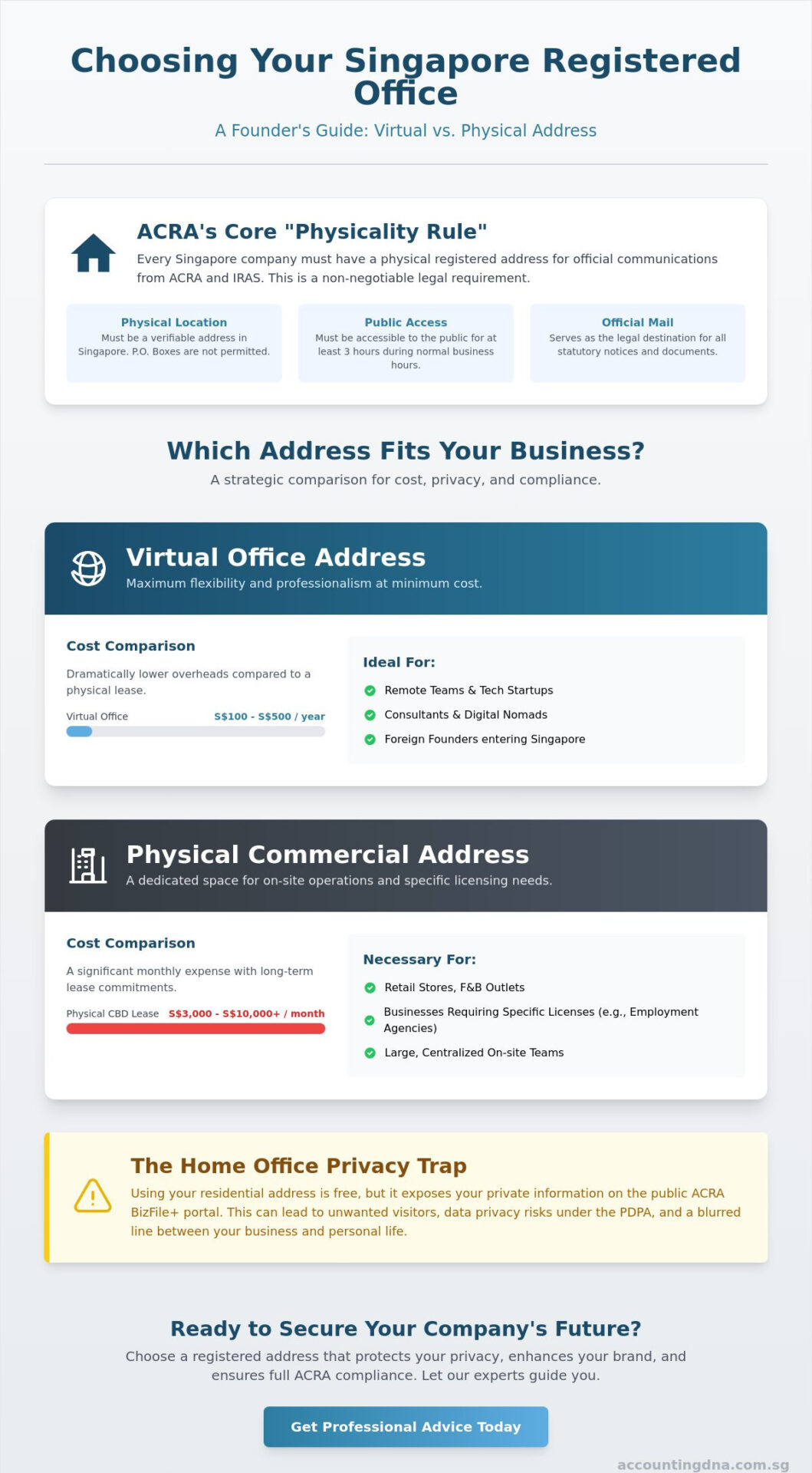
Every company incorporated in the Republic of Singapore must have an official point of contact. This isn’t just a mailing address; it’s a legal requirement. Your registered office address Singapore serves as the destination for all formal communications from the Accounting and Corporate Regulatory Authority (ACRA) and the Inland Revenue Authority of Singapore (IRAS). Under the “Physicality Rule,” this must be a physical location within the country. It can’t be a P.O. Box. The law requires this premises to be accessible to the public for at least three hours during ordinary business hours each day. This ensures that legal documents, such as court summonses or official tax notices, can be served and received reliably.
The Privacy Dilemma: Using a Residential Address
While the Home Office Scheme allows entrepreneurs to use their HDB or private property, it comes with significant trade-offs. Once registered, your home address becomes public data on the ACRA BizFile+ portal. This visibility creates a privacy gap that many founders overlook. Beyond the risk of unexpected visits from creditors or disgruntled clients, there are Personal Data Protection Act (PDPA) implications to consider. Using a residential address for business purposes can blur the lines of data security and personal safety. It’s often stressful to think about your private sanctuary being listed on a public registry where anyone can find it for a small fee.
Operational vs. Registered Address
It’s vital to distinguish between where you perform your daily tasks and where your legal records are kept. Your operational address is your “office” in the traditional sense, but your registered address is where your statutory registers and minutes are housed. Many savvy founders choose to decouple these. By engaging a corporate secretarial service, you ensure that your legal foundation is managed by professionals. This allows you to work from a co-working space, a cafe, or even overseas while remaining fully compliant with local laws without the burden of managing a physical lease for records alone.
Virtual vs. Physical Office Address: A Strategic Comparison
The cost gap is often the deciding factor. A virtual office typically ranges from S$100 to S$500 per year, providing a prime location without the heavy overhead. In contrast, a physical commercial lease in the CBD can easily reach thousands of dollars every month. While a residential address is essentially free, it may signal a “small-scale” operation to international partners who value a central business presence. Additionally, some local banks look for a physical “nexus” when opening corporate accounts, though a reputable virtual provider often satisfies these checks if they are fully compliant with ACRA’s registered office requirements.
When a Virtual Office Address is the Best Choice
Is your team fully remote or decentralized? A virtual address is the gold standard for digital nomads, consultants, and tech startups who don’t need a storefront. These services offer professional mail scanning and forwarding, ensuring you never miss a statutory deadline while you focus on scaling. This setup is particularly effective for company incorporation in Singapore when foreign directors need a reliable local anchor without the commitment of a long-term lease. Foreign founders who also need to satisfy Section 145 residency requirements should explore a nominee director service Singapore to pair with their virtual address for full compliance.
The Necessity of a Physical Commercial Space
However, a physical space remains mandatory for certain business models. If you’re launching an F&B outlet, a retail shop, or an employment agency, specific licenses require a dedicated commercial premise. A physical office also fosters a deep local presence and simplifies management for large, on-site teams. If you’re unsure which path aligns with your 2026 goals, reaching out for a quick chat can clarify your specific licensing and compliance needs.
How to Choose and Change Your Registered Address Seamlessly
Selecting the right provider for your registered office address Singapore requires looking beyond the monthly fee. It’s tempting to pick the cheapest option, but hidden costs for mail scanning or forwarding can quickly inflate your budget. You should evaluate providers based on their location prestige and the reliability of their mail handling. A prime CBD address isn’t just for show; it signals stability to stakeholders. Ensure your provider offers digital notifications for all incoming government mail. Missing a notice from IRAS or ACRA can lead to unnecessary stress and penalties.
Your address is a core component of your statutory compliance framework. Under Section 142 of Singapore’s Companies Act 1967, every company must have a registered office from the date of its incorporation. Linking this address to your corporate secretarial services creates a seamless flow of information, ensuring that legal records are always up to date and accessible. For overseas entrepreneurs, pairing this with a compliant nominee director service in Singapore ensures both your registered address and residency obligations are fully satisfied from day one.
The Process of Updating ACRA Records
Changing your address isn’t as simple as updating a website. You must follow a structured legal process to remain compliant:
- Step 1: Pass a Board Resolution. Directors must formally approve the change of registered office address before any filing occurs.
- Step 2: File the change via ACRA BizFile+. You have exactly 14 days from the effective date to notify the regulator. There’s no ACRA filing fee for this specific update.
Common Compliance Pitfalls to Avoid
Many directors forget that the company name must be clearly displayed at the registered office location. It’s a small detail that can lead to a fine if overlooked. Another common mistake is missing the 14-day filing window, which results in late lodgment penalties. If you’re planning a relocation or setting up a new entity, contact our team today for expert guidance to ensure your transition is smooth and compliant.
Set Your Company Up for Long-Term Success in 2026
Are you ready to move your business forward with a foundation built on trust and compliance? Choosing the right registered office address Singapore is more than just a legal necessity; it’s a strategic move that protects your home privacy and elevates your professional brand. We’ve explored how virtual addresses offer incredible cost-efficiency for remote teams, while physical spaces remain vital for specific licensed industries. By following the correct board resolution and ACRA filing procedures, you can transition your office location without any operational friction.
As an ACRA-certified Filing Agent trusted by Singapore SMEs since 2016, DNA Accounting provides the boutique, personalized care your business deserves. We handle your mail management with the same dedication we bring to your financial health, ensuring you never miss a critical statutory notice. Our team understands that managing a business is demanding, so we’ve designed our services to be a reliable safety net for your corporate secretarial needs.
Secure your professional Singapore business address and stay compliant-Contact DNA Accounting today. We’re here to guide you through every step of your entrepreneurial journey with confidence and clarity.
Frequently Asked Questions
Can I change my registered office address after my company is incorporated?
Yes, you can update your business location at any time as your company evolves. You must notify ACRA within 14 days of the effective change date to remain compliant. While ACRA doesn’t charge a government filing fee for this specific update, your corporate secretary will typically prepare the formal board resolution required to authorize the move. It is a simple process that ensures your official records stay accurate as you scale.
Is a virtual office address legal for ACRA compliance in 2026?
A virtual office is fully legal provided it is a physical location in Singapore and not a P.O. Box. To meet 2026 regulatory standards, the premises must be accessible to the public for at least three hours during business hours on each working day. Most professional providers manage this by maintaining a staffed reception. This setup is a reliable way to secure a registered office address Singapore without the high costs of a traditional lease.
What happens if I miss a letter from ACRA or IRAS because of a bad address?
Missing statutory mail can lead to serious consequences like composition fines or even court summonses. Under Singapore law, any official document sent to your registered address is legally “served.” This means you are held responsible for the contents even if the mail is lost or uncollected. Relying on a provider with robust mail scanning and immediate digital notifications is the best way to prevent these stressful compliance gaps and protect your company’s standing.
Does my registered office address have to be the same as my business operating address?
Disclaimer
The information provided on this website is for general informational purposes only and is not intended to constitute professional accounting, tax, legal, or financial advice. While we strive to ensure that the content is accurate and up to date, regulations in Singapore, including those administered by ACRA, IRAS, CPF Board, and MOM, may change from time to time and may differ depending on individual circumstances.
Readers should not act or rely on any information contained on this website without seeking specific advice from a qualified professional based on their individual situation.
DNA Corporate Services and its affiliates accept no responsibility or liability for any loss or damage arising from reliance on the information provided in this website or any linked materials.
For tailored advice relating to accounting, taxation, corporate secretarial, or compliance matters in Singapore, please contact us directly for professional consultation.



