

Could your company be exempt from holding an AGM and still miss a statutory deadline? Yes. AGM requirements Singapore companies must meet depend on company type, financial year-end (FYE) and whether an exemption applies. Copying last year’s calendar without checking these details can leave directors exposed.
An AGM and an Annual Return are separate obligations. An AGM exemption does not remove the requirement to file an Annual Return with ACRA. This 2026 guide explains how to identify the applicable deadlines, including first-AGM timing and the private-company financial-statement circulation exemption. It also covers what directors should document, what can happen if a required AGM is missed, and how to coordinate notices, records and filings.
Key Takeaways
- AGM requirements Singapore companies must meet depend on company type and whether a valid exemption applies. Identify your company’s position before setting dates.
- Start with your financial year-end, then calendar the applicable AGM deadline and each related action separately.
- Before relying on a private-company exemption, check its conditions and keep members’ rights in view.
- Keep notices, resolutions, circulated financial statements and evidence of completed actions together in the company’s records.
AGM requirements in Singapore: Which companies must hold an annual general meeting?
An annual general meeting (AGM) is a formal meeting where members consider company matters, including financial statements where applicable. For a general overview of its purpose and common practices, see Annual General Meeting (AGM). In Singapore, whether a company must hold an AGM depends on its type and whether it qualifies for a specific exemption.
Listed companies must hold an AGM. Other companies should check whether an exemption applies rather than assume that private-company status is enough. To establish which AGM requirements Singapore directors need to follow, identify the applicable rule, confirm its conditions and keep a record of how the company meets them.
Does a private company in Singapore have to hold an AGM?
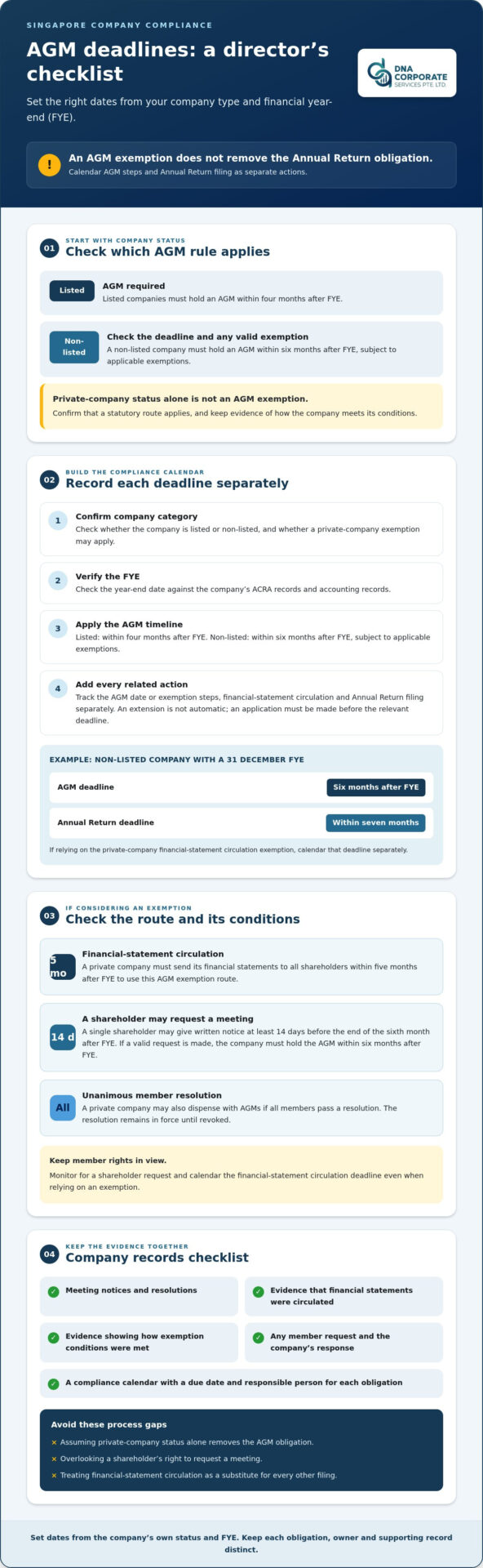
Private companies are generally required to hold an AGM unless they meet a statutory route for dispensing with it. One route is the financial-statement circulation exemption. The company must send its financial statements to all shareholders within five months after its financial year-end. Private-company status alone does not qualify a company for this exemption.
Shareholders retain the right to request a meeting. A single shareholder may give written notice at least 14 days before the end of the sixth month after the financial year-end. If a valid request is made, the company must hold the AGM within six months after that year-end. A private company may also dispense with AGMs if all members pass a resolution. That resolution remains in force until revoked.
In short: treat an AGM as required unless the company meets a valid exemption or has an effective unanimous resolution dispensing with meetings. Calendar the financial-statement circulation deadline and monitor for any member request. Keep evidence of circulation, resolutions and follow-up with the company’s records. DNA Accounting’s corporate secretarial services can help organise these obligations and records.
How to work out your Singapore AGM deadline and exemption
Build the compliance calendar around the company’s status and financial year-end, rather than copying the previous year’s dates. The AGM requirements Singapore companies face depend on the deadline that applies and whether the company is using a valid exemption.
- Confirm the company category. Check whether the company is listed or non-listed, and whether a private-company exemption may apply.
- Identify the FYE. Confirm the year-end date against the company’s ACRA records and accounting records.
- Apply the relevant rule. Under current ACRA timelines, listed companies must hold an AGM within four months after FYE. Non-listed companies must hold one within six months, subject to applicable exemptions.
- Calendar each action separately. Record the AGM date or exemption-related steps, financial-statement circulation and Annual Return filing deadline. An extension is not automatic. An application must be made before the relevant deadline, and ACRA’s current application requirements should be checked.
What dates and records should directors check first?
Start by confirming the FYE and the company’s ACRA records. Then assign a due date and responsible person to each obligation. For example, a non-listed company with a 31 December FYE generally has an AGM deadline six months later, while its Annual Return is due within seven months. If the company relies on the private-company financial-statement circulation exemption, calendar that deadline separately. Completing one step does not replace another.
Keep the calendar with supporting documents, including evidence of circulation and any extension application. The Singapore company record-keeping requirements provide useful context for organising corporate documents. DNA Accounting’s Singapore corporate secretarial services can help coordinate dates and filings. For support tailored to your company’s compliance calendar, discuss your compliance needs.
Keep AGM decisions and Singapore company records organised
Good AGM administration creates a clear record of what the company decided and what happened next. Keep meeting notices, resolutions, circulated financial statements and evidence of completed actions with the relevant company records. If the company relies on an exemption, retain evidence showing how it met the conditions. If a member requests an AGM, keep the request and the company’s response.
Common process gaps include assuming private-company status alone removes the AGM obligation, overlooking a shareholder’s right to request a meeting, or treating financial-statement circulation as a substitute for every other filing. Avoid these mistakes by keeping separate calendar entries for each obligation and recording who is responsible for each action. This makes AGM requirements Singapore companies face easier to manage from one year to the next.
When can corporate secretarial support help with AGM compliance?
Corporate secretarial support is useful when directors need a consistent way to track obligations, coordinate documents and maintain company records. DNA Accounting can help organise notices, resolutions, circulation evidence and filing tasks, while keeping AGM administration connected to your company’s wider Singapore statutory compliance obligations. This gives directors a clearer view of what is complete and what still needs attention.
For SMEs and startups managing recurring obligations, an organised records system makes it easier to find the relevant decision, supporting documents and proof of follow-through without relying on one director’s inbox.
If you’d like help coordinating your company’s records and obligations, discuss your company’s compliance needs.
Make AGM compliance part of your year-round planning
AGM planning works best as part of a wider view of your company’s obligations, not as a once-a-year task. Use the AGM requirements Singapore companies face to review how responsibilities, records and upcoming statutory actions fit together. A clear process helps directors stay on top of compliance while focusing on business decisions.
DNA Accounting provides Singapore-based corporate secretarial support, including ongoing assistance with statutory filings and compliance administration. For a practical discussion about support for your company, discuss your Singapore company’s compliance needs.
Frequently Asked Questions
What happens if a Singapore company misses its AGM deadline?
Missing a required AGM deadline can expose the company and every officer in default to an offence. ACRA may take enforcement action, and the stated maximum fine is S$5,000 per charge, with prosecution possible. Repeated defaults can put a director’s ability to act at risk. If the deadline has passed, review the company’s records and address outstanding obligations promptly.
Can members still request an AGM if a private company dispenses with one?
Yes. A member may still request an AGM under the applicable statutory process. If a written request arrives, record when it was received and promptly check the company’s response deadline and required next steps. Keep the request and evidence of follow-up with the company’s records so directors can show how it was handled.
Is an extension of time to hold an AGM automatic in Singapore?
No. A company must apply for an extension of time before its AGM deadline. Submitting an application does not itself change the due date. ACRA may grant an extension of up to 60 days, and the application fee is S$200. Check the current application requirements and track the original deadline until the extension is approved.
Does filing an annual return replace holding an AGM?
No. Filing an Annual Return does not document that members met or record their decisions. For a clear year-end audit trail, save the BizFile+ submission confirmation with the company’s filing records and note the submission date and person responsible. Keep the supporting AGM or exemption documents easy to locate in case directors need to explain the company’s compliance history.
Disclaimer
The information provided on this website is for general informational purposes only and is not intended to constitute professional accounting, tax, legal, or financial advice. While we strive to ensure that the content is accurate and up to date, regulations in Singapore, including those administered by ACRA, IRAS, CPF Board, and MOM, may change from time to time and may differ depending on individual circumstances.
Readers should not act or rely on any information contained on this website without seeking specific advice from a qualified professional based on their individual situation.
DNA Corporate Services and its affiliates accept no responsibility or liability for any loss or damage arising from reliance on the information provided in this website or any linked materials.
For tailored advice relating to accounting, taxation, corporate secretarial, or compliance matters in Singapore, please contact us directly for professional consultation.



