

Is your quarterly GST submission a strategic financial review, or a frantic race against the IRAS deadline? Many Singapore SMEs find that “doing it yourself” often leads to accidental non-compliance or missed input tax claims that hurt the bottom line. Engaging professional GST filing services Singapore ensures your business stays ahead of the 9% GST requirements while navigating the complexities of the myTax Portal. It’s completely understandable if the fear of a 5% late payment penalty or the stress of managing Corppass access feels like a heavy weight on your shoulders.
We believe that managing your tax obligations shouldn’t come at the cost of your business growth. This 2026 guide will help you secure error-free GST F5 submissions and maximize your input tax claims with confidence. You’ll learn how to adapt to the latest InvoiceNow requirements for voluntary registrants and why professional oversight is your best defense during an IRAS audit. Let’s explore how to turn a complex regulatory chore into a streamlined process that protects your company’s future and provides true peace of mind.
Key Takeaways
- Master the strict quarterly filing cycle to ensure your Form F5 is submitted within the mandatory one-month IRAS deadline.
- Identify the common pitfalls of manual record-keeping that often lead to accounting discrepancies and unwanted regulatory scrutiny.
- Discover how professional GST filing services Singapore safeguard your business from penalties while ensuring every eligible input tax claim is captured.
- Learn the essential criteria for selecting a tax partner who offers both technical expertise and seamless cloud accounting integration.
Understanding GST Filing in Singapore for SMEs in 2026
For every GST-registered business in the Lion City, compliance is a non-negotiable part of the quarterly routine. Understanding GST in Singapore involves more than just knowing the current 9% rate. It’s about classifying your supplies correctly to avoid accounting discrepancies. Standard-rated supplies carry the 9% tax, while zero-rated supplies, such as exports of goods and international services, are taxed at 0%. Exempt supplies, like certain financial services or residential property rentals, don’t attract GST at all. The GST F5 is the primary document used to report output tax and claim input tax to IRAS. Managing these details accurately is why many SMEs rely on professional GST filing services Singapore to ensure their records are pristine before submission.
Key Compliance Deadlines and IRAS Penalties
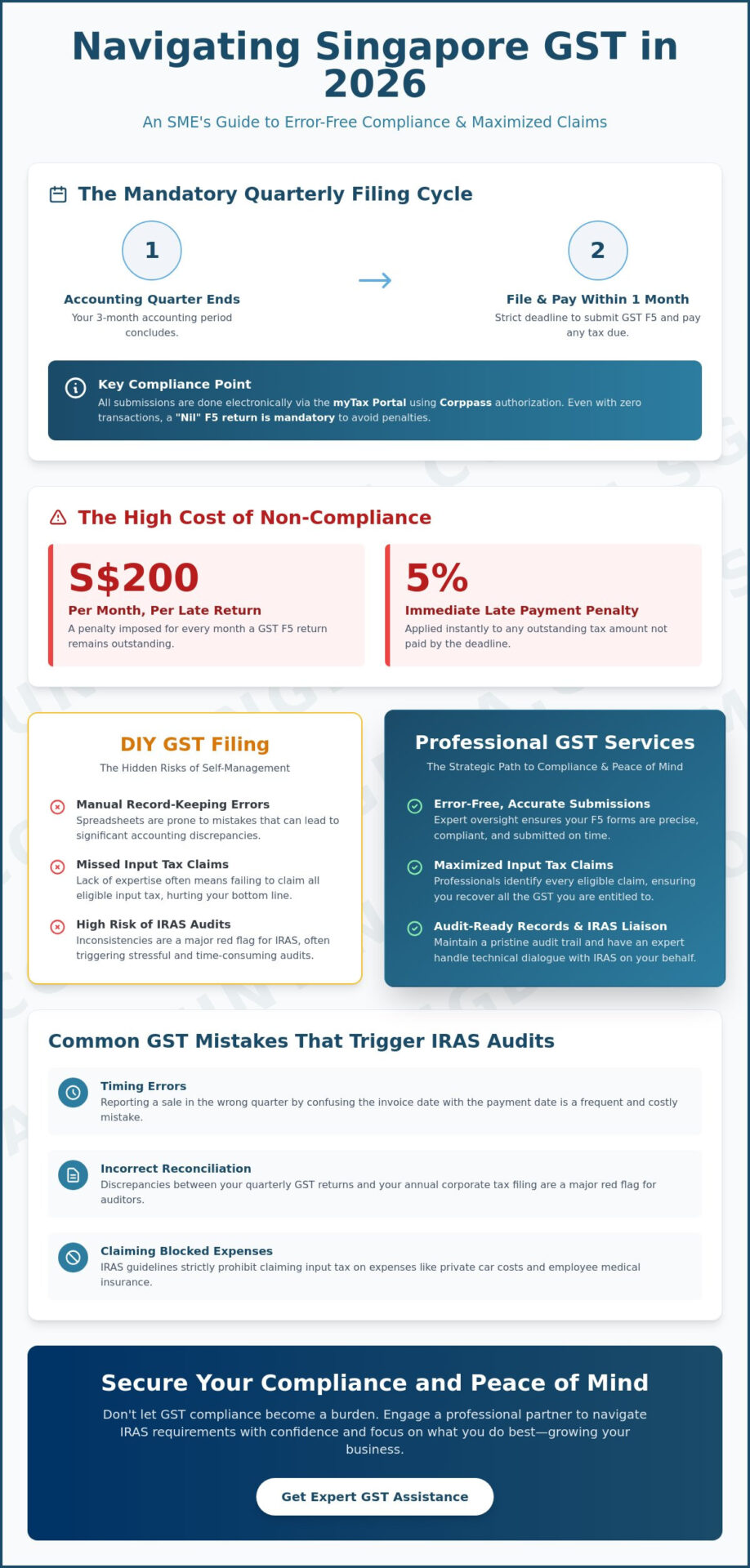
The standard filing cycle is quarterly, with a strict deadline of one month after the accounting period ends. If your quarter ends in March, your submission and payment must reach IRAS by April 30th. Missing this window is costly and stressful. IRAS imposes a S$200 penalty for every month a return remains outstanding, and this can quickly snowball. Additionally, a 5% late payment penalty applies immediately to any tax due. It’s a common misconception that you only file when you have sales. In reality, you must file a “Nil” return even if your business had zero transactions during the period to remain in good standing.
The Role of Corppass and myTax Portal
All submissions happen electronically via the myTax Portal. To ensure a smooth process, you’ll need to use Corppass to authorize your staff or a third-party tax agent. Once you’ve granted the necessary permissions, your agent can handle the heavy lifting of data entry and reconciliation. Navigating the portal allows you to view your filing status, check for outstanding balances, and download acknowledgement receipts. It’s a digital-first system designed for efficiency, provided your access rights are set up correctly from the start. Having a professional guide you through these digital requirements saves time and prevents technical errors that could delay your filing.
Professional GST Filing Services vs. DIY: A Risk Comparison
Why do so many business owners fall into the DIY trap? While manual spreadsheets might seem cost-effective, they are often the root cause of accounting discrepancies that trigger IRAS inquiries. Professional GST filing services Singapore provide a level of precision that manual entry simply cannot match. By maintaining an “audit-ready” trail for every input tax claim, these services ensure you can justify your figures if the authorities come knocking. It’s also vital to ensure your quarterly submissions reconcile perfectly with your annual corporate tax filing. Discrepancies between your GST returns and your year-end financial statements are a major red flag for auditors. Professional GST services act as a strategic buffer between your business and IRAS during routine checks, handling the technical dialogue so you can focus on operations.
Common GST Mistakes That Trigger IRAS Audits
One of the most frequent errors we see is claiming input tax on blocked expenses. Under the official IRAS GST guidelines, you cannot claim tax for private car costs or employee medical insurance. Timing errors are another hurdle. Reporting a sale in the wrong quarter because you confused the invoice date with the payment date can lead to significant penalties. Utilizing professional bookkeeping services eliminates these risks by ensuring every transaction is categorized and dated correctly in real-time. This proactive approach saves you from the headache of trying to fix errors months after they occurred.
The Complexity of Form F7: Correcting Past Errors
Errors happen, but how you handle them matters. If you discover a mistake in a previously submitted return, you must file a Form F7 to disclose it. Taking the initiative through voluntary disclosure often leads to reduced or even waived penalties. It’s always better to be proactive than to wait for IRAS to find the error during a check. If you’re feeling overwhelmed by past filing issues, speaking with an advisor can help you navigate the disclosure process smoothly and restore your compliance standing.
Choosing the Right GST Filing Partner in Singapore
Selecting a partner for your GST filing services Singapore shouldn’t be based on price alone. You need a team that understands the nuances of IRAS regulations, not just someone to punch in numbers. IRAS-qualified tax agents bring a level of technical oversight that simple data entry services lack. Modern firms leverage cloud accounting platforms like Xero or QuickBooks to provide real-time visibility into your tax position. This integration ensures that your GST reporting is seamless and significantly reduces the risk of manual errors. For growing startups, boutique firms often provide a more tailored experience, offering personalized compliance calendars that align with your specific business milestones. You can view our transparent pricing for GST and tax services to see how we fit into your budget.
The DNA Accounting Difference: Bespoke Care
We understand that a director’s day doesn’t always end at 6 PM. That’s why we pride ourselves on extreme accessibility, offering support during evenings and non-working days when you actually have time to focus on administrative hurdles. Our team manages the entire lifecycle of your tax obligations, from the initial GST registration to every quarterly submission. By utilizing a centralized service model, we link your GST, payroll, and corporate secretarial needs into one cohesive strategy. This holistic approach prevents data silos and ensures your company remains compliant across all regulatory fronts without the need to coordinate with multiple vendors.
Next Steps: Moving Toward Stress-Free Compliance
Getting started is straightforward and designed to provide immediate value. During our onboarding process, we review your past returns to identify missed tax claims or hidden risks that might trigger future audits. We then work with you to establish a clear 2026 compliance roadmap, ensuring you never miss a deadline again. Having a dedicated Singapore accounting advisor means you have a partner invested in your long-term success. If you’re ready to stop worrying about the myTax Portal and start focusing on your growth, contact DNA Accounting today for a personalized GST consultation.
Secure Your Compliance Roadmap for 2026
Are you ready to leave the stress of tax season behind? Get a Stress-Free GST Filing Consultation with DNA Accounting today. Let’s work together to build a secure, compliant future for your business.
Frequently Asked Questions
Do I need to file a GST return if my company had no sales this quarter?
Yes, you must file a “Nil” return even if your company had zero taxable transactions during the accounting period. IRAS requires every registered business to submit Form F5 regardless of activity levels to maintain a continuous compliance record. Failing to submit a Nil return still triggers the standard S$200 monthly late filing penalty, so it’s vital to complete the process even during quiet quarters.
What happens if I accidentally claim input tax on a blocked expense?
You should file a Form F7 to disclose the error to IRAS as soon as you identify the mistake. Accidentally claiming tax on blocked expenses, such as private car rentals or medical insurance for employees, is a common trigger for audits. Voluntarily disclosing these errors through professional GST filing services Singapore often helps in waiving or reducing penalties that would otherwise apply if IRAS discovered the discrepancy first.
How long must I keep my GST-related business records in Singapore?
You are legally required to maintain all GST-related business records for at least 5 years. This includes tax invoices, receipts, credit notes, and export documents required to support your claims. Even if your company ceases to be GST-registered or is struck off, these records must be preserved and remain accessible for IRAS inspection to verify past submissions if necessary.
Can I change my GST filing frequency from quarterly to monthly?
You can apply to IRAS to change your filing frequency if you believe monthly reporting better suits your business needs. This is often a strategic move for businesses that consistently receive GST refunds, such as those heavily involved in international exports, as it speeds up cash flow. You’ll need to submit the request via the myTax Portal, but keep in mind that this increases your annual administrative workload from four filings to twelve.
Disclaimer
The information provided on this website is for general informational purposes only and is not intended to constitute professional accounting, tax, legal, or financial advice. While we strive to ensure that the content is accurate and up to date, regulations in Singapore, including those administered by ACRA, IRAS, CPF Board, and MOM, may change from time to time and may differ depending on individual circumstances.
Readers should not act or rely on any information contained on this website without seeking specific advice from a qualified professional based on their individual situation.
DNA Corporate Services and its affiliates accept no responsibility or liability for any loss or damage arising from reliance on the information provided in this website or any linked materials.
For tailored advice relating to accounting, taxation, corporate secretarial, or compliance matters in Singapore, please contact us directly for professional consultation.



