

The most feature-packed platform isn’t automatically the best choice for a Singapore SME. The right cloud accounting software for SMEs in Singapore should fit how your business manages its finances now and remain practical as responsibilities change. A mismatch can leave staff sorting through unnecessary features or relying on manual workarounds. The goal is a tool your team can use consistently, not simply the longest feature list.
It’s understandable to focus on features first, but choosing software also means considering how it fits your people and processes. This comparison will help you assess business fit, onboarding, usability, and support before deciding. We’ll cover how to weigh these factors against everyday needs, what to test during a software trial, and how to choose a manageable option for your Singapore business.
Key Takeaways
- Choose software around your business’s transaction volume, entities, and workflows, then assess whether it can connect with the systems your team already uses.
- Compare onboarding, everyday usability, and customer support alongside features so your team can adopt the platform and keep records consistently.
- For Singapore operations, consider GST reporting, reliable accounting records, data protection, and the steps still required to submit filings through the relevant government portals.
- When bookkeeping or Singapore tax and GST work needs professional support, DNA Accounting provides Accounting & Bookkeeping, GST Services, and Taxation Services.
What is the best accounting software for small business in Singapore?
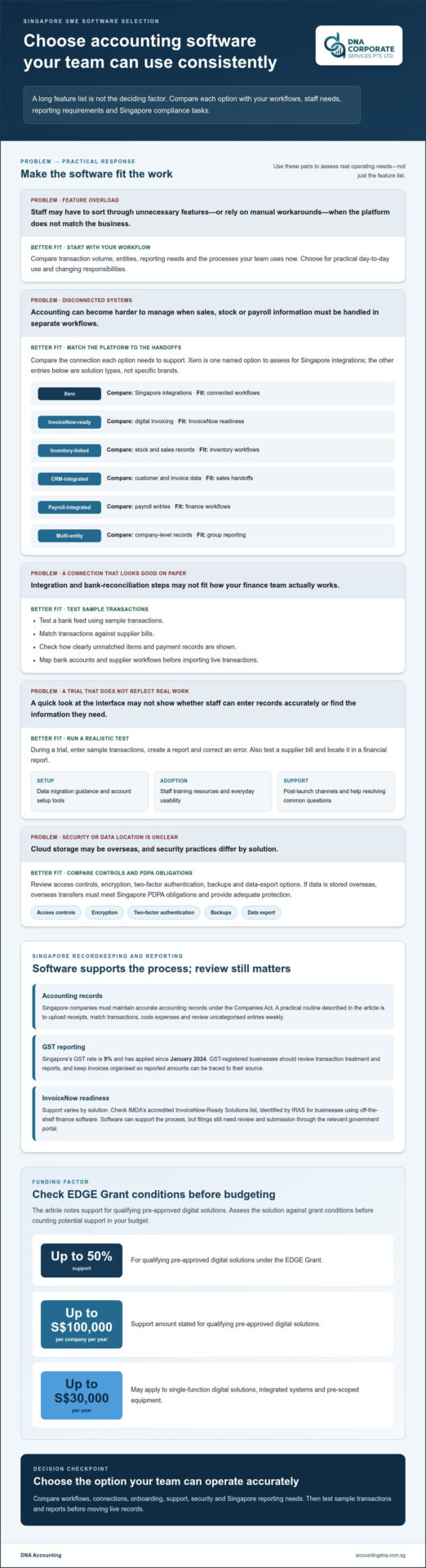
There isn’t one best platform for every SME. Compare each shortlisted product against your transaction workflows, system connections, and reporting requirements. The table names Xero as one option; the other rows describe distinct solution types to assess, not specific brands.
| Option | Compare for | Key fit |
|---|---|---|
| Xero | Singapore integrations | Connected workflows |
| InvoiceNow-ready accounting platform | Digital invoicing | InvoiceNow readiness |
| Inventory-linked accounting platform | Stock and sales records | Inventory workflows |
| CRM-integrated accounting platform | Customer and invoice data | Sales handoffs |
| Payroll-integrated accounting platform | Payroll entries | Finance workflows |
| Multi-entity accounting platform | Company-level records | Group reporting |
Scalability and Business System Integrations
Compare how each option connects accounting with inventory, CRM, or payroll as your workflows grow. Xero is one named platform to assess for Singapore integrations. Does cloud accounting software support InvoiceNow and Peppol e-invoicing? Support varies by solution, so check IMDA’s accredited InvoiceNow-Ready Solutions list, which IRAS identifies for businesses using off-the-shelf finance software.
Bank Feeds and Supplier Payments
Test a bank feed with sample transactions, then match them against supplier bills. Compare how clearly each option displays unmatched items and payment records. Before importing live transactions, map your bank accounts and supplier workflows. This helps reveal whether the reconciliation steps fit your finance team’s daily process.
Data Security and Storage Location
Compare access controls, encryption, two-factor authentication, backups, and data-export options. How secure is the software, and where is your Singapore business data stored? Storage may be overseas. Under Singapore’s Personal Data Protection Act, overseas transfers must meet PDPA obligations and provide adequate protection.
Choose the option that best fits your workflows and reporting priorities.
Onboarding, usability, and customer support
A smooth rollout starts with clean opening balances and consistent transaction records. Before choosing a platform, map the users, approval steps, invoicing tasks, and inventory records it needs to support. During a trial, enter sample transactions, create a report, and correct an error. This practical test shows whether staff can use the system accurately without workarounds.
Compare onboarding support such as data migration guidance, account setup tools, staff training resources, and post-launch support channels. When available, a free trial is most useful when you test a realistic workflow, such as recording a supplier bill and finding it in a financial report. Assess how easily your team can resolve common questions and keep records accurate. Clear support processes can help maintain useful cash-flow visibility.
Funding may influence the choice. Singapore SMEs can receive up to 50% support under the EDGE Grant for qualifying pre-approved digital solutions, with up to S$100,000 in support per company per year. Single-function digital solutions, integrated systems, and pre-scoped equipment may receive up to S$30,000 per year. Assess the solution against the grant conditions before including potential support in your budget.
Accounting software doesn’t replace corporate secretary support. Keep financial workflows distinct from corporate administration, and consider how organised records can support communication between those functions. If you’re reviewing how accounting processes fit your business, discuss your accounting and compliance needs.
Cloud accounting for Singapore startups and SMEs
Startups need dependable records from their first customer invoice, not just at year-end. Cloud bookkeeping can bring sales, expense claims, supplier bills, and cash movements into one workflow. For founders, cloud accounting software for SMEs in Singapore can help make recordkeeping more consistent. That visibility can flag missing receipts before monthly reporting and reduce repeated manual entry.
Singapore companies must maintain accurate accounting records to comply with the Companies Act. Set a weekly routine: upload receipts, match transactions, code expenses, and review uncategorised entries. For example, classify a laptop purchase consistently rather than leaving it under a generic expense label. Clear records help show how each expense relates to business activity.
GST-registered businesses should select software that calculates GST and produces reliable reports for IRAS myTax Portal. Singapore’s GST rate is 9% and has applied since January 2024. Review transaction treatment and reports before filing. Accounting software can support the process, but businesses should review their records and filings before submission. Keep invoices organised so reported amounts can be traced to their source.
As sales channels, staffing, or inventory grow, review user permissions, expense approvals, and reporting categories. A founder might move from manual receipt entry to automated bank matching and recurring invoices. Treat implementation of cloud accounting software for SMEs in Singapore as a controlled workflow: export records, map opening balances, test reports, then switch over. Compare a sample month to catch missing entries or inconsistent categories.
Choose a bookkeeping review routine that fits your team. If you’d like help putting that process into practice, discuss your accounting workflow.
DNA Accounting: Accounting & Bookkeeping
DNA Accounting can support your business when software alone isn’t enough to keep bookkeeping and financial records in order. Its Accounting & Bookkeeping services help SMEs manage day-to-day accounting, while GST Services and Taxation Services support related reporting needs. Corporate Secretarial Services can help with separate company administration requirements.
Consider professional support if transaction records need regular review, GST reporting feels complex, or your team lacks time to maintain consistent books. Software can organise entries, but sound accounting still depends on accurate information and appropriate review. DNA Accounting can connect your accounting needs with support for GST, tax, and company administration.
To discuss your accounting needs, contact DNA Accounting.
Build accounting routines that can grow with your business
Treat your software choice as an operating decision, not a one-off purchase. As sales channels, team responsibilities, or reporting needs change, review whether the platform still supports your workflows. Assign someone to oversee user access, transaction coding, and routine reviews so small process gaps don’t grow into larger bookkeeping issues. Before switching systems, identify the reports directors rely on and the handoffs that take up staff time.
Choosing cloud accounting software for SMEs in Singapore is one part of building dependable financial routines. DNA Accounting’s Accounting & Bookkeeping, GST Services, and Taxation Services can support the work around those routines.
If you’d like to explore accounting support for your business, get in touch with DNA Accounting. A considered next step can help you build a setup that works for your business today and as it grows.
Frequently Asked Questions
Can cloud accounting software handle multi-entity or group reporting?
Yes, some cloud platforms support separate company records alongside consolidated group reporting. A parent company can keep each subsidiary’s transactions distinct while reviewing combined financial results. Consolidation features vary, particularly for intercompany transactions and currency conversion. Test a realistic parent-and-subsidiary scenario, including the reports directors need for each entity and the group.
How Do the Top 6 Accounting Software Options Compare?
Compare six solution types by workflow rather than assuming one universal ranking: general accounting, Xero, inventory-linked, CRM-linked, payroll-connected, and multi-entity platforms. General accounting focuses on bookkeeping, while connected systems prioritise data flow between functions. Multi-entity platforms focus on separate company records and combined reporting. Score each option against your essential tasks, integration needs, and team’s daily use.
How do I know if a cloud accounting package meets IRAS requirements?
Assess whether the package supports accurate Singapore tax treatment and produces reports to assist with required IRAS filing. For a practical test, enter sample sales and purchases, apply the relevant tax codes, then compare the resulting GST figures with the underlying transactions. Accounting software can support recordkeeping, but businesses should review their records and complete any required filings.
What cloud accounting software is popular with SMEs in Singapore?
Xero is one option Singapore SMEs may consider, but popularity alone doesn’t show whether a platform suits your operations. A retailer with stock may prioritise inventory links, while a service startup may focus on invoicing and expense tracking. Shortlist platforms that fit your transaction patterns, team workflows, and reporting needs, then test the tasks staff perform most often.
What are the monthly subscription prices and plan limits for Singapore cloud accounting software?
Monthly subscription costs and plan limits depend on the provider and package. Compare user seats, invoice or transaction caps, included integrations, inventory functions, and multi-entity access. Work out the monthly total based on the features and users your business actually needs, rather than relying on an entry-level plan headline. Plan limits can affect costs as workflows and reporting needs expand.
Disclaimer
The information provided on this website is for general informational purposes only and is not intended to constitute professional accounting, tax, legal, or financial advice. While we strive to ensure that the content is accurate and up to date, regulations in Singapore, including those administered by ACRA, IRAS, CPF Board, and MOM, may change from time to time and may differ depending on individual circumstances.
Readers should not act or rely on any information contained on this website without seeking specific advice from a qualified professional based on their individual situation.
DNA Corporate Services and its affiliates accept no responsibility or liability for any loss or damage arising from reliance on the information provided in this website or any linked materials.
For tailored advice relating to accounting, taxation, corporate secretarial, or compliance matters in Singapore, please contact us directly for professional consultation.



